International payments in 2027: a planning checklist for finance teams
2027 brings a cluster of dated changes for companies that pay and get paid across borders. This is the one-page calendar, with what each change means and a link to the full guide.
- Published
- Reading time
- 2 min read
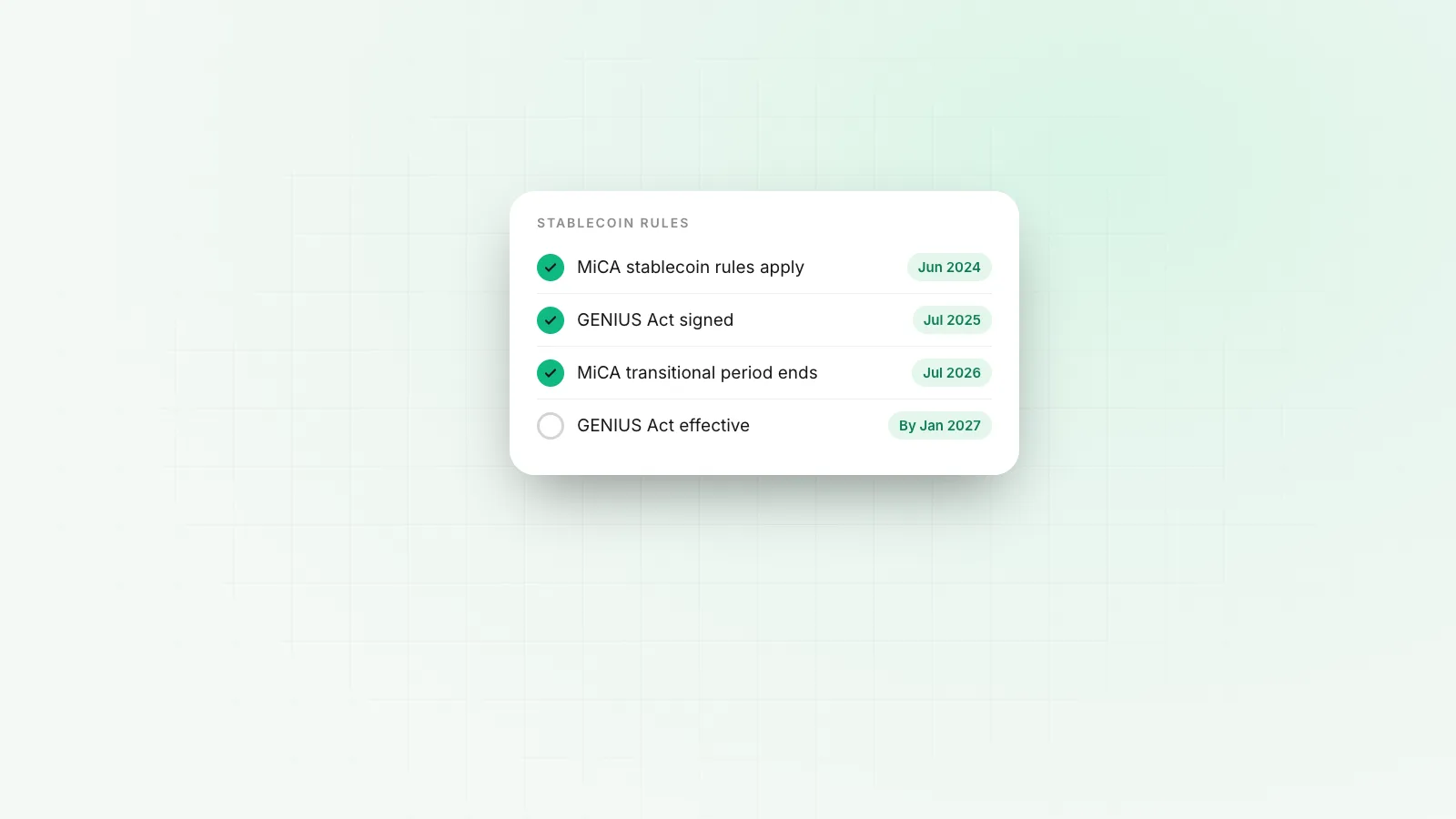
Several payment rules that were passed in 2024 and 2025 come into force in 2027. None is dramatic on its own, but together they change onboarding checks, invoice formats, filing thresholds and which payment methods your customers can use. This calendar lists them in date order, each with a link to a longer guide.
The 2027 calendar
| Date | Change | Who it touches | Guide |
|---|---|---|---|
| 1 January | German e-invoicing issue duty above €800,000 turnover | Businesses established in Germany | E-invoicing mandates |
| 9 January | Non-euro EU banks must receive SEPA Instant | Anyone paid in euros by customers in Poland, Sweden, Czechia, Denmark, Hungary or Romania | SEPA Instant 2027 |
| By 18 January | GENIUS Act in force | Companies holding or accepting stablecoins through US providers | GENIUS Act deadlines |
| 31 January | First 1099-NEC filing at $2,000 | US companies paying contractors | 1099-NEC threshold |
| 1 July | US de minimis repeal becomes law | Sellers shipping parcels to US customers | De minimis repeal |
| 9 July | Non-euro EU banks must send SEPA Instant with payee checks | Companies paying suppliers there in euros | SEPA Instant 2027 |
| 10 July | EU Anti-Money Laundering Regulation applies | Anyone opening or holding accounts with EU providers | EU AMLR 2027 |
| 1 September | French small and micro businesses must issue e-invoices | Businesses established in France | E-invoicing mandates |
Two changes from late 2026 run into 2027 as well. Swift stopped accepting fully unstructured addresses in November 2026 (see structured addresses). Existing directors of UK companies must verify their identity with Companies House by their next confirmation statement (see Companies House verification).
A checklist by team
Finance
- Map every currency, country and payment method you use.
- Confirm each payment provider's plans for stablecoins, SEPA Instant and the EU AML changes.
- Update contractor files: W-9s for US contractors, W-8 forms for foreign ones.
- Budget for duty on every US-bound parcel.
Operations and sales
- Check that your invoicing tool supports e-invoicing where your customers need it.
- Store supplier and customer addresses in separate fields.
- Put your exact legal name on invoices so payee name checks pass.
Founders
- Keep an ownership chart down to each person with 25% or more.
- Verify with Companies House if you direct a UK company.
- Keep KYB documents current. See KYB documents.
Where Rivet fits
Rivet gives registered companies USD, EUR and GBP account details, stablecoin balances beside them, and payouts to more than 120 countries, in one dashboard. See Pricing for what each plan includes.
Questions people ask
What are the biggest payment rule changes in 2027?
For most companies working across borders: the GENIUS Act effective date in January, the SEPA Instant deadlines for non-euro EU banks in January and July, the EU AML Regulation in July, the permanent end of US de minimis in July, and new e-invoicing duties in Germany and France.
Do these changes affect small businesses?
Most of them land on banks and payment providers first and reach you through their onboarding checks and product changes. E-invoicing, 1099 filing and import duties fall on businesses directly.
What should a finance team do first?
List the countries, currencies and payment methods you use, then check each item on this calendar against that list. Anything that touches your list gets an owner and a date.
Sources
Rashidatou writes Rivet's guides to how money moves between countries: the payment rails, what each one costs, and the account details a company needs to get paid in another currency. Every figure in Rashidatou's articles is traced to the scheme rulebook, the regulator or the provider's published price list, and those sources are listed at the end.
More from Rashidatou K. →This article is general information, not legal, tax or financial advice. Rules and fees change; check the sources above and the provider’s current terms before you act on them.
- international payments 2027
- payments regulation 2027
- finance planning 2027
- cross-border payments
- compliance calendar