E-invoicing mandates 2026 to 2028: Belgium, Poland, France, Germany and the EU
A PDF attached to an email is no longer a valid invoice in a growing list of European countries. Here are the dates from 2026 to 2028, who they apply to, and what a company selling into Europe from abroad should prepare.
- Published
- Reading time
- 2 min read
Tax authorities across Europe want invoices as data. When every B2B invoice arrives in a standard machine-readable format, they can match VAT charged and VAT claimed almost in real time. The result for businesses is a run of national deadlines, each with its own scope and platform.
What counts as an e-invoice
In these mandates, an e-invoice is a structured file in a defined format, usually UBL or CII, built to a European standard (EN 16931). It moves through the Peppol network or a state platform. A PDF, even one made by software, is not an e-invoice. You can still send a PDF copy for people to read.
The dates
| Country | What applies | From |
|---|---|---|
| Germany | All businesses must be able to receive e-invoices | 1 January 2025 |
| Belgium | Domestic B2B e-invoicing mandatory, on Peppol | 1 January 2026 |
| Poland | KSeF national platform mandatory, large taxpayers first | February 2026, then in stages |
| France | All businesses receive; large and mid-sized businesses issue | 1 September 2026 |
| Germany | Issuing required for businesses with turnover above €800,000 | 1 January 2027 |
| France | Small and micro businesses must issue | 1 September 2027 |
| Germany | Issuing required for all businesses | 1 January 2028 |
| EU | E-invoicing and digital reporting for intra-EU B2B sales under ViDA | 1 July 2030 |
Dates have moved before. Check the national tax authority's page before you plan around any of them.
Does this apply to a company outside Europe?
Often only in part. Most national mandates target domestic sales between businesses established in that country. A US or Singapore company selling to a French customer may sit outside the French issuing rule. Your French customer still has to receive invoices through the French system, though, and may ask you to send through it. If you are VAT-registered in a mandate country, you are more likely to be in scope. Ask a local adviser.
What to prepare
- List the countries where you have customers, VAT registrations or entities.
- Check your invoicing tool for Peppol or national platform support. Many accounting tools now include it.
- Clean up customer data. E-invoices fail validation on missing VAT numbers and wrong legal names.
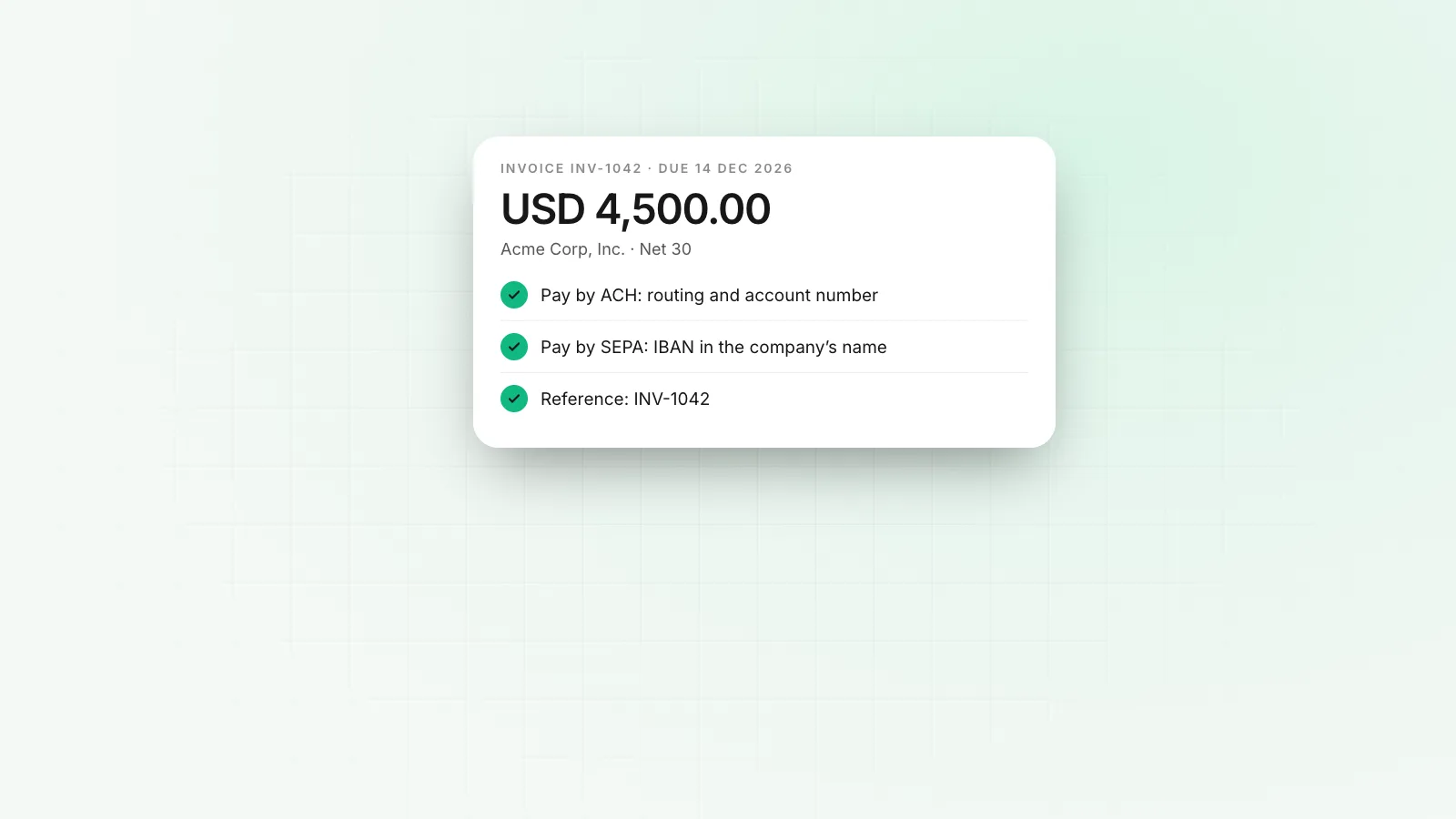
- Keep payment details exact. The bank account on the invoice must match the account you receive into. See how to invoice international clients.
- Match payments to invoices. Structured invoices carry a reference; ask customers to quote it on the transfer. The remittance advice guide shows how.
Getting paid on Rivet
E-invoicing changes how the invoice travels, not how the money moves. With EUR account details on Rivet's Growth plan, European customers pay you on SEPA in euros, and each payment shows its reference in your dashboard. See Bank accounts.
Questions people ask
Is a PDF invoice an e-invoice?
Not under these mandates. They require a structured format a computer can read without a person, such as UBL or CII, often sent over the Peppol network or a government platform. A PDF can travel alongside it as a copy.
Do foreign companies have to issue e-invoices in Europe?
It depends on the country and on whether the supplier is registered for VAT or established there. Many mandates cover only domestic sales between locally established businesses. Check each country you are VAT-registered in.
What is Peppol?
An international network and set of document standards for exchanging e-invoices between businesses and governments. A company joins through a certified access point provider and can then send and receive invoices with anyone else on the network.
What is ViDA?
VAT in the Digital Age, an EU package adopted in 2025. Among other changes, it moves cross-border B2B sales within the EU to e-invoicing with near real-time digital reporting from July 2030.
Sources
William covers what happens once a company starts moving money: getting the business verified, paying contractors and suppliers abroad, and keeping card spend under control. William writes for the founder or finance lead who has to make it work this week, and links every rule cited to the text it comes from.
More from William Sunjo M. →This article is general information, not legal, tax or financial advice. Rules and fees change; check the sources above and the provider’s current terms before you act on them.
- e-invoicing
- e-invoicing mandate 2027
- peppol
- ksef
- vida