SWIFT vs SEPA vs ACH vs Faster Payments: what each rail costs and how long it takes
Four payment networks move most of the business money between the US, Europe and the UK. They differ by an order of magnitude on cost, and the one your client uses is usually decided by the account details you send them.
- Published
- Reading time
- 8 min read
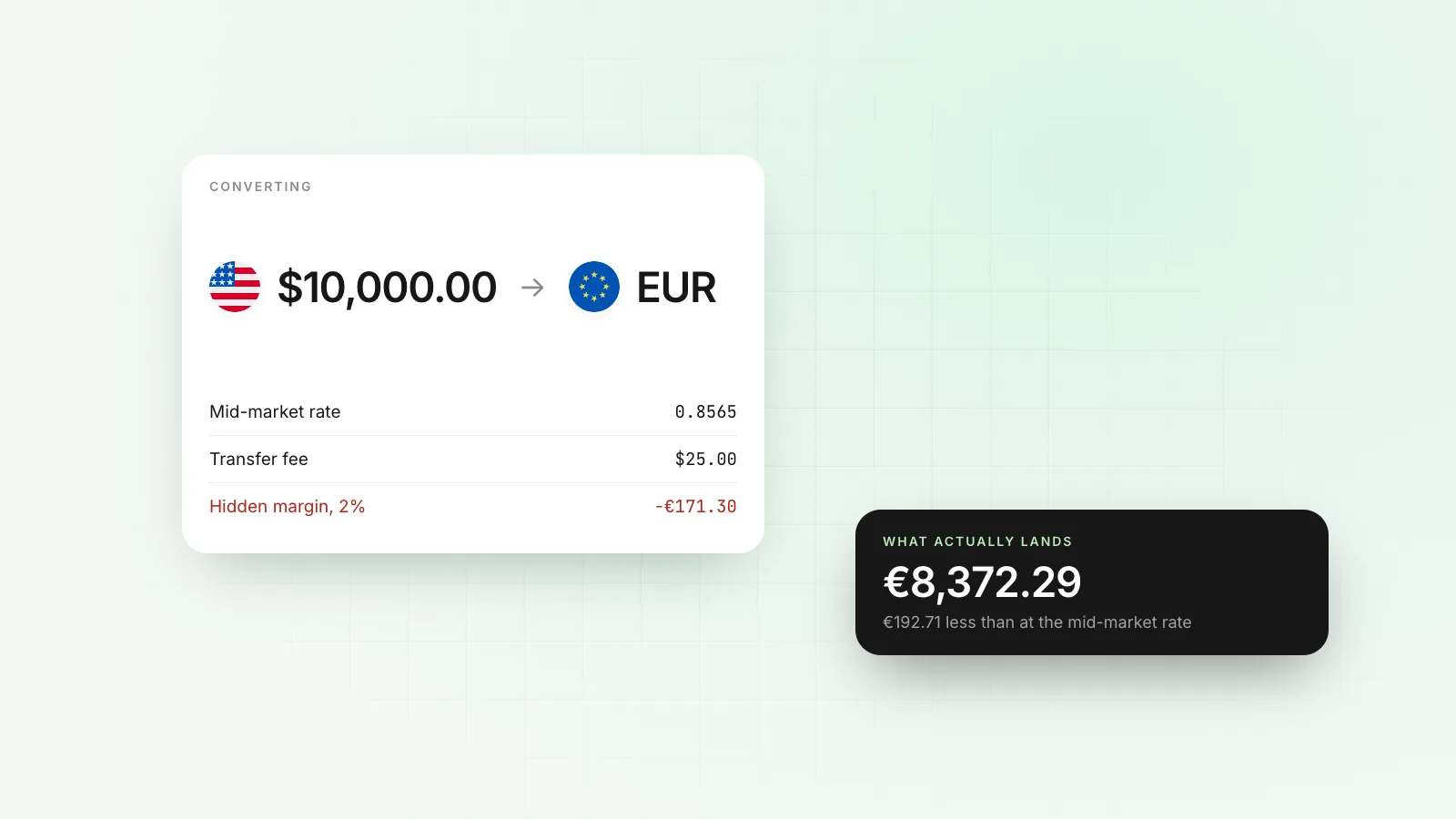
A client in Chicago owes your company $12,000. If they pay by ACH into US account details in your company's name, the money arrives as $12,000, usually the next business day, and the client pays a few cents or nothing to send it. If they pay by international wire to your bank at home, it can take two to five days, pass through one or two banks you have never heard of, lose $20 to $60 in fees on the way, and get converted at whatever rate your bank applies on arrival.
Same client, same invoice. The difference is the rail, and the rail is chosen by the account details on your invoice. This guide covers the four networks that carry most business payments between the US, Europe and the UK, what each one costs, how long it takes, and how to pick the cheap one.
The short version
| Rail | Currency | Where it works | Typical speed | Typical cost to the payer | Limit per payment |
|---|---|---|---|---|---|
| SWIFT (international wire) | Any | Between banks in different countries | Minutes to 5 business days | $15–$50 sending fee, plus intermediary and receiving fees | Set by each bank |
| SEPA Credit Transfer | EUR | 30+ European countries | By the next business day | Usually free or a few cents | Set by each bank |
| SEPA Instant | EUR | Euro area banks must offer it | Seconds, 24/7 | No more than a standard SEPA transfer | Set by each bank |
| ACH | USD | United States | Same day or next business day | Usually free to a few dollars | $1 million for Same Day ACH |
| Fedwire (domestic wire) | USD | United States | Within hours, same day | Often $15–$35 at large banks | None at scheme level |
| Faster Payments | GBP | United Kingdom | Seconds, 24/7 | Usually free | £1 million scheme maximum, lower at most banks |
The fee ranges are what banks commonly publish for business accounts; your own bank's price list is the number that counts.
SWIFT: the network that connects everything else
SWIFT is often described as a payment system, but it is a messaging network. When a bank in Lagos needs to pay a bank in Lisbon and the two hold no accounts with each other, the payment travels as a chain of instructions through correspondent banks that do. Each bank in the chain debits one account and credits another, and each one can take a fee for doing so.
That structure explains most of what frustrates people about international wires:
- Fees appear from nowhere. The sending bank charges a fee you can see. Intermediary banks, often one to three of them depending on the corridor, can deduct their own charges from the amount in transit. The receiving bank may charge again to credit the account.
- Timing varies. Swift's gpi service, which most large banks now use, tracks each payment end to end. Swift reports that most gpi payments are credited within 24 hours and a large share within 30 minutes. The slow ones are usually held up by a currency conversion, a compliance check or capital controls in the destination market, not by the network.
- Conversion happens somewhere you didn't choose. If you send dollars to a euro account, a bank in the chain converts them, at its rate.
OUR, SHA and BEN: who pays the fees
Every SWIFT payment carries a charge code that says who bears the costs:
- OUR: the sender pays all charges. The beneficiary should receive the full amount, though some intermediaries still deduct.
- SHA (shared): the sender pays their own bank; fees further down the chain come out of the amount.
- BEN: the beneficiary pays everything, deducted from the amount.
Most banks default to SHA. If you invoice in a foreign currency and need the full amount, say so on the invoice and ask for OUR, or better, avoid SWIFT altogether.
What SWIFT is good for
SWIFT reaches almost every bank in the world. For a currency or a country where you have no local account details, and for large one-off payments where a fixed fee is small relative to the amount, it is still the right tool. What it is poor at is recurring, mid-sized business payments in the big currencies, which is exactly where most companies use it.
SEPA: euros across more than 30 countries
The Single Euro Payments Area lets euro payments move between banks in the EU and a number of neighbouring countries (including the UK, Switzerland and Norway) as if they were domestic. Two schemes matter for businesses.
SEPA Credit Transfer (SCT) is the standard euro bank transfer. Under EU payment rules, the money must reach the payee's bank by the end of the next business day, and in practice it often arrives the same day. Most business accounts charge nothing or very little for it.
SEPA Instant Credit Transfer (SCT Inst) settles in seconds, at any hour, including weekends. The EU's Instant Payments Regulation (Regulation 2024/886) changed it from an optional extra to a standard feature:
- From 9 January 2025, payment providers in the euro area had to be able to receive instant euro payments.
- From 9 October 2025, they must also be able to send them, and may not charge more for an instant transfer than for a standard one.
- From the same date, they must offer Verification of Payee: before you send, your bank checks that the name you typed matches the name on the IBAN and warns you if it doesn't.
That last rule matters for anyone receiving euros. A payer whose bank flags a name mismatch may stop and email you instead of paying. Account details issued in your company's own legal name pass the check; a shared account with a payment reference often does not.
ACH and Fedwire: the two US rails
US dollars inside the United States move on two main systems.
ACH is the batch network behind payroll, bill payments and most business-to-business transfers. Standard ACH settles in one to two business days. Same Day ACH settles several times each business day, and since March 2022 it accepts payments up to $1 million each. For the payer, ACH is cheap: many business accounts include it free, and even per-payment pricing tends to be well under a dollar.
Fedwire is the Federal Reserve's real-time gross settlement system, used for domestic wires. A Fedwire payment settles individually and with finality within the operating day, which is why property closings and urgent supplier payments use it. Banks charge for it accordingly; outgoing domestic wire fees in the range of $15 to $35 are common.
Neither rail reaches outside the US. A US client can only pay you by ACH if you have a US routing number and account number to give them. Since a foreign company rarely has a US bank account of its own, most end up asking clients to send an international wire, which is the expensive option for everyone.
Practical rule: if more than a handful of your clients are in the US, US account details in your company's name will pay for themselves in fees the payers no longer lose, and in invoices that arrive whole.
Faster Payments and CHAPS: pounds in the UK
The UK runs two main rails for sterling.
Faster Payments settles in seconds, around the clock. The scheme's maximum per payment rose from £250,000 to £1 million in February 2022, though most banks set lower limits of their own, especially for online banking. For businesses it is usually free.
CHAPS is the Bank of England's high-value system: same-day settlement with no upper limit, available during business hours, with fees in the tens of pounds per payment. It is used for property purchases and large treasury movements. For an invoice of a few thousand pounds, Faster Payments is the obvious choice.
As with ACH, a payer can only use Faster Payments if you give them a UK sort code and account number.
What it really costs: a worked example
Take a £5,000 invoice paid by a UK client to a company based outside the UK.
Over SWIFT, to a dollar account at the company's home bank: the client's bank charges a sending fee, often £15 to £30. One intermediary deducts its fee. The pounds are converted to dollars by a bank in the chain at a margin that commonly runs between 1% and 3% on a business account. On £5,000, a 2% margin alone is £100. The receiving bank may charge again. The company is short by £120 to £160 and does not know the exact figure until the money lands.
Over Faster Payments, to UK details in the company's name: the client pays nothing to send. The £5,000 arrives as £5,000, usually within seconds. The company can hold the pounds, spend them, or convert them later at a rate it sees before it confirms.
The World Bank's long-running survey of remittance prices shows the same pattern at a smaller scale: in its 2025 data, sending money internationally cost about 6.4% of the amount on average, and banks were the most expensive type of provider by a wide margin. Business payments are larger and cheaper per dollar, but the structure of the cost is the same: fixed fees, chain fees and a conversion margin.
How to choose the rail, as the person getting paid
You rarely choose the rail directly. Your payer does, based on what you put on the invoice. So the decision is really about which account details you hold.
- List where your money comes from. By currency and by country of the payer, over the last twelve months.
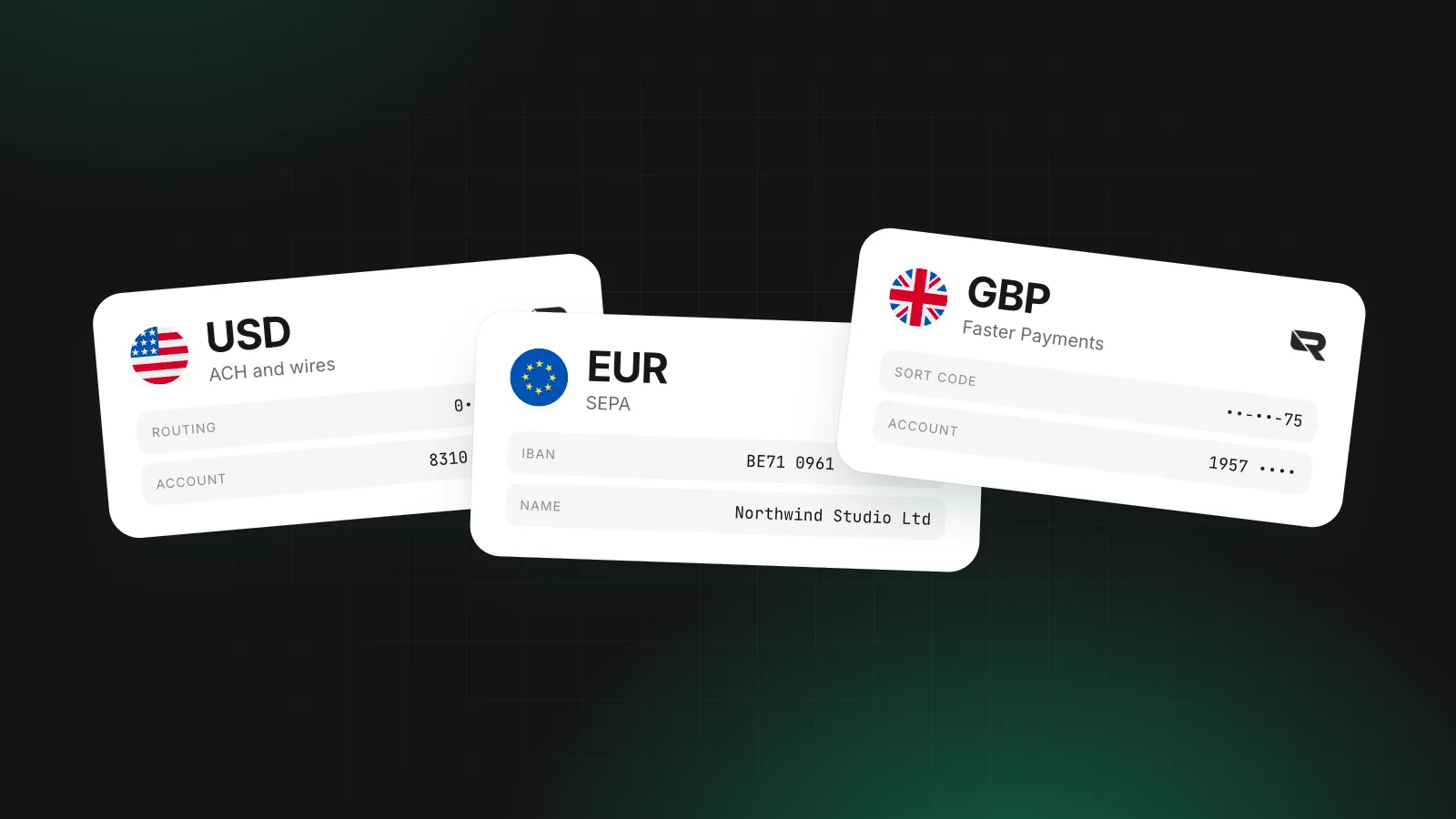
- Hold local details for every currency that makes up a meaningful share. For most companies selling to the US, Europe and the UK, that is a US routing and account number, a euro IBAN and a UK sort code and account number.
- Put the right details on each invoice. A US client sees only the ACH details; a German client sees only the IBAN. Two sets of instructions on one invoice invite the expensive one.
- Keep SWIFT details for the long tail. Currencies and countries where you have no local option still need a way in.
- Hold before you convert. If you also spend or pay suppliers in that currency, keep it. Converting on arrival and back again later pays the margin twice.
How Rivet handles this
Rivet issues account details in your company's legal name: a US account and routing number for ACH and domestic wires, a euro IBAN for SEPA, and a UK sort code and account number for Faster Payments, with more currencies on higher plans. Payments land in the matching currency balance, so a dollar payment stays in dollars until you decide otherwise. When you do convert, the rate and the fee are on screen before you confirm. The named accounts page lists what each currency gets, and pricing shows the fee for each rail.
If you are deciding what account to open in the first place, our guide to multi-currency business accounts covers what to check. If your clients are mainly in the US, read how to get paid by US clients as a non-US company.
Questions people ask
Is SWIFT the same thing as a wire transfer?
Not exactly. SWIFT is the messaging network banks use to instruct each other across borders. An international wire is a payment sent with those messages, settled through correspondent accounts. A domestic US wire runs on Fedwire and does not use SWIFT at all.
How long does a SWIFT transfer take?
Anywhere from minutes to several business days. Swift reports that most payments on its gpi tracking service are credited within 24 hours, and a large share within 30 minutes. Payments that need currency conversion, extra compliance checks or that cross into markets with capital controls take longer.
Can I receive a SEPA transfer outside the EU?
Yes, if you have a euro IBAN that is reachable on SEPA. The scheme covers more than 30 European countries, including non-EU members such as the UK, Switzerland and Norway, and a company based anywhere can hold a SEPA-reachable IBAN through a provider that issues one.
What is the cheapest way for a US client to pay a foreign company?
Usually ACH to US account details held in the foreign company's name. ACH costs the payer little or nothing, there are no intermediary banks, and the dollars arrive as dollars. An international wire from the client's bank is the expensive alternative.
Why did my invoice arrive short?
Most often because the payment went over SWIFT with the SHA or BEN charge code, and an intermediary or your own bank deducted a fee from the amount. The other common cause is a currency conversion at your bank's rate when the payment arrived in a currency your account does not hold.
Sources
Rashidatou writes Rivet's guides to how money moves between countries: the payment rails, what each one costs, and the account details a company needs to get paid in another currency. Every figure in Rashidatou's articles is traced to the scheme rulebook, the regulator or the provider's published price list, and those sources are listed at the end.
More from Rashidatou K. →This article is general information, not legal, tax or financial advice. Rules and fees change; check the sources above and the provider’s current terms before you act on them.
- swift
- sepa
- ach
- faster payments
- wire transfers
- fees