Payoneer vs Rivet: what it costs to get paid by international clients
Payoneer was built for marketplace payouts. If your clients pay you directly, its percentage fees on receiving and withdrawing can cost more than the work of switching. Here is the arithmetic.
- Published
- Reading time
- 4 min read

Payoneer solved a real problem. Marketplaces and platforms needed a way to pay sellers and freelancers in dozens of countries, and Payoneer gave each of them an account the platform could pay into. Many agencies and service companies opened an account for that reason and then kept using it for every client.
The fees are mostly percentages, and a percentage of every invoice gets large once a company bills tens of thousands a month. This article compares Payoneer with Rivet for one case: a company invoicing business clients abroad and converting some of what it earns.
Figures are from each provider's published pricing page, linked at the end. Payoneer notes that the fees in your account can vary by region and volume, so check the Fees section of your own account too.
The fees side by side
| Payoneer | Rivet | |
|---|---|---|
| Receive into USD, EUR or GBP details | Free in your local currency; 1% (min 1 USD) in a non-local currency | No receiving percentage; account details in your company's name |
| Convert between balances | 0.50% | FX from 0.80% (Starter), 0.50% (Growth), 0.30% (Scale) |
| Withdraw to a bank in another currency | 1.2% to 4% | Pay out from your balance; per-payout fee $2.00 to $0.50 by plan |
| Withdraw to a bank in the same currency | 1.50 USD in the US | Per-payout fee by plan |
| Account fee | 29.95 USD a year if you receive under 6,000 USD in 12 months | Starter free; Growth $200 a month; Scale $500 a month |
| Card fees | Annual card fee 29.95 USD; up to 3.5% with conversion | Unlimited digital cards on every plan |
| Stablecoins | Not listed on its pricing page | USDC and USDT on six networks |
A worked example
Take a design agency registered in the UK. Its US clients pay it 20,000 USD a month. It keeps a few thousand dollars for US software subscriptions and converts the rest to pay staff in pounds.
On Payoneer, the dollars land in a USD receiving account. For a UK company USD is not the local currency, so the 1% receiving fee applies: 200 USD. Converting and withdrawing about 17,000 USD to a GBP bank account falls in the published 1.2% to 4% range: 204 to 680 USD. Total: about 404 to 880 USD a month, before any card fees.
On Rivet Growth, the clients pay into the agency's USD account details by ACH or domestic wire. Nothing is deducted on arrival. Converting 17,000 USD at a margin from 0.50% costs about 85 USD, and the plan fee is 200 USD. Total: about 285 USD a month, with GBP account details, physical cards and approvals included.
The difference grows with volume, because Payoneer's costs are percentages and Rivet's plan fee is fixed. At lower volumes, Rivet's free Starter plan has no monthly fee and FX from 0.80%; the per-payout fee is $2.00.
Where Payoneer still makes sense
Payoneer fits when most of your income comes from marketplaces that pay Payoneer accounts directly. Transfers between Payoneer customers are free. It also fits if you receive in your local currency and rarely convert, so the 1% non-local receiving fee does not apply, or if your volume is small enough that the percentages come to a few dollars a month.
Plenty of companies keep both: Payoneer for marketplace income, and a business account in their own name for direct clients.
What clients see
Fees are one part of the decision. The other is what the client sees when they pay.
With US account details, a US client pays by ACH or a domestic wire, the same way it pays its other vendors. Our guide to getting paid by US clients covers why that tends to get invoices paid on time.
Rivet issues account details in your company's legal name. Name-checking services such as the UK's Confirmation of Payee and the EU's Verification of Payee compare the name a payer types with the name on the account. A match avoids a warning on the client's screen.
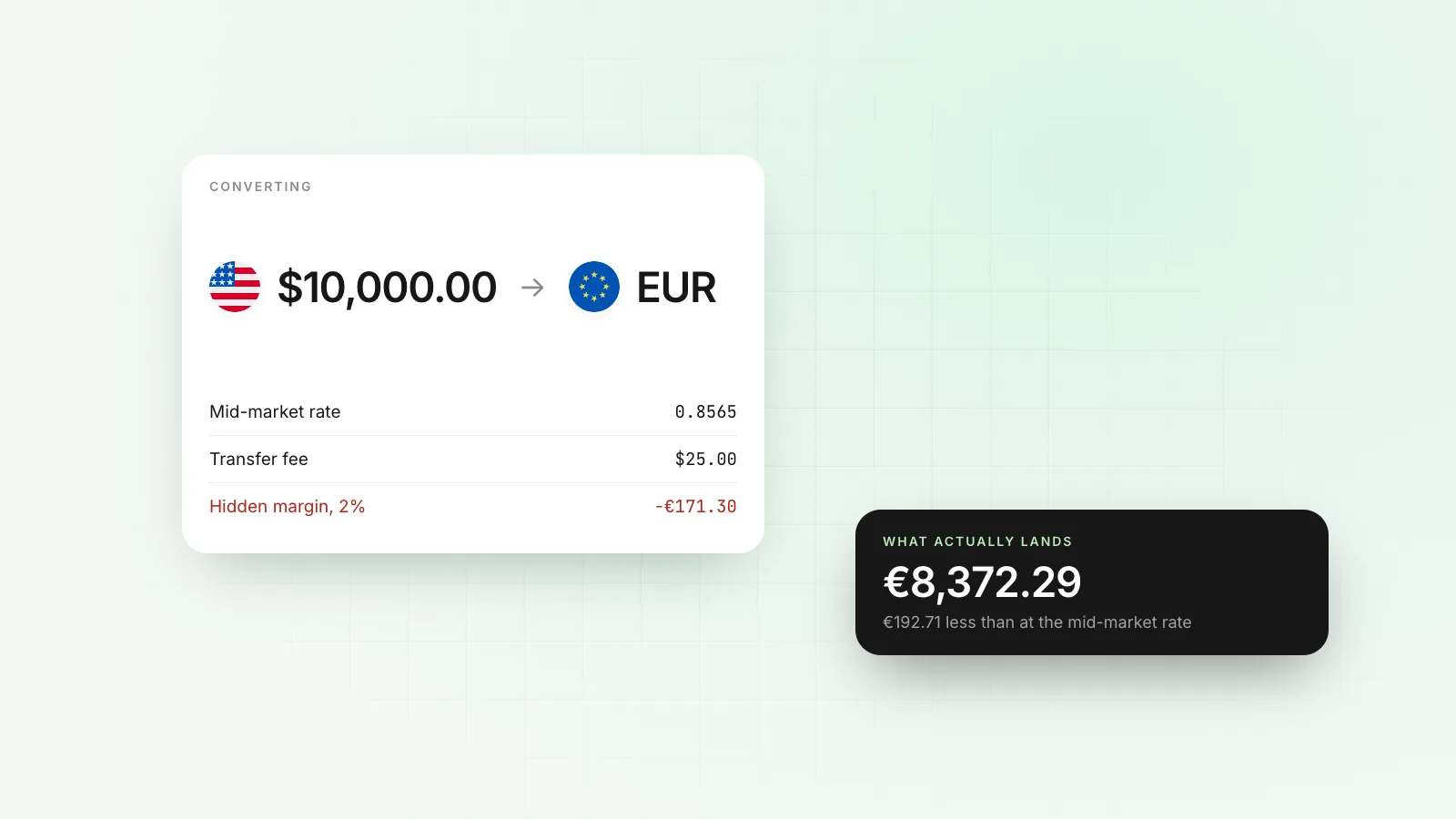
A 10,000 USD invoice arrives as 10,000 USD in your balance.
Beyond receiving
The same workspace also covers the work around the invoice.
Pay a team or freelancers abroad with bulk payouts, one approval per batch. Our guide to paying international contractors covers the paperwork.
Control client ad spend with a corporate card per client or per platform, each with its own limit. See virtual cards for ad spend.
Accept or pay in stablecoins when a client or contractor prefers USDC or USDT, through Rivet's ramps.
How Rivet handles this
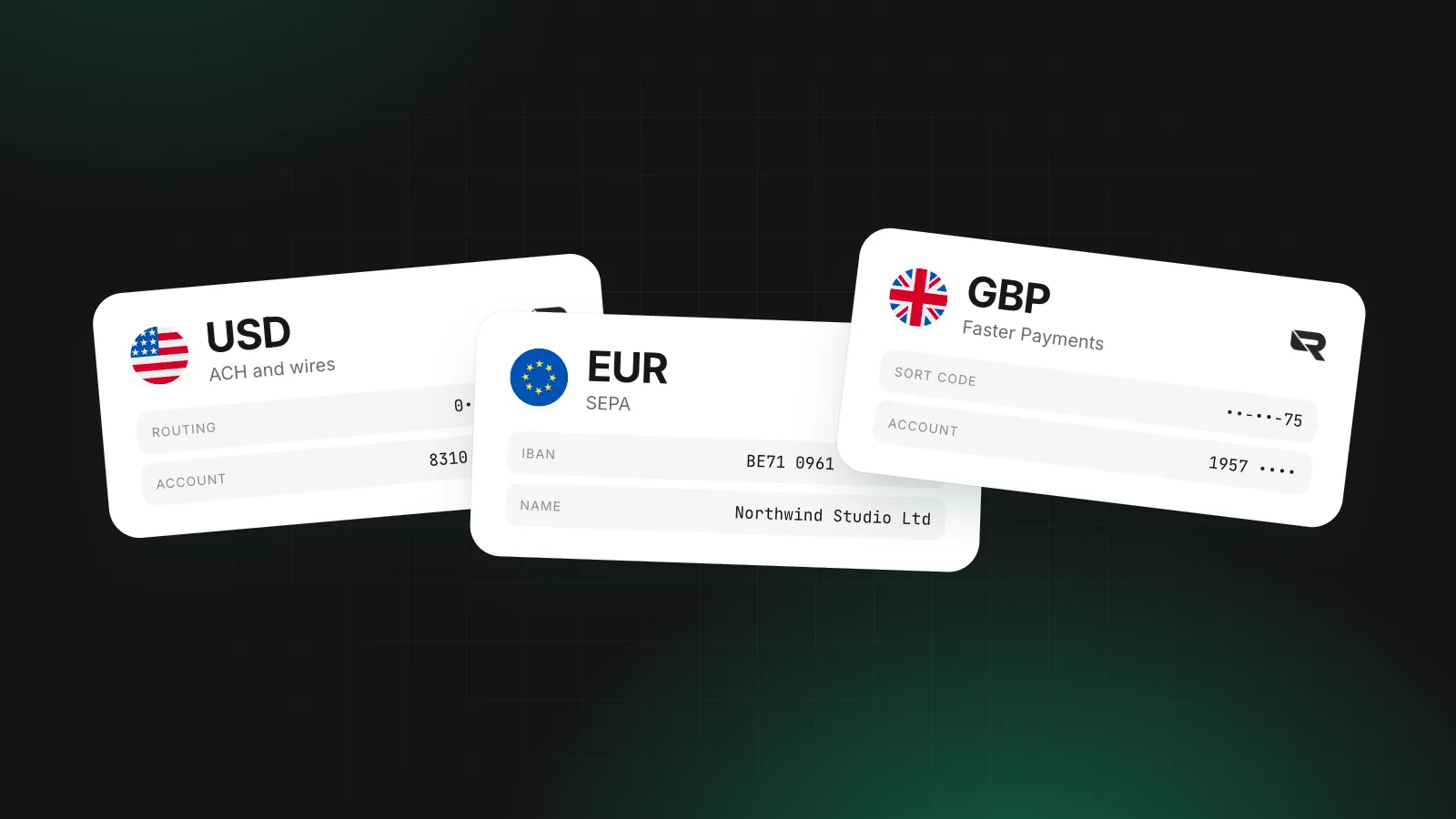
Rivet gives your company USD account details on every plan, and EUR and GBP details from Growth, all in its legal name. Clients pay on their domestic rails. Nothing is taken on arrival. Every conversion shows the rate and fee before you confirm. Your FX rate is confirmed during onboarding, before you move anything. Compare the plans on pricing, or see the Wise Business alternatives comparison if you are weighing other providers too.
Questions people ask
Does Payoneer charge to receive payments?
Payoneer's pricing page lists receiving into a local-currency receiving account as free and receiving into a non-local currency account at 1%, with a 1 USD minimum. Payments from other Payoneer customers are free. Payment requests that a client pays by card or ACH bank debit carry separate fees.
What is Payoneer's annual fee?
29.95 USD a year, charged only if the account receives less than 6,000 USD (or equivalent) in any 12 consecutive months, according to Payoneer's pricing page. Payoneer cards carry their own annual fee.
Is Rivet a good Payoneer alternative for agencies?
For agencies invoicing clients directly, usually yes. Clients pay into account details in your company's name on their domestic rail, nothing is deducted on arrival, and you choose when to convert. Agencies paid mainly through marketplaces that pay out to Payoneer may still want to keep a Payoneer account for that income.
Can I move from Payoneer to Rivet without disrupting clients?
Yes. Open and verify the Rivet account, then send clients the new details with your next invoice rather than mid-cycle. Keep the old account open for a billing cycle or two to catch late payments, and withdraw the balance once nothing new arrives.
Sources
William covers what happens once a company starts moving money: getting the business verified, paying contractors and suppliers abroad, and keeping card spend under control. William writes for the founder or finance lead who has to make it work this week, and links every rule cited to the text it comes from.
More from William Sunjo M. →This article is general information, not legal, tax or financial advice. Rules and fees change; check the sources above and the provider’s current terms before you act on them.
- payoneer alternative
- payoneer fees
- receive international payments
- agency payments
- comparison