How to get paid by US clients when your company is not American
US clients pay most easily, and most cheaply, by ACH to a US account. Here is how a company based elsewhere gets one, which paperwork the client will ask for, and what to put on the invoice.
- Published
- Reading time
- 6 min read

For a company outside the United States, a US client is often the best client it has: invoices in a strong currency, budgets that renew, and an accounts payable team that pays on schedule. The friction is almost always in the last step. The client's AP system is set up to pay American vendors by ACH, your invoice asks for an international wire, and someone in finance has to fill in a form they don't use very often.
This guide covers the ways a non-US company can receive dollars from US clients, what each costs both sides, the paperwork the client will ask for, and the small invoice changes that get you paid faster.
The four ways a US client can pay you
| Method | What you need | Cost to the client | What reaches you | Speed |
|---|---|---|---|---|
| ACH | US routing and account number in your company's name | Usually free to a few dollars | The full amount, in USD | Same day to 2 business days |
| Domestic wire (Fedwire) | The same US details | Often $15–$35 | The full amount, in USD | Same day |
| International wire (SWIFT) | Your home bank's SWIFT code and account | Often $25–$50, plus possible intermediary fees | The amount minus any deductions, often converted at your bank's rate | 1–5 business days |
| Card or payment platform | A merchant or platform account | Usually nothing | The amount minus a percentage fee | Varies |
ACH is the method US companies already use for their domestic vendors. If you can offer it, the payment goes through the same process as every other bill they pay, which is the single biggest factor in getting paid on time.
Why the international wire is the expensive default
When a foreign company has no US account details, the client sends an international wire. Three things happen to that payment:
- The client pays to send it. Large US banks commonly charge $25 to $50 for an outgoing international wire, and some AP teams push that cost back onto the vendor.
- Intermediaries can deduct fees. If the client's bank and yours have no direct relationship, the payment passes through one or more correspondent banks. With the default "shared" charge setting, each one can take its fee out of the amount. That is how a $5,000 invoice arrives as $4,965.
- Your bank converts it. If the receiving account is not in dollars, your bank converts on arrival at its own rate. A margin of 1% to 3% is common for business accounts, and it is the largest cost in most cross-border payments.
For the mechanics behind this, see our comparison of SWIFT, SEPA, ACH and Faster Payments.
Getting US account details as a foreign company
There are three realistic routes.
1. Open an account at a US bank
Some US banks open accounts for foreign-owned businesses, but most want a US-registered entity, an EIN, a US address and often a visit to a branch. For a company that only needs to receive payments, it is a lot of work for a basic account.
2. Form a US entity, then open a US account
Founders who expect to raise money in the US or sell mainly to US enterprises sometimes form a Delaware or Wyoming company. That brings its own US tax filings and registered agent costs. It is a legitimate structure, but it is a corporate decision with tax consequences, not a payments shortcut. Talk to an accountant before you do it for payments alone.
If you do form a US entity, it will need an EIN. Applicants with no US address or principal place of business cannot use the IRS online application; the SS-4 instructions give an international phone line and fax option, and the IRS does not charge for an EIN.
3. Use a business account that issues USD details to foreign entities
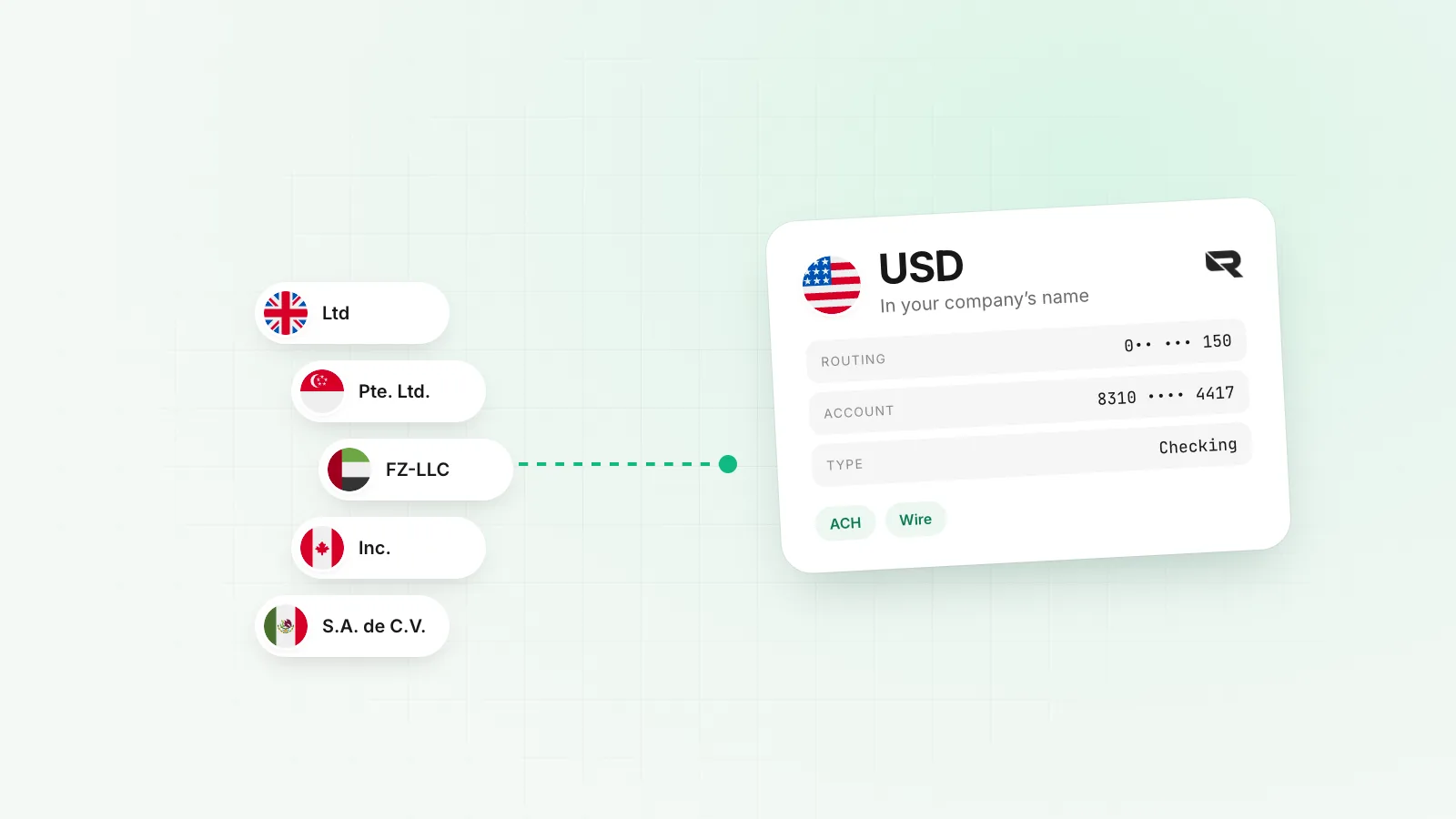
Multi-currency business account providers can issue a US account number and routing number in your company's own legal name, without a US entity. The client pays by ACH or domestic wire as if you were a US vendor, and the dollars land in a USD balance. You hold them, spend them, pay US suppliers from them, or convert when you choose.
The trade-off is verification. Because the account is in your company's name, the provider has to verify the company and the people who own and control it before issuing details. Our guide to business verification documents lists what to prepare.
The paperwork: W-8BEN-E
At some point a US client will email asking for a W-8BEN-E. Don't ignore it: some AP teams will not release payment without one on file.
What it is. Form W-8BEN-E is the IRS form a foreign entity gives to a US payer to certify that it is not a US person, and to claim the benefits of a tax treaty where one applies. (A foreign individual uses the shorter W-8BEN.)
Who it goes to. You send it to the client who asked for it. You do not file it with the IRS. The client keeps it in their records as their reason for not withholding US tax on your payments.
Why the client wants it. A US company paying a foreign vendor has to document why it is not withholding tax. For services performed entirely outside the US, the income is generally foreign-source and withholding usually does not apply; the W-8BEN-E is the evidence. If your services are performed in the US, or you receive royalties or certain other income, different rules apply.
What you need to fill it in. Your company's legal name and country of incorporation, its entity type and status under the US information-reporting rules (FATCA), its registered address, and a foreign tax identification number. The form is long because it covers every type of foreign entity; most operating companies only complete a few parts.
This is general information. Treaty claims and FATCA classifications depend on your facts, and a tax adviser should check your first W-8BEN-E.
What to put on the invoice
Small changes on the invoice decide which rail the client uses.
- Invoice in USD. A US company pays a dollar invoice from its normal AP run. A foreign-currency invoice needs a special request to the bank.
- Show only the US payment details. Account name (your company's exact legal name), bank name and address, routing number, account number and account type. Leave the SWIFT details off a US client's invoice.
- Say "ACH preferred". Some AP teams default to wires for any new foreign vendor. Telling them ACH works saves them a fee and you a few days.
- Use the same legal name everywhere. The name on the invoice, the W-8BEN-E and the account should match exactly. Mismatches are the most common reason a new vendor setup gets stuck in a client's approval queue.
- Include a reference. The invoice number in the payment reference lets you match the payment to the invoice the moment it lands.
When the client insists on a wire
Some clients only pay foreign vendors by international wire, whatever the invoice says. Three things help:
- Ask them to send it as a domestic wire to your US details instead. To their bank it is a US-to-US payment.
- If it must be an international wire, ask for the OUR charge code, so the fees are not deducted from your amount.
- Receive it into a USD balance, so your bank does not convert it on arrival.
How Rivet handles this
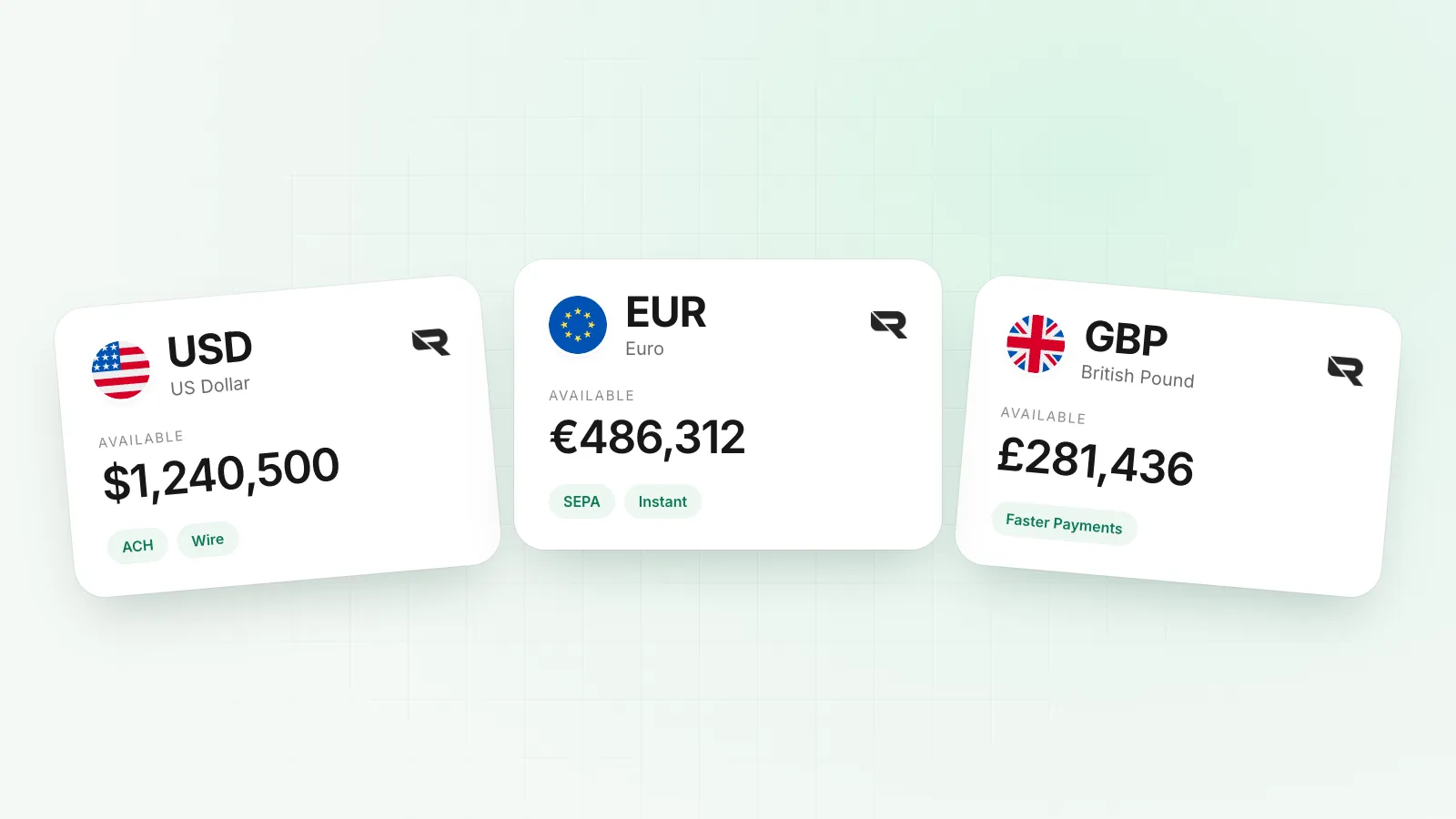
Rivet issues USD account details (an account number and a routing number for ACH and domestic wires) in your company's legal name once the business is verified, whether or not it is registered in the US. Dollars land in your USD balance and stay there until you move them: hold them, pay suppliers, spend on a card, or convert with the rate on screen before you confirm. EUR and GBP details work the same way for European and UK clients. See named accounts for what each currency includes, and pricing for the plans.
If you were weighing a US LLC only to open an account, read Mercury alternatives for non-US companies first. If you also pay people in the US or elsewhere, our guide to paying international contractors covers the other direction.
Questions people ask
Do I need a US LLC to get a US bank account?
Not with every provider. Traditional US banks rarely open accounts for foreign companies without a US entity, an EIN and often an in-person visit. Business account providers that serve international companies can issue USD details to a foreign entity after verifying it. A US LLC is a separate decision, usually driven by tax, investors or the clients you sell to.
What is Form W-8BEN-E and who files it?
It is an IRS form a foreign entity gives to a US payer to certify that it is not a US person and, where relevant, to claim treaty benefits. You give it to the client who asked for it; it is not sent to the IRS. Individuals use the shorter W-8BEN. A tax adviser can confirm which boxes apply to your company.
Will the US client withhold tax from my invoice?
For services performed entirely outside the US, the income is generally not US-source, so withholding usually does not apply, and the W-8BEN-E is how the client documents that. Payments for services performed in the US, royalties and some other income types are treated differently. Check with a tax adviser before your first large contract.
Can a US client pay me by ACH if my account is outside the US?
No. ACH only moves money between accounts at US institutions. To be paid by ACH you need US routing and account numbers, which a multi-currency business account can provide even if your company is registered elsewhere.
Is it better to invoice US clients in dollars or in my own currency?
Usually in dollars. US companies pay dollar invoices faster and without asking their bank for a foreign-currency wire. Invoicing in your own currency moves the exchange risk to the client, but in practice it slows payment and often means an international wire.
Sources
Rashidatou writes Rivet's guides to how money moves between countries: the payment rails, what each one costs, and the account details a company needs to get paid in another currency. Every figure in Rashidatou's articles is traced to the scheme rulebook, the regulator or the provider's published price list, and those sources are listed at the end.
More from Rashidatou K. →This article is general information, not legal, tax or financial advice. Rules and fees change; check the sources above and the provider’s current terms before you act on them.
- usd
- ach
- wire transfers
- w-8ben-e
- invoicing
- us clients