What an international payment really costs: the FX margin, the fees and how to compare providers
The fee printed on a transfer is usually the smaller part of its cost. The bigger part is inside the exchange rate. Here is how to find it, and how to compare providers on one number.
- Published
- Reading time
- 4 min read
Most companies know what they pay to send a wire. Fewer can say what the conversion inside that wire cost, because the figure is rarely printed anywhere. It sits in the exchange rate.
This guide shows how to find each part of the cost, how to turn a provider's rate into a percentage you can compare, and what a typical conversion costs across five kinds of provider using their published prices.
The three parts of the cost
The transfer fee is the visible charge for sending or receiving. It is a flat amount for a wire, and sometimes a percentage on platforms.
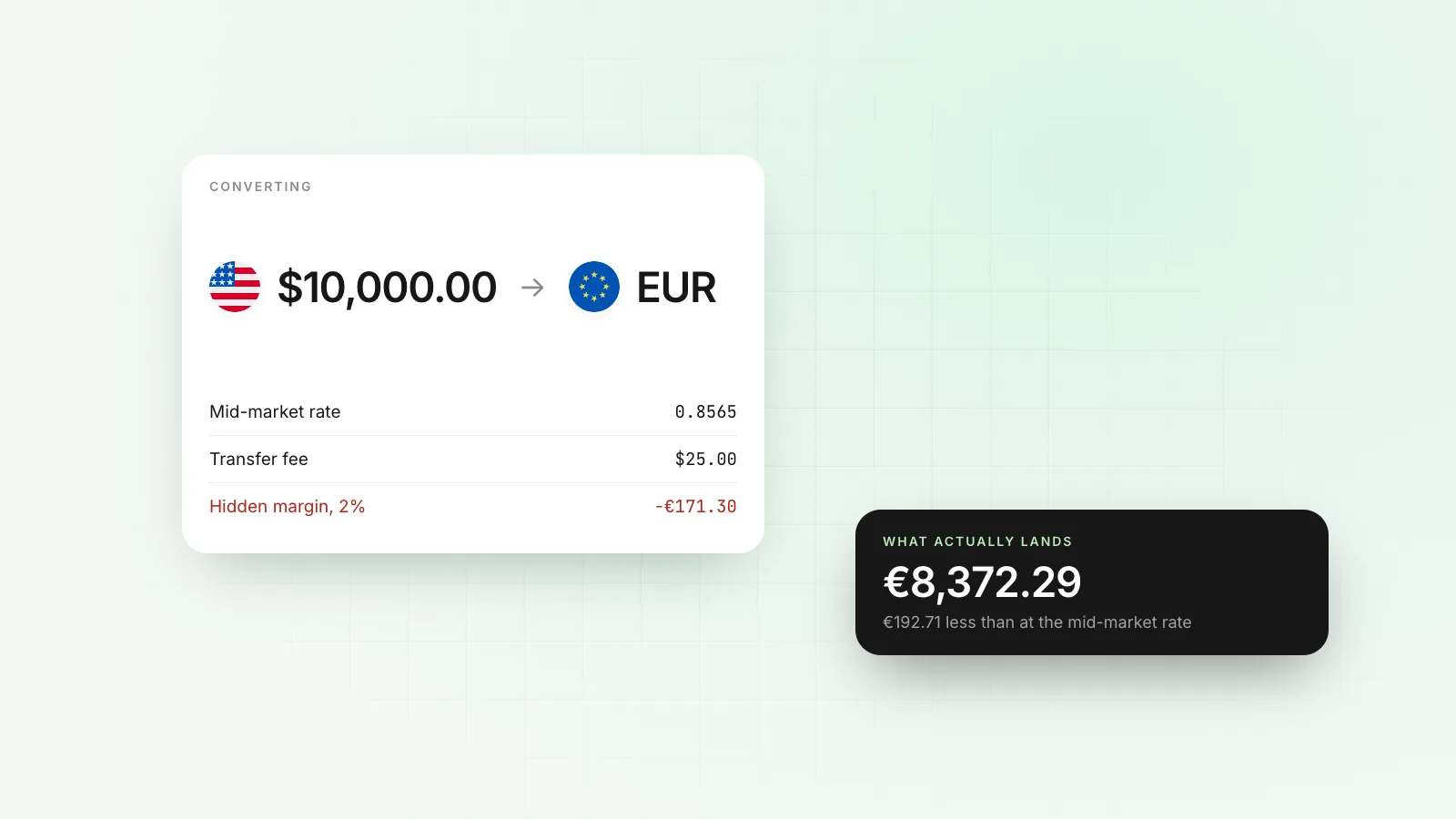
The FX margin is the difference between the rate you get and the mid-market rate. A provider converting USD to EUR at 0.8394 when the mid-market rate is 0.8565 is keeping 2% of the value.
Intermediary and receiving fees show up on SWIFT payments. Correspondent banks can deduct their own fees in transit, and the receiving bank may charge to credit the payment. Our comparison of SWIFT, SEPA, ACH and Faster Payments explains when this happens.
The World Bank has tracked the cost of sending money across borders for years in its Remittance Prices Worldwide database, and its data consistently finds that banks are among the most expensive channels, largely because of what sits in the exchange rate.
How to measure the margin
You need two numbers taken at the same time: the mid-market rate and what you actually receive.
Margin = (amount at mid-market rate − amount you receive) ÷ amount at mid-market rate
Example: you convert 10,000 USD when the mid-market rate is 0.8565. At mid-market you would get 8,565.00 EUR. The provider gives you 8,393.70 EUR.
(8,565.00 − 8,393.70) ÷ 8,565.00 = 2.0%, or 171.30 EUR.
Do this once for each provider you use, on a real payment. It takes about five minutes, and it shows what a "free" transfer actually cost.
A worked comparison
A company converts 10,000 USD to EUR once. Here is what the published pricing implies. Margins vary by currency pair and size, so the ranges are what each provider publishes, not quotes.
| Provider | Published conversion pricing | Conversion cost on 10,000 USD |
|---|---|---|
| A typical bank | Rarely published; industry estimates commonly 1% to 3% | 100 to 300 USD |
| Payoneer | 1.2% to 4% on withdrawals with conversion; 0.5% between balances | 50 to 400 USD |
| Airwallex | 0.5% above interbank for major currencies | 50 USD |
| Wise Business | From 0.23%, varies by currency | From 23 USD |
| Rivet | From 0.80% (Starter), 0.50% (Growth), 0.30% (Scale) | From 80, 50 or 30 USD |
Add the fixed costs:
A bank may charge 25 to 50 USD for an outgoing international wire, and intermediaries may deduct more.
Payoneer charges 1% to receive into a non-local currency account, and an annual fee if you receive under 6,000 USD in 12 months.
Wise has a one-time 31 USD setup fee and no monthly fee.
Airwallex has a free plan and a paid plan priced per user.
Rivet has a free Starter plan. Growth is $200 a month and Scale is $500 a month, with per-payout fees from $2.00 to $0.50.
Where volume changes the answer
For one conversion, a free provider with a low published margin is hard to beat. Over a month, the fixed plan fee and the margin trade against each other. On Rivet, the break-even points work out like this.
Moving from Starter (0.80%) to Growth (0.50%) saves 0.30% of what you convert. At about 67,000 USD converted a month, that saving equals the 200 USD plan fee.
Moving from Growth (0.50%) to Scale (0.30%) saves another 0.20%. At 150,000 USD a month, that saving equals the 300 USD difference in plan fees.
Conversion is one line on the bill. A company that would otherwise pay for a separate stablecoin provider, a card program and a payout tool should count those too.
Five ways to cut the cost
- Convert less. Hold USD for USD expenses. Every dollar you do not convert costs nothing in margin.
- Get paid on local rails. Local account details let clients pay by ACH, SEPA or Faster Payments, with no intermediaries and no conversion by your bank on arrival. See how to receive USD from US clients.
- See the rate before you confirm. You want the rate and the fee on screen before you commit.
- Use OUR on wires you have to send by SWIFT, so the recipient gets the full amount.
- Review once a quarter. Re-run the margin calculation on a real payment. Pricing changes.
How Rivet handles this
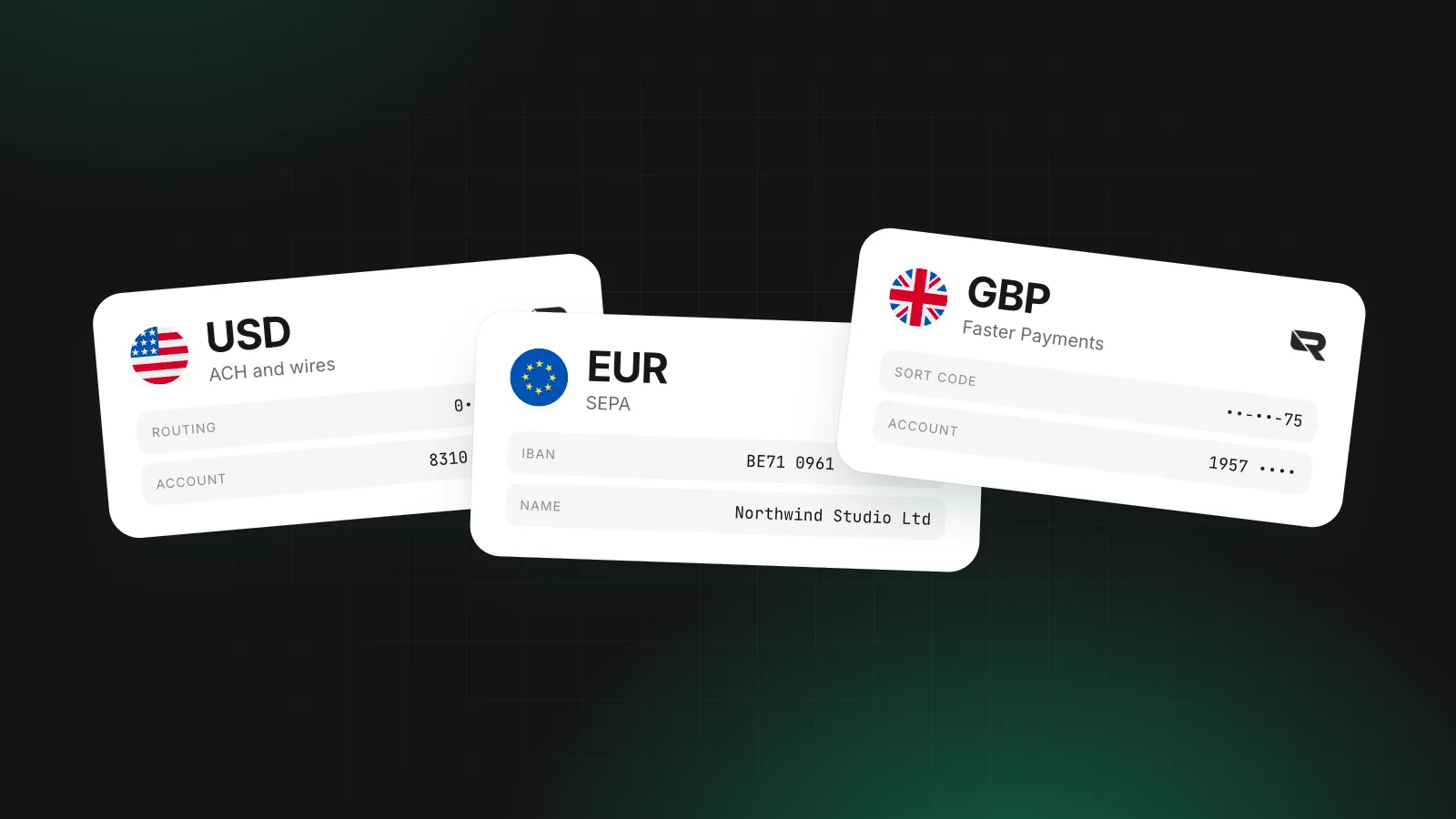
Every conversion in Rivet shows the rate, the fee and the exact amount before you confirm, so you can check the margin against the mid-market rate yourself. Your FX rate is confirmed during onboarding, before you move anything, and it falls as the plan rises: from 0.80% on Starter to 0.30% on Scale and 0.15% on Enterprise. With USD, EUR and GBP accounts in your company's name, you can hold each currency and convert only what you need. See pricing, or read our Wise Business alternatives comparison if you are weighing several providers.
Questions people ask
What is the mid-market rate?
The midpoint between the buy and sell prices for a currency pair on the wholesale market at a given moment. It is the fairest benchmark for measuring how much a provider adds. Most financial data sites show it, and some providers show it next to their own rate.
Why does my bank say the transfer is free?
Because the cost is in the exchange rate. A bank that converts at a rate 2% worse than the mid-market rate earns 200 USD on a 10,000 USD transfer, whether or not it charges a fee. Ask for the margin as a percentage.
Is a lower margin always cheaper?
Not on its own. A provider with a monthly plan fee and a low margin can be cheaper or more expensive than a free provider with a higher margin, depending on how much you convert. Add both together for a typical month.
How can I avoid FX costs altogether?
Convert less. Receive and pay in the same currency where you can: hold the dollars your US clients pay you and use them for dollar expenses, and only convert what you need in your home currency.
Sources
Rashidatou writes Rivet's guides to how money moves between countries: the payment rails, what each one costs, and the account details a company needs to get paid in another currency. Every figure in Rashidatou's articles is traced to the scheme rulebook, the regulator or the provider's published price list, and those sources are listed at the end.
More from Rashidatou K. →This article is general information, not legal, tax or financial advice. Rules and fees change; check the sources above and the provider’s current terms before you act on them.
- fx margin
- exchange rate markup
- international payment fees
- mid-market rate
- comparison