Mercury alternatives for non-US companies: US account details without forming a US LLC
Mercury is built for US companies, and its rules say so. If your company is registered in London, Dubai, Singapore or Lagos, you can still get US account details in its own name, without a Delaware filing.
- Published
- Reading time
- 4 min read
Mercury is a popular account for startups, and it is built for US companies. Its eligibility rules say the company generally must be formed and registered in the US or a US territory and have existing or planned US operations. Founders do not need to be US citizens or residents, but Mercury also publishes a list of countries whose residents it cannot currently serve.
That is why so many guides about "Mercury for non-US founders" turn into guides to forming a Delaware or Wyoming LLC first. This article covers the other route: US account details for the company you already have.
What you actually need from a US account
Start from the client's side. A US company paying a vendor wants three things.
A routing number and an account number, so it can pay by ACH or domestic wire from its normal accounts payable run.
A name that matches the invoice, so its vendor setup and fraud checks pass.
A W-9 or W-8 form, so its tax team knows whether to withhold or report. A foreign company gives a W-8BEN-E.
None of these require the vendor to be a US company. They require US account details in the vendor's name. Our guide to receiving USD from US clients explains the client side in more detail.
Option 1: Form a US LLC, then open Mercury
This is the route most "non-resident" guides describe. It works, but it creates a second company to run.
You pay for formation and a registered agent in the state you choose, plus an annual report or franchise tax in most states.
You need an EIN from the IRS. Applicants without a US tax number apply with Form SS-4, which the IRS instructions say international applicants can submit by phone, fax or mail.
You file US tax returns every year. A single-member LLC owned by a foreign person is treated as a disregarded entity that must file Form 5472 with a pro forma Form 1120, according to the IRS instructions, and the penalty for failing to file is significant.
If money moves between your home company and the LLC, you need transfer pricing and contracts between them.
Form a US entity when there is a business reason: US employees, US investors who want a Delaware C-Corp, or sales tax and nexus questions. Forming one only to get a bank account is an expensive route to the same account details.
Option 2: US account details for your existing company
A multi-currency business account can issue US account details to a company registered in another country. What to check:
| Check | Why it matters |
|---|---|
| The account is in your company's legal name | The client's vendor setup and fraud checks compare names |
| It accepts ACH and domestic wires | ACH is how most US companies pay vendors |
| You can hold USD without converting | You decide when to convert, at a rate you can see |
| Receiving is free or a flat fee, not a percentage | A percentage of every invoice adds up fast |
| It works for your country and industry | Every provider has a list of supported countries |
| Who holds the money | Most providers are not banks; ask which institution holds the funds |
How the main options compare
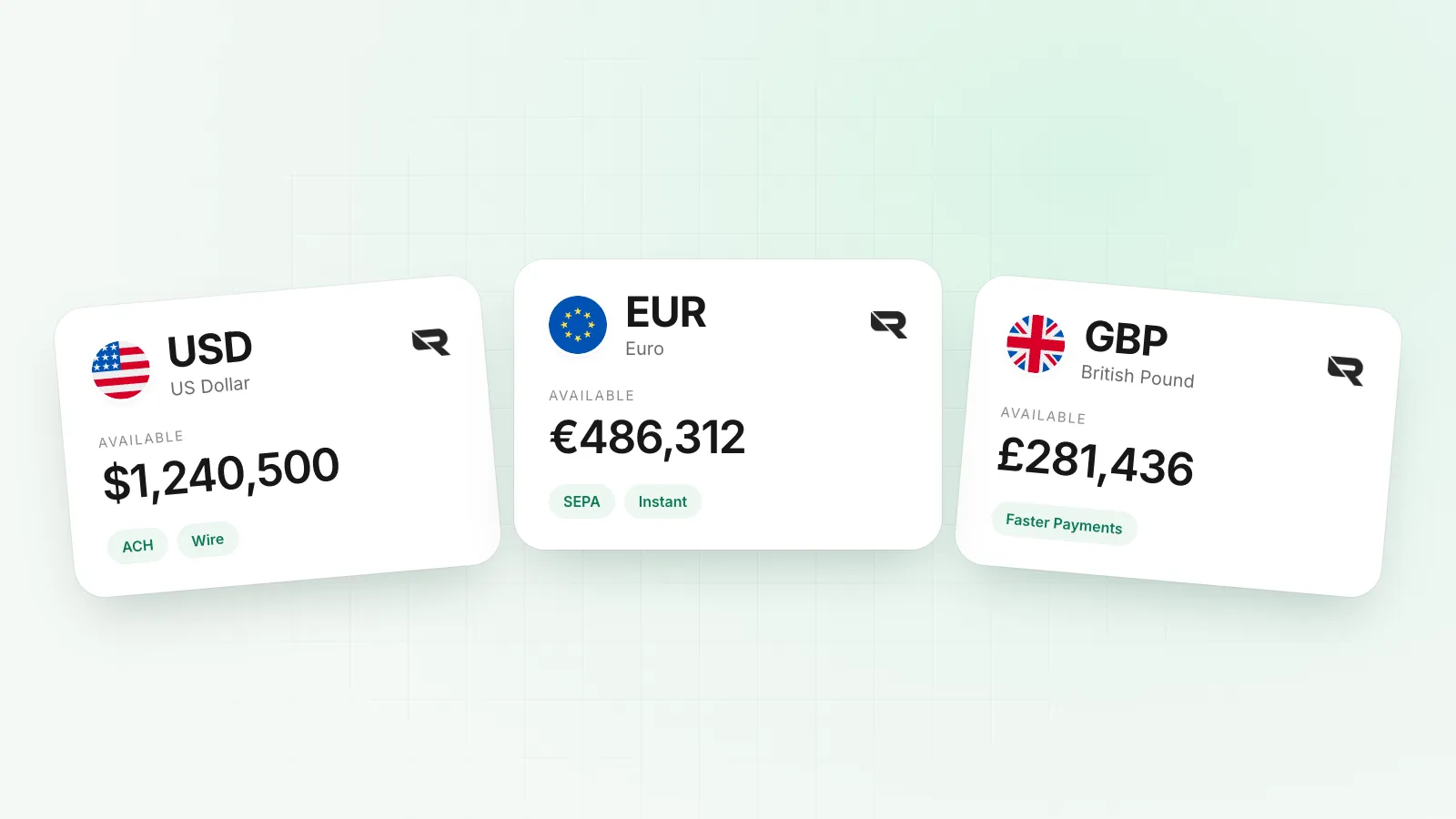
Rivet issues a US account and routing number in your company's legal name on every plan, including the free Starter plan, for registered companies in supported countries. It accepts ACH and domestic wires, holds the dollars until you decide what to do with them, and adds EUR and GBP details from Growth.
Wise Business issues USD details to companies in many countries for a one-time 31 USD setup fee. Domestic USD receipts are free and incoming wires cost 6.11 USD each. It does not support stablecoins. See our Wise Business alternatives comparison.
Payoneer offers USD receiving accounts, and charges 1% to receive into a currency that is not your local one. See Payoneer vs Rivet.
What changes for your clients
From the client's side, you look like any other vendor. They add you in accounts payable and pay by ACH. Payments arrive in your USD balance in full. The client pays no international wire fee, correspondent banks do not deduct anything, and your home bank does not convert the dollars at its own rate.
Two habits make the first payment smoother. Put only the US details on invoices to US clients, with the exact legal name on the account. Send a W-8BEN-E with your first invoice, before their AP team asks for it.
How Rivet handles this
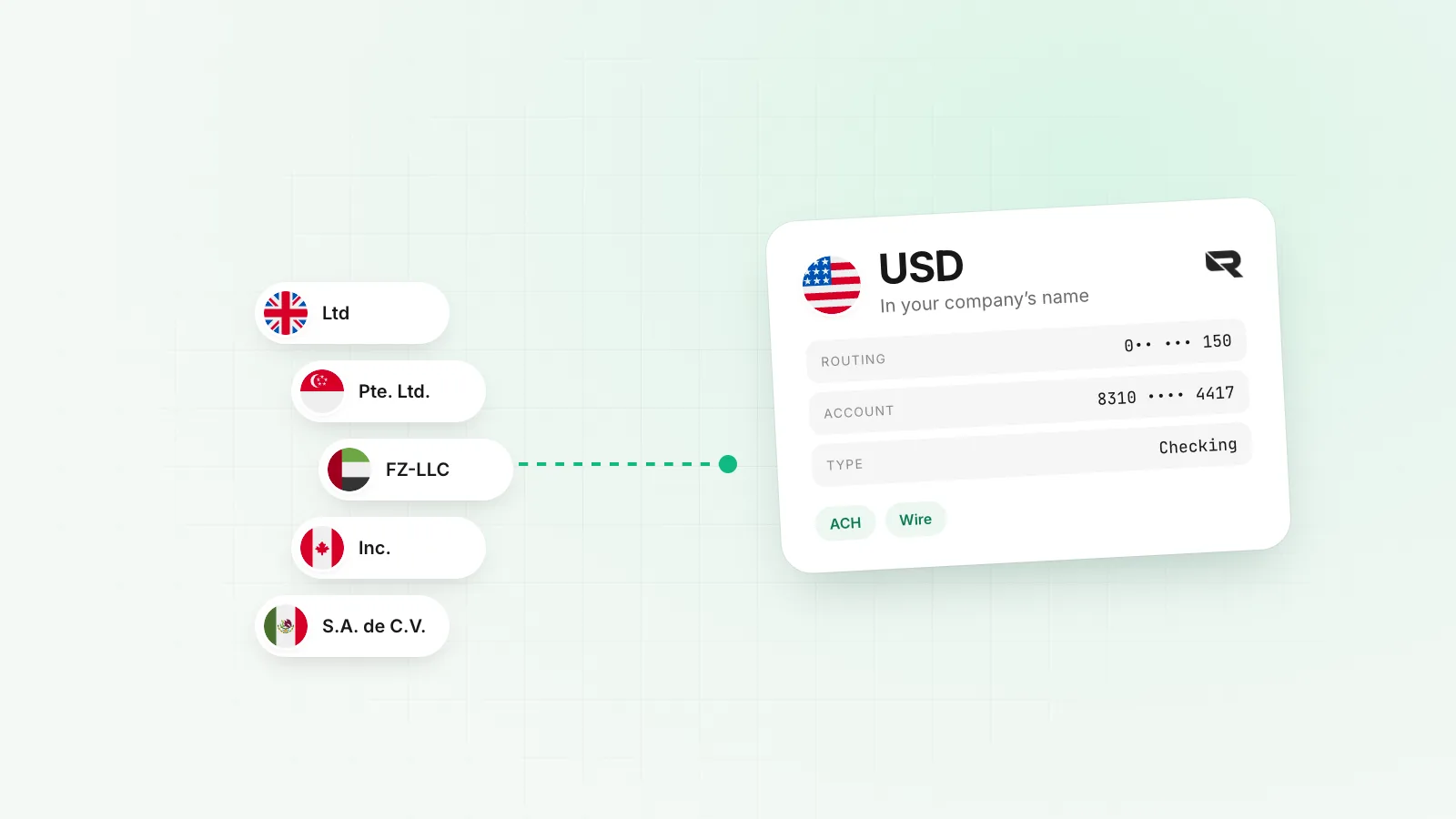
Rivet opens USD account details in your company's legal name once the business is verified, whether it is registered in the UK, the UAE, Singapore, Canada, Mexico or another supported country. A complete verification file gets a decision in three business days. Our KYB checklist lists what to prepare. From there, dollars land in your USD balance and stay there until you hold them, pay them out, spend them on a card or convert them. Starter is free. See pricing and named accounts for the rest.
Questions people ask
Can a non-US company open a Mercury account?
Generally not. Mercury's eligibility article says the company generally must be formed and registered in the US or a US territory and have existing or planned US operations. Founders do not need to be US citizens or residents, but Mercury also lists countries where founders cannot be served. Check Mercury's current rules before forming a company for it.
How can a foreign company get a US routing number?
Through a provider that issues US account details to companies registered abroad. The details include a routing number and an account number at a US institution, which lets US clients pay by ACH or domestic wire. The account should be in your company's legal name.
Do I need an EIN to receive payments from US clients?
Usually not as a foreign company performing services outside the US. US clients typically ask for a Form W-8BEN-E instead, which documents that the company is foreign. An EIN becomes necessary if you form a US entity or have certain US tax obligations; a tax adviser can confirm your case.
Is it worth forming a US LLC just for banking?
Rarely. A US LLC brings annual state fees, a registered agent, US tax filings and, for a foreign-owned single-member LLC, extra IRS reporting. If the only goal is to receive dollars, a US account in your existing company's name avoids all of that.
Sources
- 01Mercury Help Center: Eligibility and requirements for opening a Mercury account
- 02Mercury Help Center: Prohibited countries
- 03IRS: About Form W-8BEN-E
- 04IRS: Instructions for Form SS-4 (EIN applications, including international applicants)
- 05IRS: Instructions for Form 5472 (foreign-owned US disregarded entities)
- 06Nacha: Same Day ACH
William covers what happens once a company starts moving money: getting the business verified, paying contractors and suppliers abroad, and keeping card spend under control. William writes for the founder or finance lead who has to make it work this week, and links every rule cited to the text it comes from.
More from William Sunjo M. →This article is general information, not legal, tax or financial advice. Rules and fees change; check the sources above and the provider’s current terms before you act on them.
- mercury alternative
- us bank account for non-us company
- us llc
- ach
- non-resident founders