MiCA and stablecoins: what EU rules mean for USDC and USDT
Since June 2024, stablecoin issuers that offer tokens to the public in the EU need authorisation under MiCA. That has changed which stablecoins EU businesses can easily use.
- Published
- Reading time
- 2 min read
"Mica stablecoin regulation" is searched by EU finance teams who noticed their exchange stopped offering USDT. MiCA, the EU's crypto law, has applied to stablecoin issuers since mid-2024, and it decides which stablecoins regulated providers can offer to Europeans. This is a summary, not legal advice.
What MiCA is
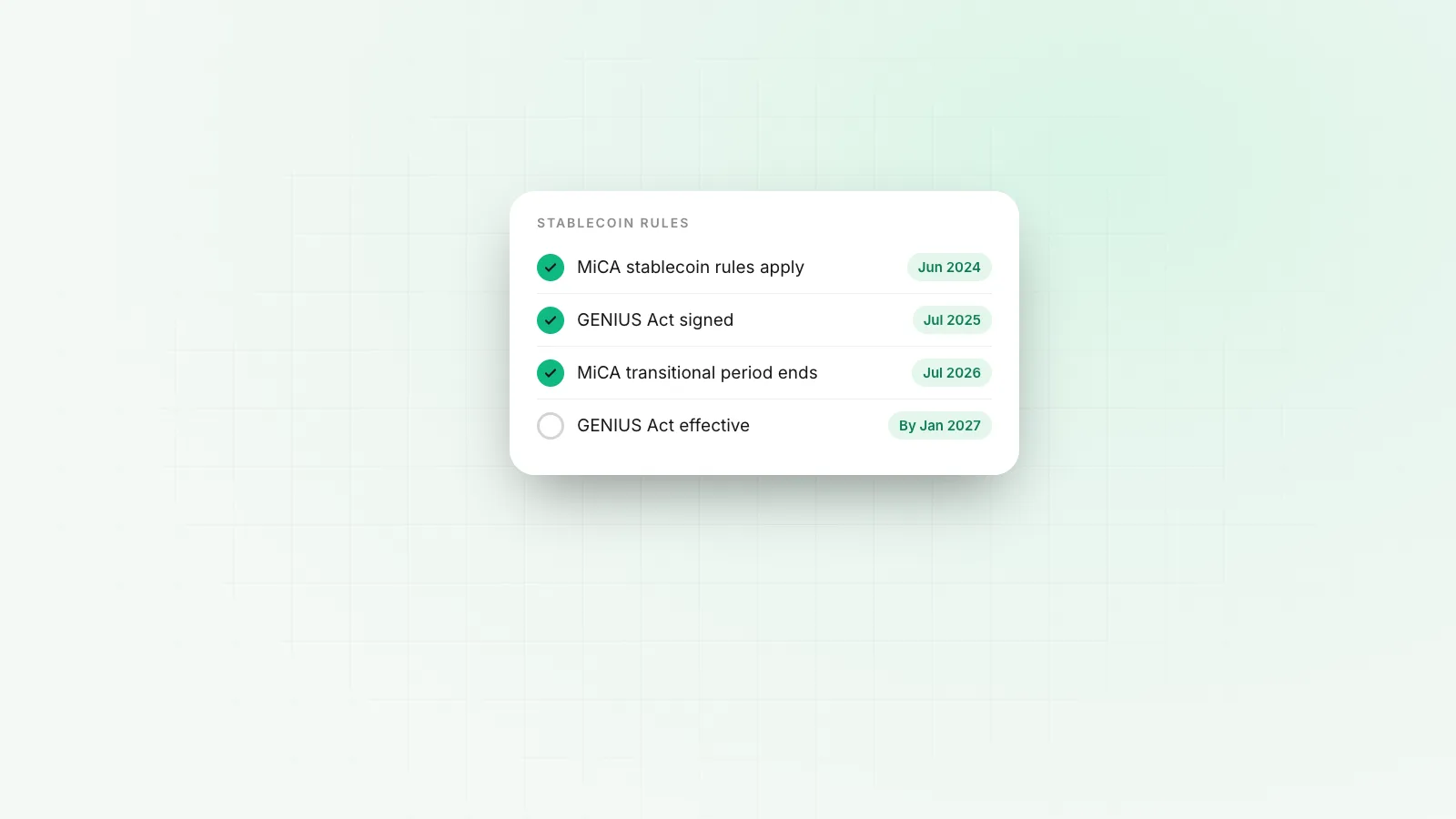
The Markets in Crypto-Assets Regulation (Regulation (EU) 2023/1114) sets EU-wide rules for crypto-asset issuers and service providers. Its stablecoin provisions applied from 30 June 2024, and the rules for service providers from 30 December 2024. Member states could allow existing providers a transitional period, which ended by July 2026 at the latest.
Two kinds of stablecoin
| Type | What it references | Who can issue |
|---|---|---|
| E-money token (EMT) | One official currency, such as USD or EUR | Authorised credit institution or e-money institution |
| Asset-referenced token (ART) | A basket of currencies, commodities or crypto | Issuer authorised under MiCA |
USDC and USDT are EMTs under MiCA's definitions, because each references a single currency.
Key rules for EMT issuers
- Authorisation as a bank or e-money institution in an EU member state
- Redemption at par, at any time, without fees except in limited cases
- Reserves held in secure, low-risk assets, with a large share as deposits at credit institutions
- A published white paper
- No interest paid to holders
- Extra requirements for tokens the EBA classifies as significant
What changed for USDT and USDC
Crypto-asset service providers in the EU may only offer stablecoins from authorised issuers. Circle obtained an e-money institution licence in France and issues USDC and EURC under MiCA. Tether did not authorise USDT, so several EU exchanges restricted USDT for EU users.
What an EU business should check
- Which stablecoins your provider supports for EU customers.
- Whether counterparties outside the EU expect USDT; if so, how you will pay them compliantly.
- Accounting treatment with your auditor.
- Whether a euro stablecoin such as EURC fits EUR-denominated flows.
Outside the EU
In the US, the GENIUS Act sets a parallel framework. See the GENIUS Act explained. For a plain introduction, see stablecoins explained.
On Rivet
Rivet supports USDC and USDT beside your USD and EUR balances, subject to the rules that apply where your company is registered. See Ramps.
Questions people ask
What is MiCA?
The Markets in Crypto-Assets Regulation, an EU law that sets rules for issuers of crypto-assets and for service providers such as exchanges and custodians. It applies directly in all EU member states.
Is USDC compliant with MiCA?
Circle obtained an e-money institution licence in France and issues USDC and EURC as e-money tokens under MiCA. Check Circle's current disclosures for the latest status.
Why was USDT delisted in the EU?
Under MiCA, EU crypto-asset service providers may only offer stablecoins whose issuers are authorised. Tether did not obtain authorisation for USDT, so several EU platforms restricted USDT trading for EU users.
Can an EU business still use USDT?
MiCA regulates issuers and service providers, not holding as such. But EU-regulated platforms may not offer non-compliant stablecoins, so access through regulated providers is limited. Take advice before building USDT into EU operations.
Sources
Rashidatou writes Rivet's guides to how money moves between countries: the payment rails, what each one costs, and the account details a company needs to get paid in another currency. Every figure in Rashidatou's articles is traced to the scheme rulebook, the regulator or the provider's published price list, and those sources are listed at the end.
More from Rashidatou K. →This article is general information, not legal, tax or financial advice. Rules and fees change; check the sources above and the provider’s current terms before you act on them.
- mica stablecoin
- mica stablecoin regulation
- e-money token
- stablecoin regulation eu
- usdt mica