Stablecoin vs SWIFT for paying suppliers: speed, cost, weekends and risk
A SWIFT wire reaches almost any bank but can lose a day and a fee at each hop. A stablecoin transfer settles in minutes on a Sunday, if the supplier can take it. Which to use depends on the supplier, not the hype.
- Published
- Reading time
- 6 min read
You owe a supplier in Shenzhen, Istanbul or Lagos $18,000, and the goods ship when the money lands. The usual answer is a SWIFT wire. More and more suppliers now ask to be paid in USDC or USDT instead. Both move dollars across a border, but they work very differently, and the cheaper one depends on the supplier more than on the technology.
This guide compares the two on speed, end-to-end cost, reach and risk, and ends with a simple way to decide. For the basics of how stablecoins work and what the GENIUS Act changed, see stablecoin payments for business. For how wires compare with SEPA, ACH and Faster Payments, see the payment rails guide.
The short version
| SWIFT wire | Stablecoin transfer (USDC or USDT) | |
|---|---|---|
| Reaches | Almost any bank account in the world | A wallet or account that accepts the coin on that network |
| Speed to the supplier | Hours to five business days | Seconds to minutes once sent |
| Works on weekends and holidays | No; waits for banks to open | Yes, at any hour |
| Fees on the transfer | Sending fee, often $15 to $50, plus intermediary and receiving fees | Network fee, often cents; more on Ethereum mainnet at busy times |
| Hidden cost | FX margin if the wire converts currency | Conversion into the coin, and the supplier's conversion out |
| Can be recalled | Sometimes, with the banks' cooperation | No |
| Tracking | Reference number; tracking through Swift gpi where banks support it | Public transaction hash, visible to both sides |
| Regulation | Banking and payments law in each country | Issuer rules (GENIUS Act in the US, MiCA in the EU) plus local crypto rules |
Speed: where the time actually goes
SWIFT has become faster. In October 2024, Swift said about 90% of cross-border payments on its network reached the recipient's bank within an hour. The same release said only 43% reached the end customer's account within an hour. The delay comes after the money arrives at the receiving bank: compliance checks, cut-off times, time zones and local clearing.
A wire sent on Friday afternoon in New York to a bank in Asia will usually be credited on Monday or Tuesday. A public holiday at either end, or at an intermediary, adds another day.
A stablecoin transfer is confirmed on-chain in seconds on networks such as Solana, Base or Polygon, and in about a minute on Ethereum. Bank hours do not apply. A Sunday-night payment arrives on Sunday night. That speed only helps if the supplier can use the money in that form, or convert it quickly.
Cost: add up both ends
Comparing a $25 wire fee with a $0.02 network fee is misleading. Add up everything between your balance and the supplier's.
For a wire:
- Your sending fee.
- Intermediary bank fees, deducted along the way. These depend on the corridor and whether the wire is sent OUR, SHA or BEN.
- The supplier's receiving fee.
- The FX margin, if the wire converts from your currency to theirs. On a large payment this is usually the biggest number.
For a stablecoin:
- Your conversion into USDC or USDT, or nothing if you already hold it.
- The network fee.
- The supplier's conversion out of the coin into local currency, if they need it. In many emerging markets this goes through a local exchange or OTC desk at a spread you do not see.
The second list is often cheaper, especially for suppliers who keep the dollars as stablecoins. If the supplier converts at a poor rate, the saving can disappear. Ask them what they actually receive.
The G20 has set targets for cross-border payments to be cheaper and faster by the end of 2027. For retail payments, which include business-to-business, the Financial Stability Board's targets are an average cost of no more than 1% and 75% of payments credited within an hour. Many corridors are still well short of that, which is part of why suppliers are asking for stablecoins.
Reach: the supplier decides
A wire works whenever the supplier has a bank account. Stablecoins work only if all of these are true:
- the supplier has a wallet or account that can receive the coin,
- on the network you are sending on,
- and holding or converting stablecoins is allowed for them in their country.
Rules differ widely. Some countries regulate stablecoin exchanges, some restrict how businesses use crypto-assets, and some have FX controls that apply to stablecoin conversions as well. Ask the supplier, and do not push a payment method on them that creates a problem at their end.
Risk: what goes wrong with each
With wires, the common problems are a payment returned because of wrong beneficiary details, a payment held for a compliance query at an intermediary, or less money arriving than expected because of fees deducted along the way. These are slow and annoying, but the money is usually traceable and recoverable.
With stablecoins, the common problems are harder to undo:
- Wrong address or wrong network. A transfer cannot be recalled. Sending USDT on Tron to an address that only watches Ethereum can mean a long recovery, or none.
- Address substitution. Malware and fake invoices replace a supplier's address with the attacker's. Confirm a new or changed address by phone or video, not by email alone.
- Issuer and peg risk. Stablecoins have briefly traded below $1 under stress; USDC did in March 2023 when part of its reserves sat at Silicon Valley Bank. Hold what you need for payments, not a long-term treasury reserve in a single coin.
- Sanctions. On-chain addresses can be sanctioned like bank accounts. Use a provider that screens addresses before you send.
When each one wins
Use a SWIFT wire when:
- the supplier only has a bank account, or is not allowed to receive crypto-assets,
- the payment is large and the supplier wants funds in a regulated bank account,
- your contract or your auditor requires a bank transfer.
Use a stablecoin transfer when:
- the supplier already holds USDC or USDT, or converts locally at a fair rate,
- timing matters, for example goods are released on payment, or it is the weekend,
- the wire corridor is slow or expensive, with several intermediaries.
Use neither when the supplier's country has a local rail you can reach. A payout in the supplier's currency on their domestic system, such as SEPA in Europe or a local bank transfer in many African and Asian markets, is often cheaper and faster than both. It also arrives in the form the supplier uses to pay their own costs.
A simple rule
Ask the supplier three questions before the first payment: which currency they want, which accounts or wallets they can receive into, and what they lose converting it. Then price each route end to end. The cheapest route on paper is the wrong one if the supplier ends up worse off.
How Rivet handles this
Rivet holds USD, EUR and GBP balances beside USDC and USDT in one business account. Stablecoins are held on Ethereum, Base, Solana, Polygon, Optimism and Avalanche. You can pay a supplier by Swift wire, on a local rail in 20+ countries, or on-chain, and one bulk batch can mix all three. Every leg shows its rate and fee before you confirm. A Swift wire is $25.00, falling to $20.00 on Scale, and a local or on-chain payout costs your plan's per-payout fee, from $2.00 on Starter to $0.50 on Scale, plus the network fee on-chain.
Ramps explains how conversion works, and Pricing lists every fee by plan.
Questions people ask
Is paying a supplier in USDC cheaper than a wire?
Often, but not always. The on-chain transfer itself usually costs cents. Add your conversion into USDC and the supplier's conversion back to local currency, and compare that total with the wire fee plus any intermediary and receiving fees. For large payments, the FX margin matters more than either fee.
How long does a SWIFT wire take?
Most reach the receiving bank within hours, but crediting the supplier's account can take one to five business days depending on the corridor, cut-off times, time zones and compliance checks. Wires sent on a Friday afternoon or before a holiday usually wait until the next business day.
Can a stablecoin payment be reversed?
No. Once a transfer is confirmed on-chain it cannot be recalled. Sending to a wrong address, or to the right address on the wrong network, can mean the money is lost. Test with a small amount for a new supplier, and confirm the address and network in writing.
Which stablecoin should I use to pay suppliers?
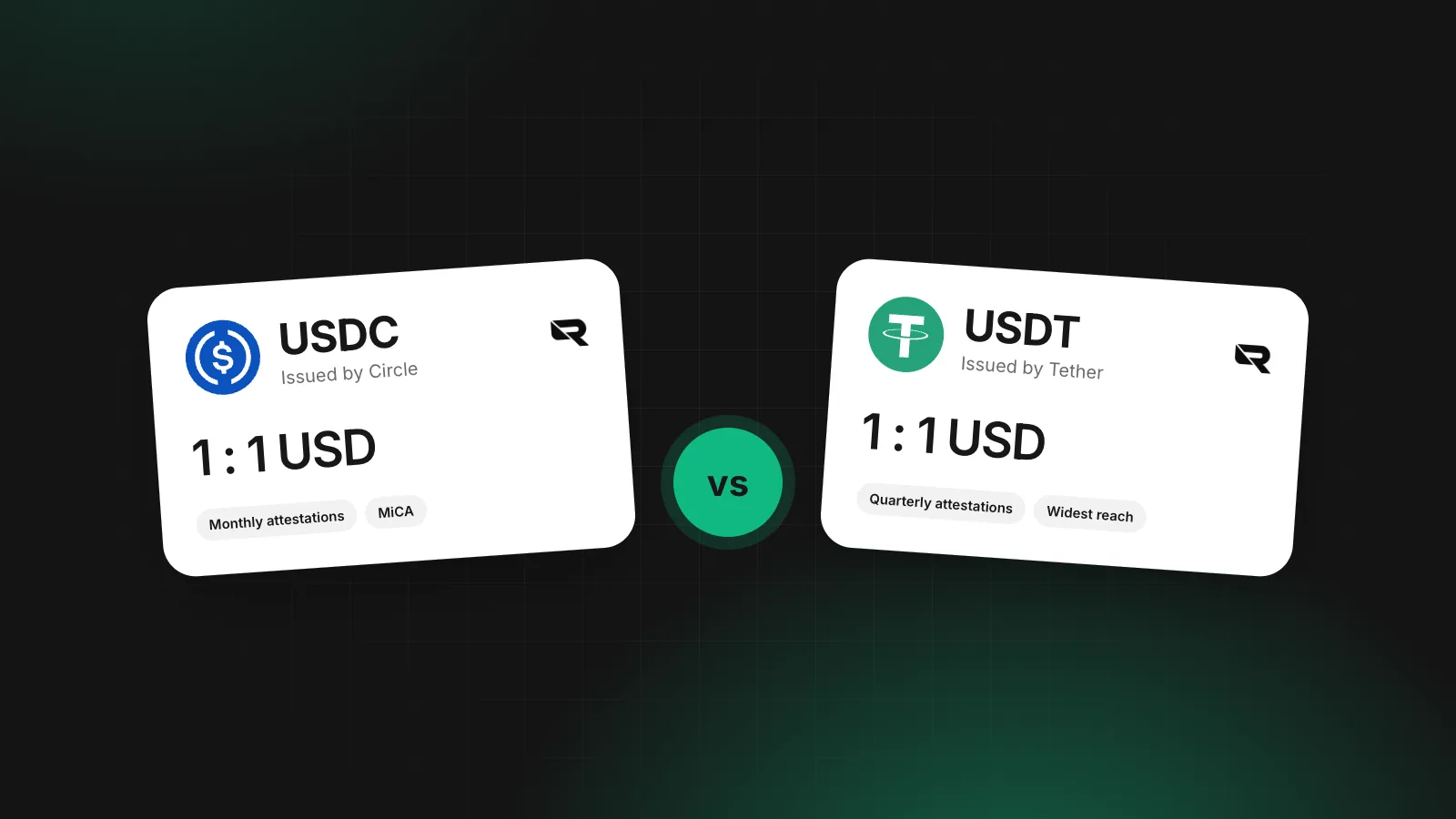
Use the one your supplier can receive and convert locally. USDC is the usual choice for companies that want regulated US reserves and monthly attestations. USDT is more widely used in many emerging markets. Agree the coin and the network before the first payment.
Do I need a crypto wallet to pay in stablecoins?
You need somewhere to hold and send them, which can be a business account that holds stablecoins beside ordinary balances. The supplier needs a wallet or an account that can receive the coin on the network you use, and a way to convert it if they pay their costs in local currency.
Sources
- 01Swift: cross-border payment processing speed stretches further ahead of G20 target (October 2024)
- 02Financial Stability Board: Targets for addressing the four challenges of cross-border payments (final report, October 2021)
- 03Congress.gov: S.1582, GENIUS Act
- 04Regulation (EU) 2023/1114 on markets in crypto-assets (MiCA)
- 05Circle: USDC transparency and reserves
Rashidatou writes Rivet's guides to how money moves between countries: the payment rails, what each one costs, and the account details a company needs to get paid in another currency. Every figure in Rashidatou's articles is traced to the scheme rulebook, the regulator or the provider's published price list, and those sources are listed at the end.
More from Rashidatou K. →This article is general information, not legal, tax or financial advice. Rules and fees change; check the sources above and the provider’s current terms before you act on them.
- stablecoins
- swift
- wire transfer
- usdc
- usdt
- supplier payments
- cross-border payments