How a business moves USDT or USDC to a bank account
Getting paid in USDT is easy. Getting it into the company's bank account cleanly, with a record your accountant accepts, takes a little planning.
- Published
- Updated
- Reading time
- 2 min read
More businesses are paid in stablecoins every month: a client in the Gulf who settles in USDT, a marketplace paying sellers in USDC, a partner who simply prefers it. Receiving is easy. The question people search is the next step: "usdt to bank account". For a company, the answer is about the route as much as the conversion.
What is an off-ramp?
An off-ramp converts stablecoins into bank money and pays it to a bank account. You send USDT or USDC to a provider, the provider sells it for USD or another currency, and pays the result to an account by ACH, wire or a local rail.
The opposite, buying stablecoins with bank money, is an on-ramp.
The routes, for a business
| Route | Fits a company? | Watch for |
|---|---|---|
| Business account with stablecoin support | Yes | Supported networks; conversion fee |
| Exchange business account | Yes, if verified as a business | Whose name is on the bank account it pays |
| Personal exchange account | No | Company money in a personal account |
| Peer-to-peer trade | No | Counterparty risk; unclear record; frozen bank accounts in some countries |
The first two produce a clean record: tokens in, dollars out, company name on both sides. Peer-to-peer trades are common in some markets, and they are the route most likely to get a business bank account frozen when the bank sees payments from unknown individuals.
Step by step
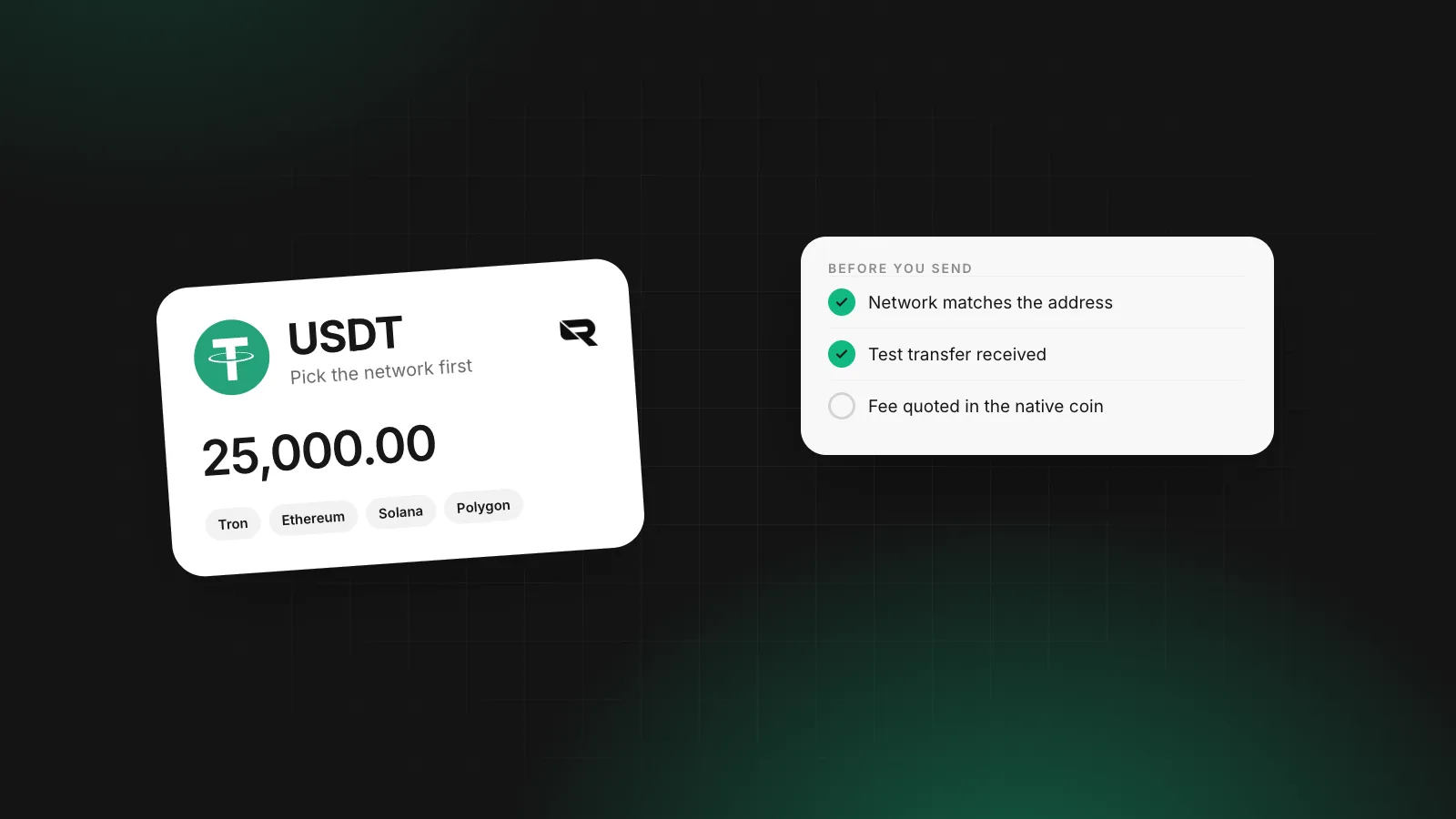
- Get a deposit address from your provider, on a named network (for example, USDT on Tron or USDC on Ethereum).
- Send a small test amount. Check it arrives.
- Send the rest.
- Convert to USD at the quoted rate.
- Pay out to the company's bank account, or keep it as a USD balance to pay suppliers.
What it costs
- Network fee: what the blockchain charges to move the tokens. Low on Tron, Solana and Polygon; higher on Ethereum when it is busy.
- Conversion: a fee or spread to turn stablecoins into USD.
- Payout: the rail fee for ACH, wire or the local transfer.
Compare the USD that lands for a given amount, because some providers advertise zero fees and price the spread instead.
The mistakes that lose money
- Wrong network. Sending USDT on Ethereum to an address expecting USDT on Tron can mean the funds are lost or need a costly recovery.
- No test transfer to a new address.
- Converting into a personal account, then moving it to the company. The bank sees two unexplained transfers.
- No record. Without the hash and the conversion confirmation, your accountant cannot show where the money came from.
The record your accountant needs
For each off-ramp, keep the invoice or reason for the incoming payment, the transaction hash, the conversion confirmation with rate and fee, and the bank credit. The stablecoin payments guide covers booking them.
On Rivet
USDC and USDT sit in the same workspace as your USD balance. You convert at a rate shown before you confirm, and the USD lands in the company's own balance, ready to pay suppliers or move to another account. Stablecoin deposits and withdrawals are included in every plan. See Ramps.
Questions people ask
Can I transfer USDT to my bank account?
Not directly. A bank account holds bank money, not tokens. You send the USDT to a provider that converts it to USD or your local currency and pays the result to your bank account. For a company, the provider should pay the company's own account.
How do I convert USDC to USD?
Send the USDC to an account with a provider that supports USDC redemption or sale, convert to USD, and withdraw to a bank account by ACH or wire. Circle redeems USDC directly for eligible institutional customers; most businesses use a payment provider or exchange.
Can I withdraw USDT from Binance to a bank account?
Exchanges offer bank withdrawals in some countries, for verified accounts. For a business, the issue is whose name is on the exchange account and the bank account. Use a business account in the company's name on both sides, or the payment may be questioned.
How much does it cost to move USDT to a bank account?
The network fee to send the tokens, which varies by blockchain; the provider's conversion fee or spread; and the bank payout fee. Ask the provider for an all-in quote for your amount, and compare the USD that lands, not the advertised fee.
Sources
Rashidatou writes Rivet's guides to how money moves between countries: the payment rails, what each one costs, and the account details a company needs to get paid in another currency. Every figure in Rashidatou's articles is traced to the scheme rulebook, the regulator or the provider's published price list, and those sources are listed at the end.
More from Rashidatou K. →This article is general information, not legal, tax or financial advice. Rules and fees change; check the sources above and the provider’s current terms before you act on them.
- usdt to bank account
- usdc to usd
- withdraw usdt to bank account
- stablecoin off-ramp
- usdc