Stablecoins explained simply, for finance teams
A stablecoin is a digital dollar that moves on a blockchain. That one sentence leaves a finance team with ten questions. Here are the answers, without the jargon.
- Published
- Updated
- Reading time
- 2 min read
Finance teams hear about stablecoins from two directions: a supplier who asks to be paid in USDT, and a board member who read that stablecoins are the future of payments. Neither helps you decide what to do on Monday. This guide explains what they are, how they hold their value, and what to check before you touch one.
What is a stablecoin?
A stablecoin is a token on a blockchain that aims to keep a fixed value, almost always one US dollar. The issuer creates tokens when customers deposit dollars and destroys them when customers redeem. In between, the tokens can be sent to anyone with a compatible wallet, in minutes, at any hour.
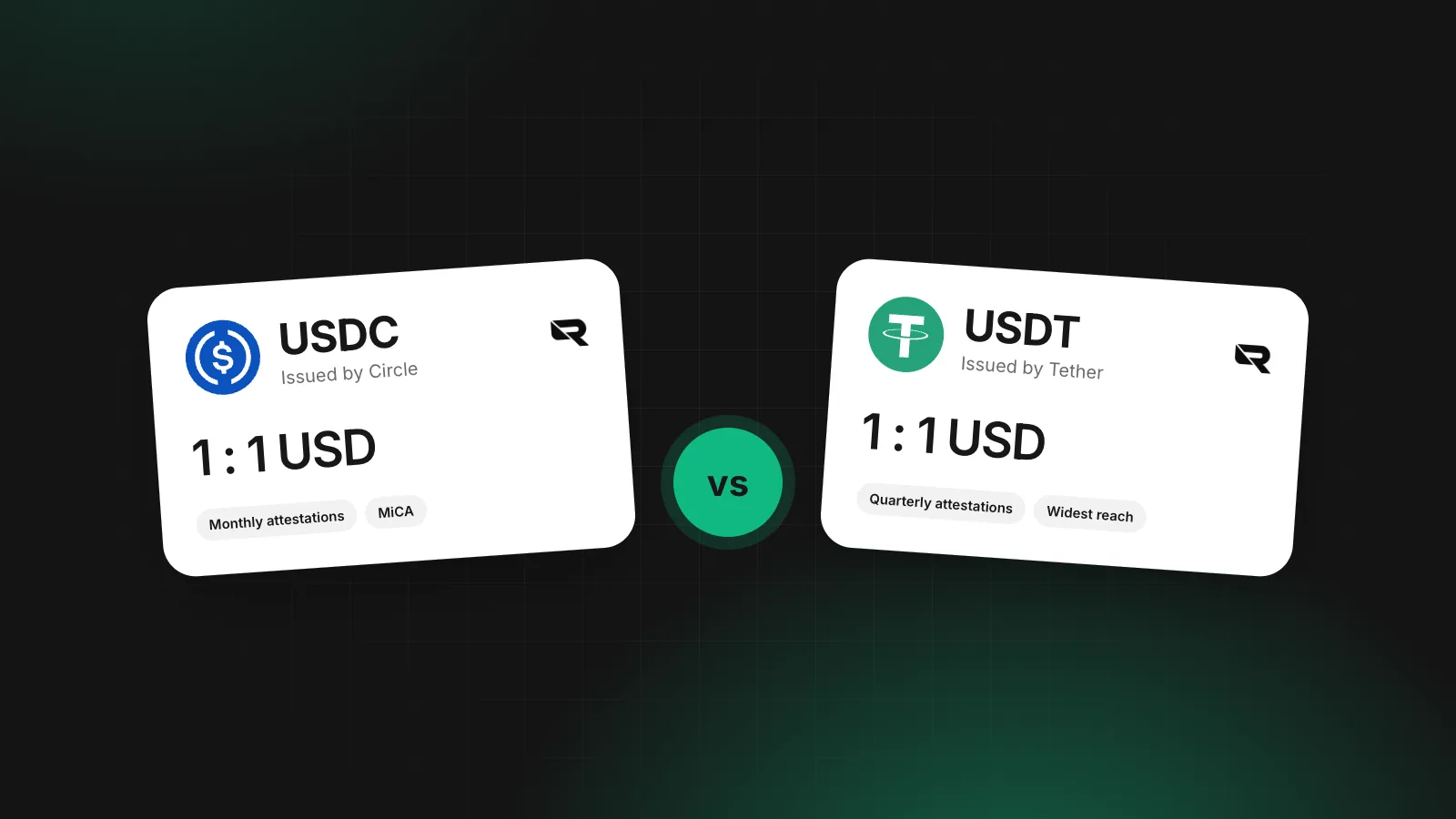
The two largest are USDC, issued by Circle, and USDT, issued by Tether. Both exist on several blockchains, such as Ethereum, Tron, Solana and Polygon.
How does a stablecoin keep its value?
Fiat-backed stablecoins hold reserves, mostly cash and short-term US government debt, and promise to redeem each token for one dollar. Large holders can redeem directly with the issuer. Everyone else buys and sells through exchanges and payment providers, and arbitrage keeps the market price close to one dollar.
Both Circle and Tether publish reports on their reserves. Read them, because reserve quality and disclosure are the main difference between issuers. The USDC vs USDT guide compares the two.
Stablecoins vs crypto
| Fiat-backed stablecoin | Bitcoin, ether | |
|---|---|---|
| Price | Designed to stay at 1 USD | Set by the market, moves constantly |
| Backing | Reserves held by the issuer | None |
| Business use | Payments, holding dollars | Investment, speculation |
| Accounting feel | Close to a cash balance | A volatile asset |
Both run on the same blockchains; only the stablecoin is designed to hold its value.
How are stablecoins regulated?
In the US, the GENIUS Act became law in July 2025. It sets federal rules for issuers of payment stablecoins, including fully backed reserves and regular public disclosure. In the EU, the Markets in Crypto-Assets Regulation (MiCA) has applied to stablecoin issuers since June 2024; an issuer must be authorised to offer its token to the public there.
For a business user, regulation mostly matters in two places: which stablecoins your provider supports, and how your accountant books them.
What finance teams use them for
- Paying a supplier or contractor who already works in USDC or USDT, often in countries where receiving a USD wire is slow or costly.
- Settling outside banking hours. A stablecoin transfer on Saturday arrives on Saturday.
- Holding dollars for a subsidiary or team in a country with currency controls, where allowed.
How companies use stablecoins goes through real cases.
The risks to manage
- Wrong address or wrong network. A token sent to an address on the wrong blockchain can be lost. Test with a small amount first.
- Issuer risk. A stablecoin is only as good as its reserves and its issuer.
- On- and off-ramp costs. Moving between bank money and stablecoins costs a fee and sometimes a spread.
- Local rules. Some countries restrict holding or paying in stablecoins. Check before you use them there.
How Rivet handles them
On Rivet, USDC and USDT sit next to your USD and EUR balances. Clients pay your bank details as usual, you convert when you choose, and payouts in stablecoins run under the same approvals as bank payouts. Stablecoin deposits and withdrawals come with every plan, including the free one. See Ramps for the networks we support.
Questions people ask
What is a stablecoin, in simple terms?
A stablecoin is a digital token designed to keep a steady value, usually one US dollar. The issuer holds reserves, such as cash and US Treasury bills, and redeems tokens for dollars. Because the token lives on a blockchain, it can be sent anywhere in minutes, at any hour.
How are stablecoins different from crypto like bitcoin?
Bitcoin's price is set by the market and moves every minute. A fiat-backed stablecoin is designed to stay at one dollar because it can be redeemed for one dollar from the issuer. Stablecoins use the same blockchains as other crypto, but a finance team treats them like a dollar balance, not an investment.
What are the benefits of stablecoins for a business?
Settlement in minutes, every day of the year, including weekends and public holidays. Lower cost on routes where bank wires pass through several intermediaries. And a way to hold and pay dollars for counterparties who cannot easily get a US bank account.
Are stablecoins regulated?
Increasingly. The US GENIUS Act, signed in July 2025, sets federal rules for payment stablecoin issuers, including reserve and disclosure requirements. In the EU, issuers of e-money tokens and asset-referenced tokens must be authorised under MiCA. Other countries have their own rules.
Sources
Rashidatou writes Rivet's guides to how money moves between countries: the payment rails, what each one costs, and the account details a company needs to get paid in another currency. Every figure in Rashidatou's articles is traced to the scheme rulebook, the regulator or the provider's published price list, and those sources are listed at the end.
More from Rashidatou K. →This article is general information, not legal, tax or financial advice. Rules and fees change; check the sources above and the provider’s current terms before you act on them.
- stablecoins explained
- stablecoin definition
- stablecoins vs crypto
- usdc
- usdt
- genius act