How to invoice international clients and get paid in full
An invoice to a client abroad needs a few things a domestic one does not. Get them right and the payment arrives in full and on time.
- Published
- Updated
- Reading time
- 3 min read
Most late or short international payments trace back to the invoice. The currency was unclear, the bank details needed a SWIFT wire, the client's accounts payable team could not match the payee name, or the tax line was missing. This guide covers what a cross-border invoice needs.
Tax rules differ by country. Use this as a checklist, and get your accountant to confirm the tax wording once.
What goes on an international invoice
| Field | Notes |
|---|---|
| Your legal name, address, registration number, tax ID | As on your company registration |
| Client's legal name, address, tax ID | Their finance team will check it |
| Invoice number | One sequence, no gaps |
| Issue date and due date | Payment terms in days |
| Description of the service | Specific enough for an auditor |
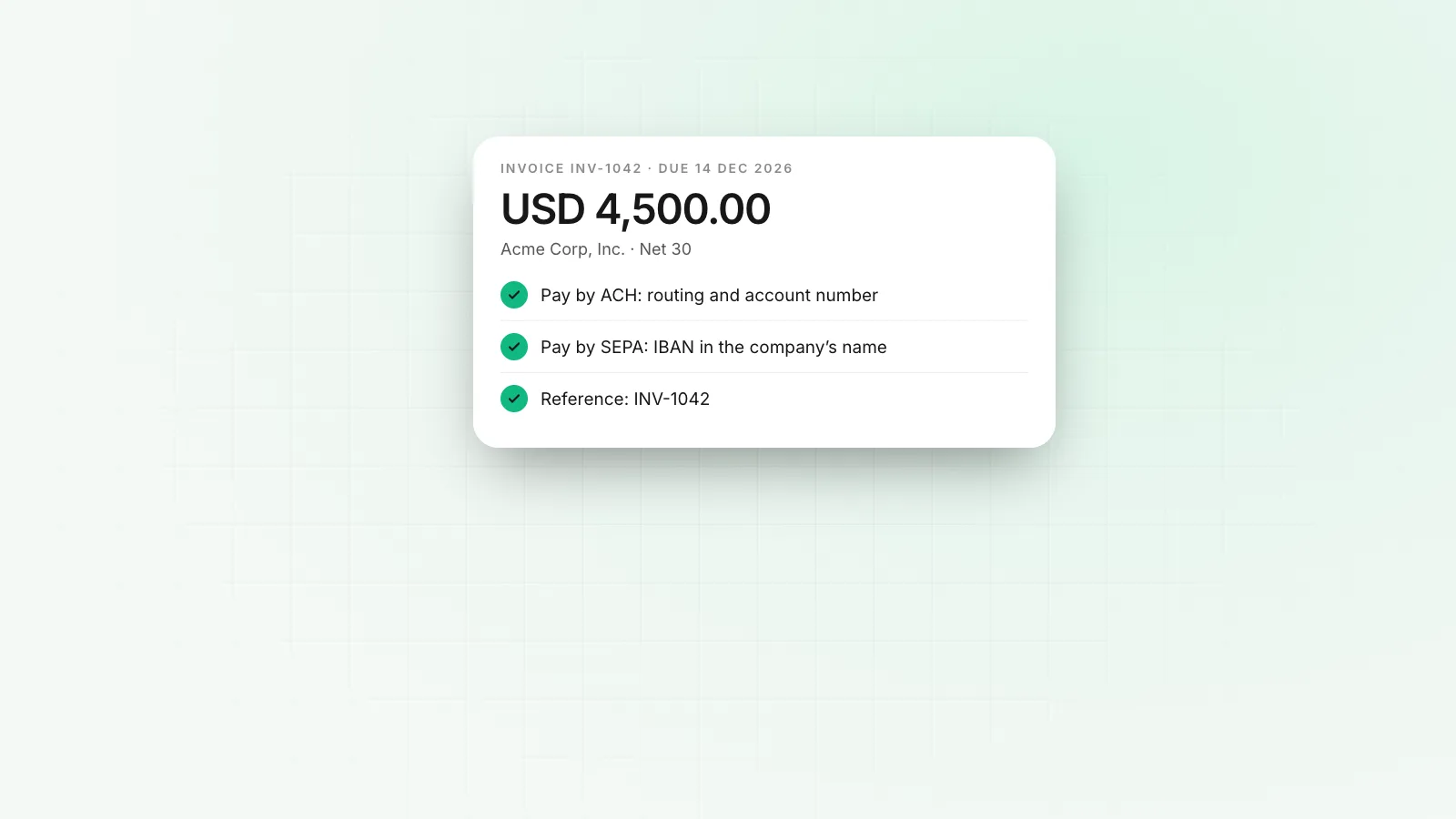
| Amount, with currency code | "USD 4,500.00", not "$4,500" |
| Tax line | Rate, or the reason no tax applies |
| Payment details | Ones the client can pay domestically |
| Payment reference | Ask them to quote the invoice number |
Pick the currency deliberately
Write the ISO code with every amount. "
quot; means different things in the US, Canada, Australia and Singapore.Invoice in the currency you want to receive, if you can receive it cheaply. A US client paying USD into ACH details pays like it would any US supplier. If you invoice in your local currency instead, the client's bank converts at its rate, and some clients will ask you to absorb that.
Give payment details the client can pay domestically
- US clients: USD details with an ACH routing number and account number, plus wire details for large payments.
- EU clients: EUR details with an IBAN on SEPA. Make sure the account name matches the name on your invoice, because EU payers now see a name check.
- UK clients: GBP details with a sort code and account number for Faster Payments.
Each domestic payment avoids SWIFT, intermediary fees and the "why is it short?" email. The receiving international payments guide covers the options.
If the client must pay by SWIFT
Add a line: "Please pay all bank charges (OUR) so the full amount is received." Put the same term in the contract. Without it, the default is usually SHA, and intermediary fees come out of your money. The SWIFT fees guide explains the charge codes.
Tax wording
For services to a business in another country, local VAT or GST often does not apply, or the client accounts for it under a reverse charge:
- EU: B2B services to a customer in another member state usually fall under the reverse charge, and the invoice must say "Reverse charge" and show the customer's VAT number.
- UK: B2B services supplied outside the UK are generally outside the scope of UK VAT; the invoice should say why no VAT is charged.
- India: exports of services under a letter of undertaking are zero rated, with the LUT reference on the invoice.
US clients may also ask you for a W-8BEN-E (for a company) before paying, to confirm they need not withhold tax.
Payment terms
Thirty days is common. State the due date as a date, not "net 30". For new clients, ask for a deposit before work starts.
Invoicing from Rivet
Rivet's invoicing lets you send each client a hosted invoice and a PDF that show your company's account details in the invoice currency, so a US client sees ACH details and a European client sees an IBAN. Payments land in the matching balance. See Bank accounts for the details each currency includes.
Questions people ask
What currency should I invoice an international client in?
In the currency you want to receive, as long as you have a way to receive it cheaply. Many service businesses invoice US clients in USD and EU clients in EUR, and hold balances in both. Invoicing in your local currency pushes the conversion onto the client, which some will resist.
Do I charge VAT to a client in another country?
Often not, for business-to-business services, because the place of supply is where the client is. In the EU and UK, B2B services to a business customer in another country are usually under the reverse charge, and the invoice must say so. Rules differ by country and service, so check with your accountant.
How do I invoice from India or the UK to a client abroad?
The structure is the same everywhere: your details, the client's legal details, a unique number, the date, a description, the amount and currency, and payment details. Each country adds its own tax wording, such as a letter of undertaking reference for Indian exports of services or reverse charge wording for UK B2B services to the EU.
How do I make sure I receive the full invoice amount?
Give local payment details so the client pays a domestic transfer. If they must use SWIFT, ask for OUR charges in the contract and on the invoice. State the currency clearly, and quote the invoice number as the payment reference.
Sources
William covers what happens once a company starts moving money: getting the business verified, paying contractors and suppliers abroad, and keeping card spend under control. William writes for the founder or finance lead who has to make it work this week, and links every rule cited to the text it comes from.
More from William Sunjo M. →This article is general information, not legal, tax or financial advice. Rules and fees change; check the sources above and the provider’s current terms before you act on them.
- invoice international clients
- invoicing overseas clients
- how to invoice foreign clients
- reverse charge
- export of services