Converting USD to EUR for a business: timing, cost and control
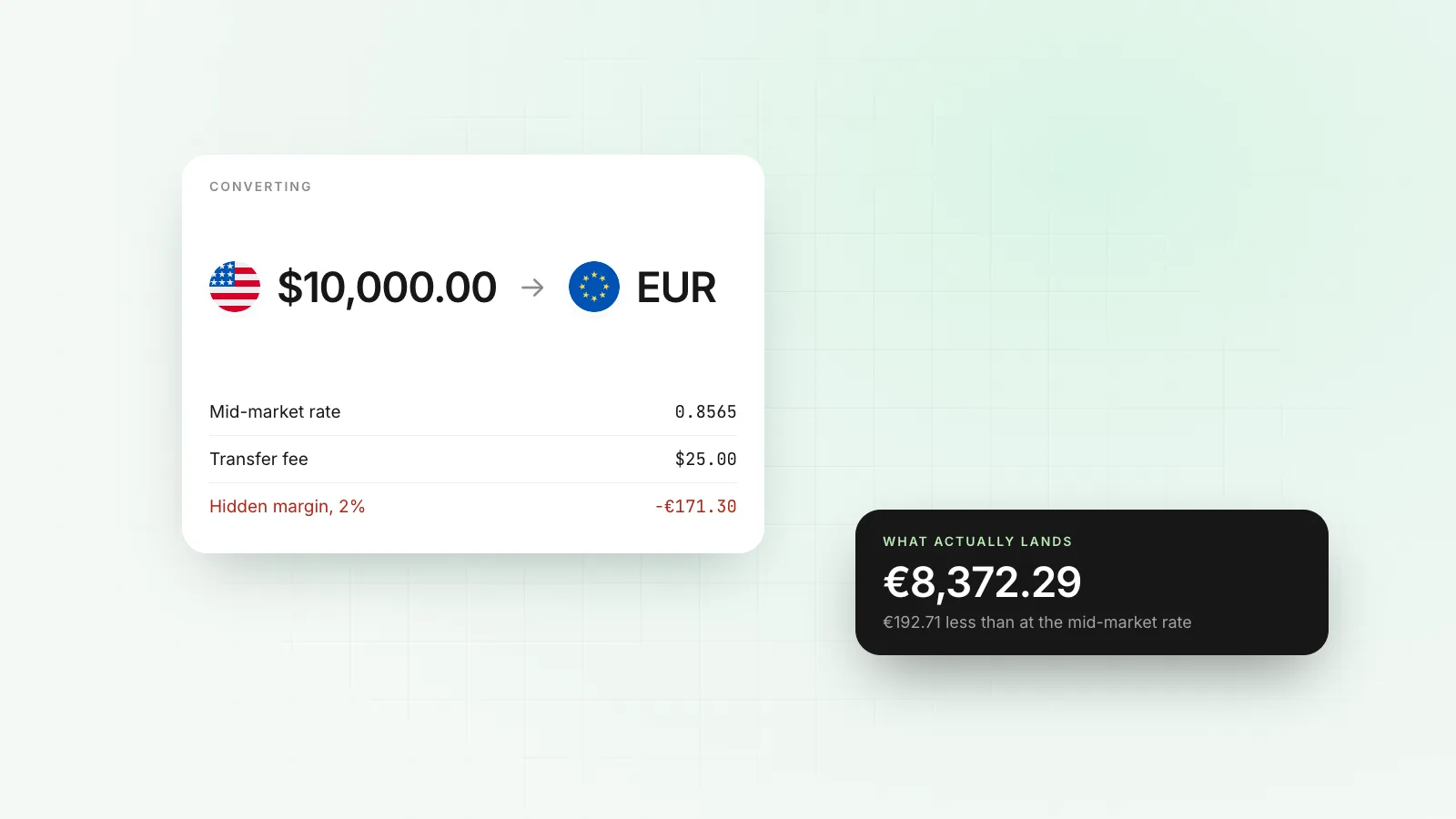
A business converting dollars to euros every month pays a margin each time. Comparing it with the mid-market rate, converting in planned amounts and holding euros where you spend them all reduce the cost.
- Published
- Reading time
- 1 min read
A US company with a team or suppliers in Europe converts dollars to euros every month. Small differences in rate add up across a year.
Where the cost sits
| Component | Visible? |
|---|---|
| Fee per conversion | Usually |
| Margin over mid-market | In the rate |
| Wire fee to send euros | Usually |
On $50,000 a month, a 2% margin costs $1,000. A 0.5% margin costs $250. Over a year, $9,000 difference.
How to check your margin
- Note the rate you received and the time.
- Look up the mid-market rate at the same time.
- Divide the difference by the mid-market rate.
Ways to reduce it
- Use a provider with a published margin.
- Convert twice a month in planned amounts, not per payment.
- Hold euros from European revenue and pay euro costs from them.
- For large known payments, consider a forward. See FX forward contracts explained.
Paying into the United States: the local rail
| What | Detail |
|---|---|
| Local rail | ACH for batch payments; RTP and FedNow for instant transfers |
| Run by | Nacha for ACH; The Clearing House for RTP; the Federal Reserve for FedNow |
| Settlement | Same-day ACH within the business day, standard ACH the next; RTP and FedNow in seconds, 24/7, where both banks take part |
Source: Nacha: Same Day ACH. Checked when this guide was last updated; the scheme's own page has the current figures.
Where Rivet fits
Rivet converts between USD and EUR at a rate shown before you confirm, from 0.80% on Starter, 0.50% on Growth and 0.30% on Scale, and holds euros with an IBAN on Growth so you can pay European costs directly. Rivet is not a bank; regulated partner institutions hold the funds. See mid-market rate and FX markup.
Questions people ask
What is the best way to convert USD to EUR for a business?
Use a provider with a published margin close to mid-market, convert in planned amounts, and hold euros where you spend them.
What is the mid-market rate?
The midpoint between buy and sell rates in the wholesale market. Publications such as the ECB's reference rates and the Federal Reserve's H.10 give benchmarks.
Should I use a forward contract?
If you have large, predictable euro payments and want certainty, a forward can help. It locks in a rate, both ways.
How do I know my margin?
Compare the rate you got with the mid-market rate at the same moment, and express the difference as a percentage.
Sources
Alexia compares the accounts, cards and payment tools companies weigh before they switch, and writes Rivet's market guides for founders in a specific country. Prices in Alexia's comparisons come from each provider's own pricing page on the date given in the article, rules come from the regulator or tax authority that sets them, and every source is listed at the end.
More from Alexia M. →This article is general information, not legal, tax or financial advice. Rules and fees change; check the sources above and the provider’s current terms before you act on them.
- convert usd to eur
- usd eur business
- fx margin
- mid-market rate
- forward contract
- us