The mid-market rate and FX markups: how to see what a conversion really costs
Every currency conversion has a cost, even when the fee line says zero. It is the gap between your rate and the mid-market rate. Here is how to measure it.
- Published
- Updated
- Reading time
- 2 min read
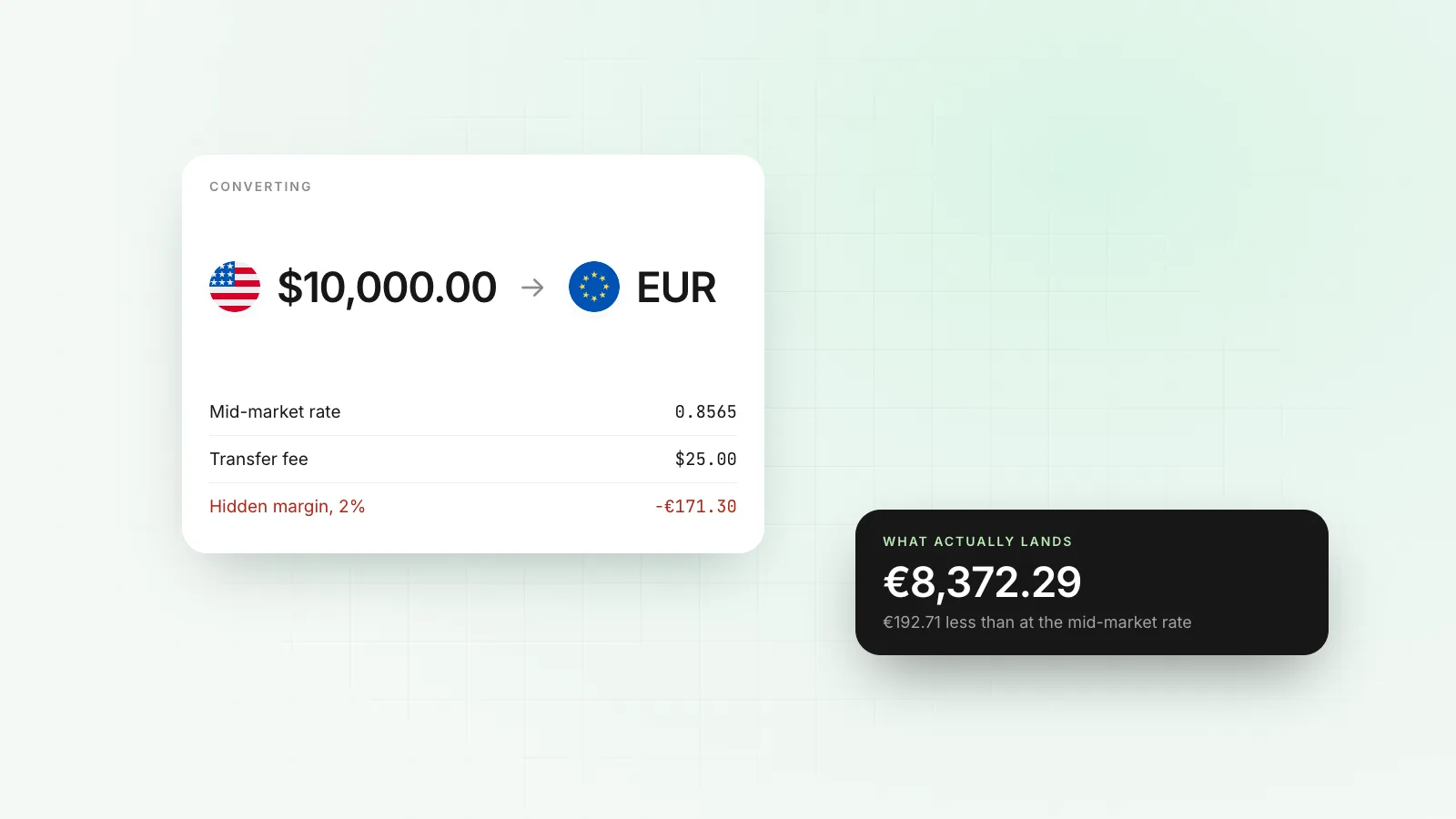
"Mid market rate meaning" and "fx markup meaning" are searched by people who have just converted money and received less than they expected. The fee line said 0. The cost was in the rate.
What the mid-market rate is
In the wholesale currency market, banks quote two prices for every pair: a price to buy and a price to sell. The mid-market rate is the midpoint between them. It has no margin built in, and it is the rate you see on Google, Reuters or XE. No business customer gets exactly that rate, but it is the fair yardstick.
What an FX markup is
Your provider gives you a rate a little worse than mid-market and keeps the difference. That gap is the markup. Some providers show it as a fee and give you the mid-market rate; others build it into the rate and show no fee at all. Either way, it is the cost of converting.
How to calculate it
markup = (mid-market rate − your rate) ÷ mid-market rateExample: converting USD to EUR when the mid-market rate is 0.9200 EUR per USD, and you are quoted 0.9016.
- (0.9200 − 0.9016) ÷ 0.9200 = 0.02
- Markup: 2%. On 10,000 USD, that is 184 EUR you did not receive.
Check the mid-market rate at the same moment as the quote; rates move every second.
What providers publish
From providers' own pricing pages, read on 1 November 2026:
| Provider | How FX is priced |
|---|---|
| Wise Business | Mid-market rate plus a fee from 0.23%, varying by currency |
| Revolut Business (US) | Interbank rate up to a monthly allowance, then 0.6%; 1% outside market hours |
| PayPal (US business transactions) | 3.00% spread above the base rate |
| Rivet | From 0.80% (Starter) to 0.30% (Scale), shown before you confirm |
Traditional banks often do not publish a business margin at all. Ask, or measure it with the formula above.
Comparing quotes properly
- Get quotes at the same moment.
- Compare the amount that lands in the destination currency, not the rate or the fee alone.
- Include fixed fees: on small amounts, a 5 USD fee can matter more than the margin.
- Check for a second conversion on the receiving side.
The true cost of international payments adds up all the costs on a payment, and FX risk for small businesses covers what happens when rates move.
On Rivet
Rivet shows the rate, the margin and the amount that will land before you confirm any conversion. See Pricing.
Questions people ask
What does mid-market rate mean?
It is the midpoint between the price at which banks buy and sell a currency in the wholesale market at a given moment. It has no margin built in, which makes it the fair reference for judging any rate you are quoted.
What is an FX markup fee?
The difference between the exchange rate a provider gives you and the mid-market rate, expressed as a percentage. Some providers show it as a separate fee, others build it into the rate, where it is easy to miss.
How do I calculate the FX markup?
Look up the mid-market rate at the same time as your quote. Subtract your rate from it, divide by the mid-market rate, and multiply by 100. For example, a mid-market rate of 1.1000 and your rate of 1.0780 gives a 2% markup.
Is a zero-fee money transfer really free?
Rarely. If no fee is charged, check the rate. A provider that shows 0 fees but gives a rate 3% worse than mid-market is charging 3%.
Sources
Rashidatou writes Rivet's guides to how money moves between countries: the payment rails, what each one costs, and the account details a company needs to get paid in another currency. Every figure in Rashidatou's articles is traced to the scheme rulebook, the regulator or the provider's published price list, and those sources are listed at the end.
More from Rashidatou K. →This article is general information, not legal, tax or financial advice. Rules and fees change; check the sources above and the provider’s current terms before you act on them.
- mid market rate
- mid market rate meaning
- fx markup
- fx markup fees
- exchange rate