USDT and USDC networks compared: Tron, Ethereum, Polygon and Solana fees
USDT on Tron and USDT on Ethereum are the same dollar on different roads. The road decides the fee, the speed, and whether the money arrives at all.
- Published
- Reading time
- 2 min read
"Tron usdt fees" and "usdc on polygon network" are searched by businesses that have just been asked, "Which network?" by a supplier. A stablecoin is not on one blockchain. Each network is its own road with its own tolls, and a payment sent on the wrong road does not arrive.
Same token, separate networks
Tether issues USDT, and Circle issues USDC, on several blockchains. One USDT on Tron and one USDT on Ethereum are both worth one dollar and both redeemable, but they live on separate ledgers. An address on one network cannot receive tokens sent on another.
The main networks
| Network | Common names | Fee paid in | Typical cost | Notes |
|---|---|---|---|---|
| Ethereum | ERC20 | ETH | Higher; rises when busy | Deepest support; good for large transfers |
| Tron | TRC20 | TRX (energy, bandwidth) | Low | Most-used network for USDT payments |
| Polygon PoS | Polygon | POL | Very low | Native USDC from Circle; watch for bridged USDC.e |
| Solana | SPL | SOL | Very low | Native USDC; fast |
Fees change with network conditions and token prices, so check a current estimate before you set a policy.
How fees work
Each network charges a fee to process the transfer, paid in its own coin, not in the stablecoin. Your wallet or provider needs that coin, or pays it for you and charges you. On Tron, fees are expressed as energy and bandwidth; staking TRX can provide those resources instead of paying per transfer.
Moving USDC between networks
Circle's Cross-Chain Transfer Protocol (CCTP) burns USDC on one network and mints the same amount on another, so you do not need a third-party bridge. Most business accounts that support USDC handle this for you.
Choosing a network for each counterparty
- Ask which token and network they accept, and get it in writing.
- Save their address with the network named next to it.
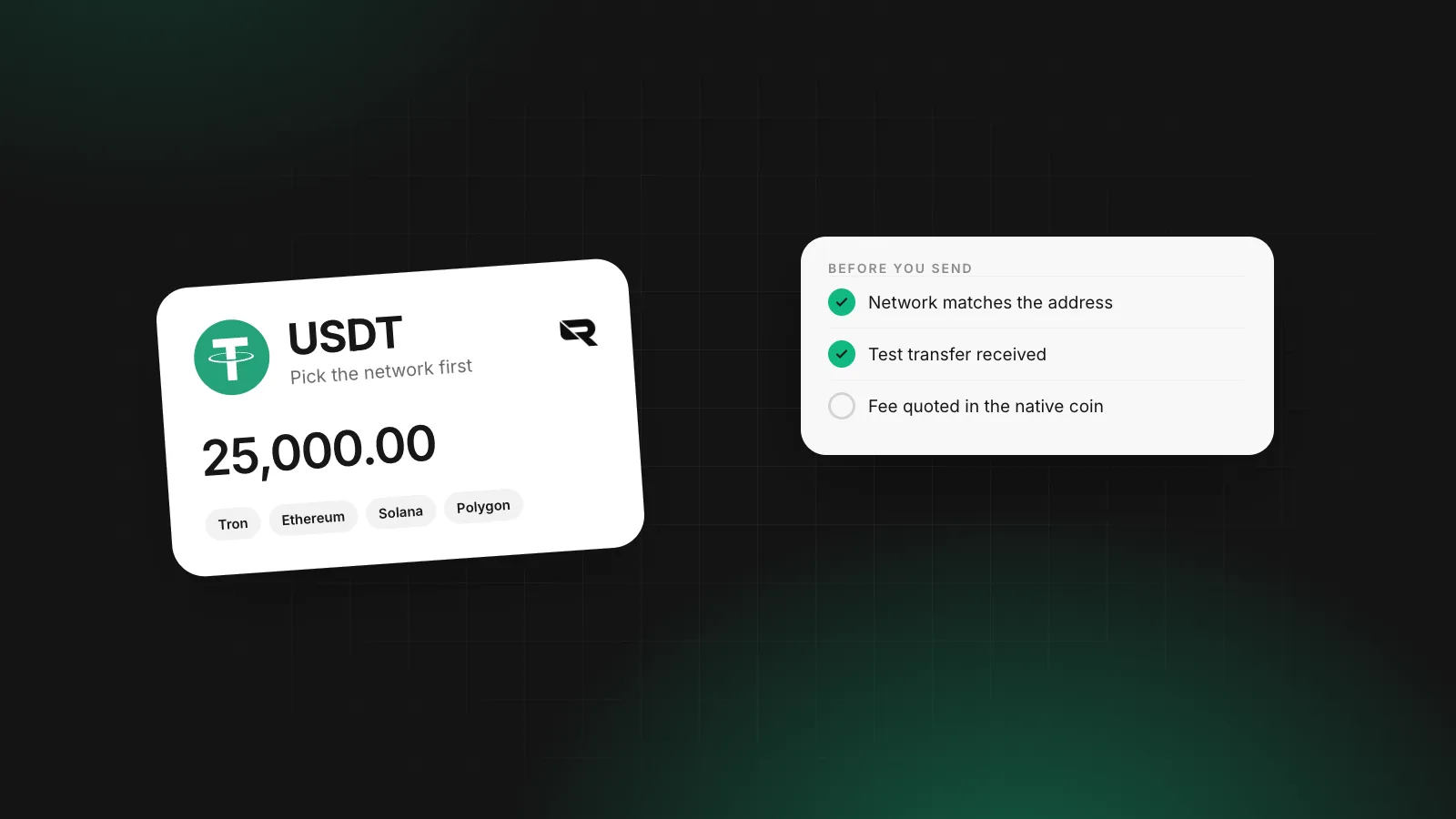
- Send a small test amount to every new address.
- Prefer low-fee networks for small and frequent payments; consider Ethereum for large, infrequent ones.
The USDC vs USDT guide compares the issuers, and USDT or USDC to a bank account covers converting back to dollars.
On Rivet
Rivet supports USDC and USDT on the networks listed in your account, shows the network next to every address, and quotes the fee before you send. See Ramps.
Questions people ask
What is the difference between USDT TRC20 and ERC20?
TRC20 is USDT on the Tron blockchain; ERC20 is USDT on Ethereum. They are the same stablecoin from the same issuer on two separate networks. Fees differ, and a transfer sent on one cannot arrive at an address expecting the other.
How much are USDT fees on Tron?
Tron charges network resources (energy and bandwidth), paid in TRX if the sender has not staked for them. The cost per transfer depends on network settings and whether the receiving address has held USDT before. Check a current Tron fee estimator before large volumes.
Is USDC on Polygon the same as USDC on Ethereum?
Circle issues native USDC on Polygon PoS, redeemable like USDC on Ethereum. An older bridged version, often labelled USDC.e, also exists on Polygon. Check which one your counterparty and provider support.
Which network should a business use?
The one both sides support, with a fee that fits the payment size. For small and frequent payments, a low-fee network such as Tron, Polygon or Solana. For large treasury moves, many businesses accept Ethereum's higher fees for its depth and support.
Sources
Rashidatou writes Rivet's guides to how money moves between countries: the payment rails, what each one costs, and the account details a company needs to get paid in another currency. Every figure in Rashidatou's articles is traced to the scheme rulebook, the regulator or the provider's published price list, and those sources are listed at the end.
More from Rashidatou K. →This article is general information, not legal, tax or financial advice. Rules and fees change; check the sources above and the provider’s current terms before you act on them.
- tron usdt fees
- usdc on polygon
- usdt trc20 vs erc20
- stablecoin network fees
- usdc on solana