USDC vs USDT for business: which stablecoin to hold, accept and pay with
Both are dollar stablecoins, and both settle in seconds. They differ in who issues them, how reserves are reported and where regulators accept them. For most companies the answer is to hold one and accept both.
- Published
- Reading time
- 4 min read
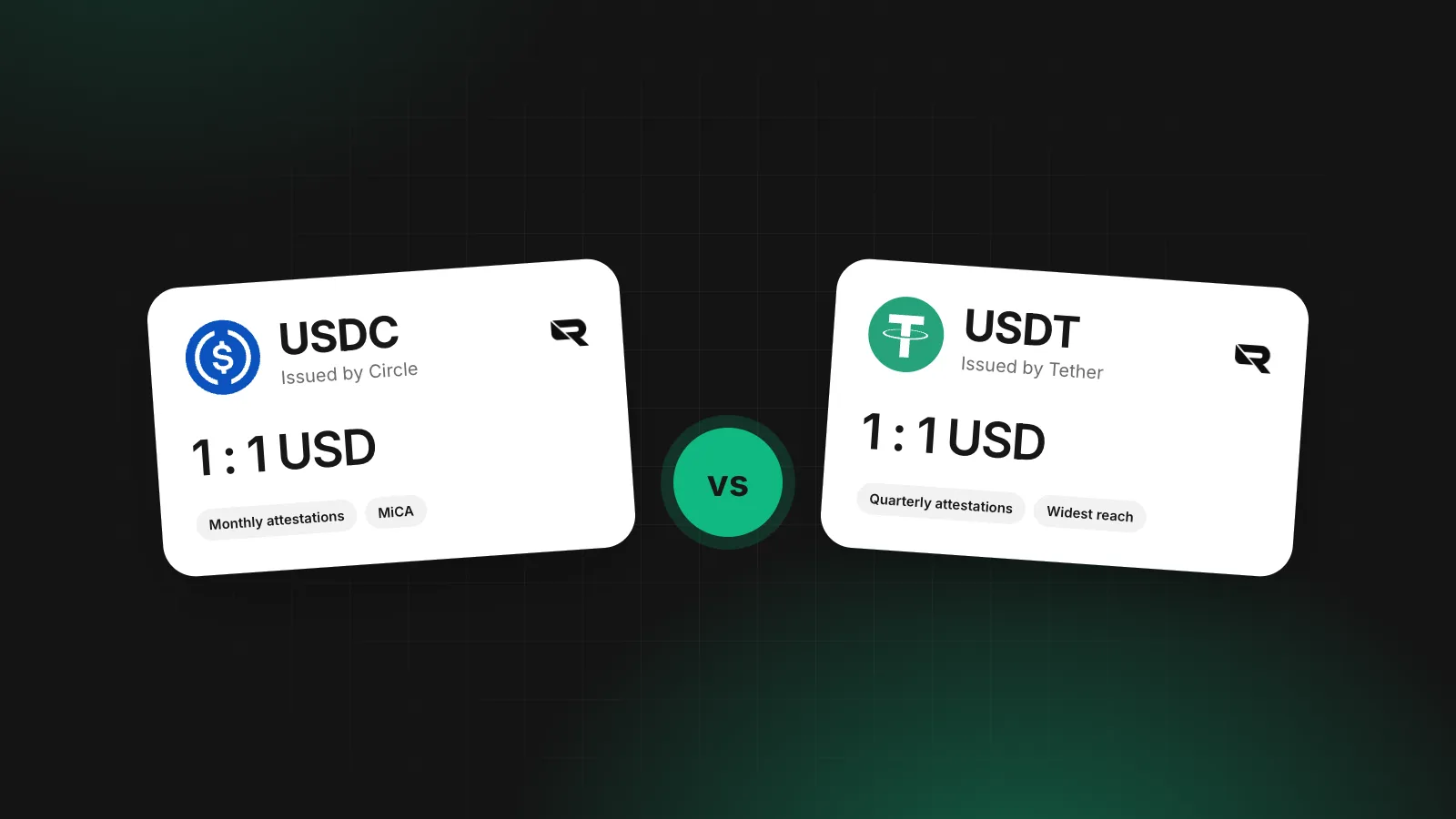
USDC and USDT are the two dollar stablecoins most businesses meet first. Both aim to be worth exactly one US dollar, both can be redeemed with their issuer by eligible customers, and both move in seconds on several blockchains, including weekends. Our introduction to stablecoin payments covers why companies use them.
This article answers a narrower question: when a company has a choice, which one should it hold, accept and pay with?
The differences at a glance
| USDC | USDT | |
|---|---|---|
| Issuer | Circle | Tether |
| Where reserves sit | Mostly the Circle Reserve Fund, an SEC-registered government money market fund; the rest as cash at large banks | Tether's reserves, reported in its regular reserve reports |
| Reporting | Monthly attestations by a Big Four accounting firm | Regular reserve reports published on Tether's transparency page |
| EU (MiCA) | Issued under a French e-money licence; MiCA-compliant since July 2024 | Not issued by a MiCA-authorised issuer; restricted on several EU exchanges |
| US (GENIUS Act) | Circle is a US issuer | USDT is issued outside the US; Tether's US-facing token is a separate one, USAT |
| Where it is most used | US and European businesses, regulated platforms | Exchanges and peer-to-peer markets, especially in emerging markets |
Reserves and reporting
A stablecoin is only as sound as what stands behind it, and both issuers publish information about their reserves.
Circle says most USDC reserves are held in the Circle Reserve Fund, an SEC-registered 2a-7 government money market fund managed by BlackRock, with the remainder in cash at large banks. A Big Four accounting firm provides monthly third-party assurance that reserves exceed the USDC in circulation.
Tether states that USDT is backed by Tether's reserves and that its assets exceed its liabilities, with reserve reports published on its transparency page. Its reserves have historically included assets beyond cash and short-dated Treasuries.
For a finance team, the question is what your auditor, your bank and your board will accept as a treasury asset. That usually points to the coin with the simpler reserve composition and the more frequent reporting.
Regulation in the US and the EU
In the US, the GENIUS Act, signed in July 2025, created the first federal framework for payment stablecoin issuers. It requires one-to-one reserves in cash, deposits and short-dated Treasuries, monthly reserve disclosures, and a ban on paying holders interest. Circle is a US company. Tether's main token is issued outside the US. In January 2026 Tether launched USAT, a separate token issued by Anchorage Digital Bank for the US market. USAT has its own reserves and is not interchangeable with USDT on a ledger.
In the EU, under MiCA, crypto-asset service providers may only offer stablecoins from authorised issuers. Circle became the first global stablecoin issuer to comply in July 2024, through an electronic money institution licence from France's ACPR, covering both USDC and EURC. Several large exchanges restricted USDT for users in the European Economic Area.
If your counterparties are EU-regulated firms, USDC is usually the coin they can handle.
Liquidity and reach
USDT is the larger coin by circulation and dominates exchange volume and peer-to-peer trade in many emerging markets. If you pay suppliers or contractors in parts of Latin America, Africa or Asia who already hold stablecoins, there is a good chance they hold USDT and would rather be paid in it.
That is the reason to accept USDT even if you would not hold it. Your counterparty's preference often decides the coin.
Networks
Both coins live on several blockchains. The network decides the transaction fee and the speed. It does not change the value of the coin. Three habits prevent most mistakes.
Agree the network before the address. The same address format can exist on several networks.
Send a small test payment to any new address and wait for confirmation.
Keep a fee balance if your wallet needs the network's native token to pay fees.
A simple policy for most companies
Hold USDC if you hold stablecoins at all, for its reserve composition, reporting and regulatory standing in the US and the EU.
Accept both. Let clients and partners pay in the coin they have.
Pay in the coin the recipient asks for, on the network they name.
Convert to fiat, or to your treasury coin, on arrival when you do not need the stablecoin balance. Check the rate before you confirm.
Write down which coins you use, which networks, who can approve a transfer, and at what amount.
How Rivet handles this
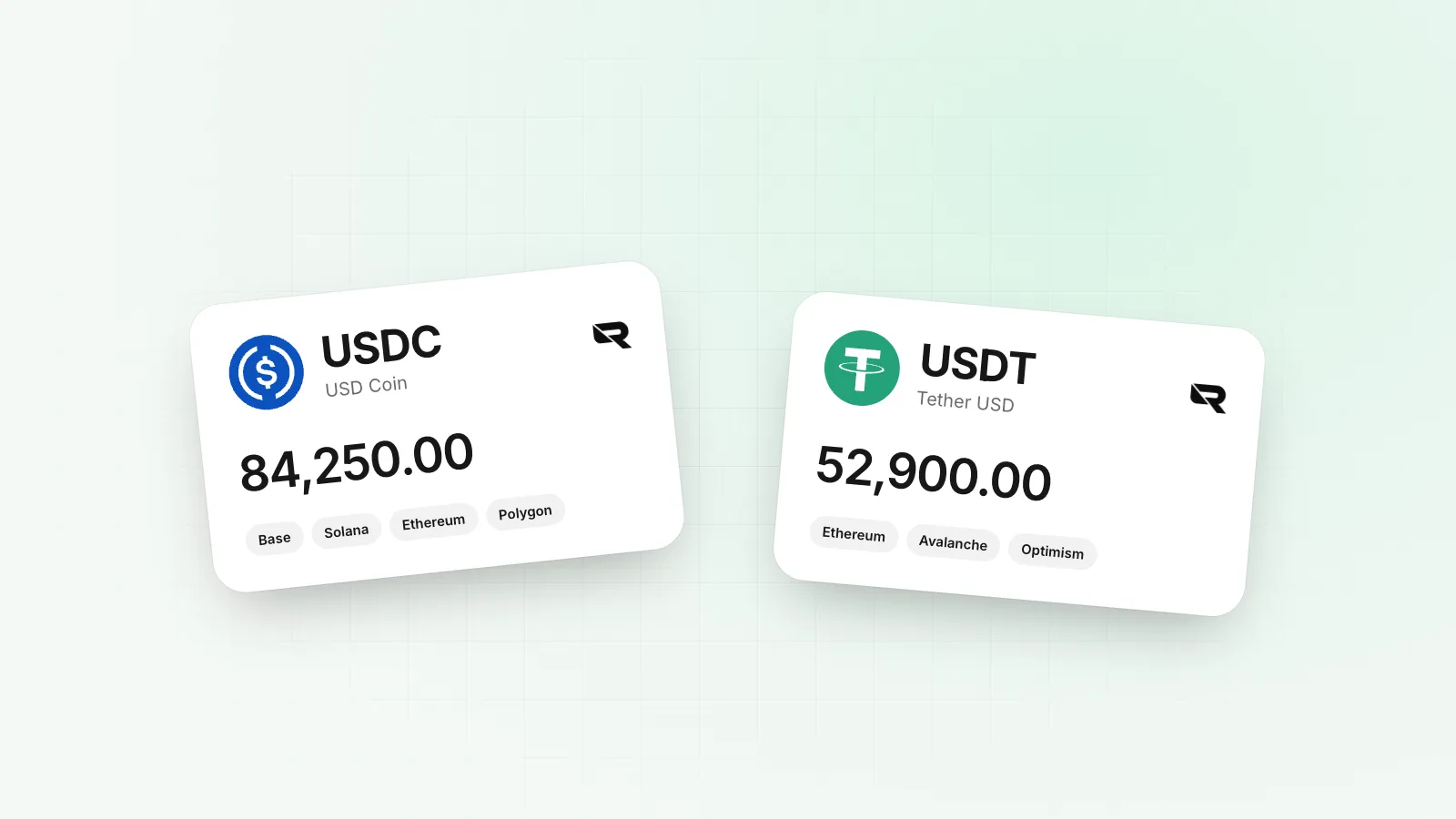
Rivet's ramps let your company deposit, withdraw and convert both USDC and USDT on Ethereum, Base, Solana, Polygon, Optimism and Avalanche, alongside its USD, EUR and GBP accounts. Accept the coin your counterparty uses, convert it to dollars with the rate and fee on screen before you confirm, and pay contractors in either through bulk payouts. On-chain transfers carry the network fee on top. Plans and fees are on pricing.
Questions people ask
Is USDC safer than USDT?
They carry different risks. USDC's reserves are mostly in a registered government money market fund with monthly attestations, and Circle is regulated in the US and under MiCA in the EU. Tether publishes regular reserve reports, but its reserves have historically included assets beyond cash and Treasuries. Neither is a bank deposit. Decide based on what your auditors, banks and counterparties require.
Can a business accept USDT and hold USDC?
Yes, and many do. Accept USDT from a counterparty that prefers it, then convert to USDC or to fiat on arrival. The conversion has a cost, so compare it with the cost of holding USDT for the time you need it.
Which network should I use for USDC or USDT?
The one your counterparty supports, with low fees for your payment size. Both coins exist on several networks, and a coin sent on the wrong network can be hard or impossible to recover. Always confirm the network and send a small test payment to a new address.
Is USDT legal in the EU?
Holding it is not banned, but under MiCA, crypto-asset service providers in the EU may only offer stablecoins issued by authorised issuers. Several large exchanges restricted USDT for EU users as a result. Check the rules that apply to your counterparties and your provider.
Sources
- 01Circle: USDC transparency and reserves
- 02Circle: First global stablecoin issuer to comply with MiCA (July 2024)
- 03Tether: Transparency
- 04Congress.gov: S.1582, GENIUS Act (Public Law 119-27)
- 05Regulation (EU) 2023/1114 on markets in crypto-assets (MiCA), EUR-Lex
- 06Decrypt: Tether launches US-regulated USAT stablecoin issued by Anchorage Digital
Rashidatou writes Rivet's guides to how money moves between countries: the payment rails, what each one costs, and the account details a company needs to get paid in another currency. Every figure in Rashidatou's articles is traced to the scheme rulebook, the regulator or the provider's published price list, and those sources are listed at the end.
More from Rashidatou K. →This article is general information, not legal, tax or financial advice. Rules and fees change; check the sources above and the provider’s current terms before you act on them.
- usdc vs usdt
- stablecoins
- usdc
- usdt
- genius act
- mica
- treasury