Why is my Stripe payout delayed or on hold?
A Stripe payout is usually held for one of five reasons: a new account's first payout schedule, an account review, a reserve, missing verification details, or a negative balance from refunds and disputes. Each has a different fix, and most are faster if you answer quickly.
- Published
- Reading time
- 2 min read
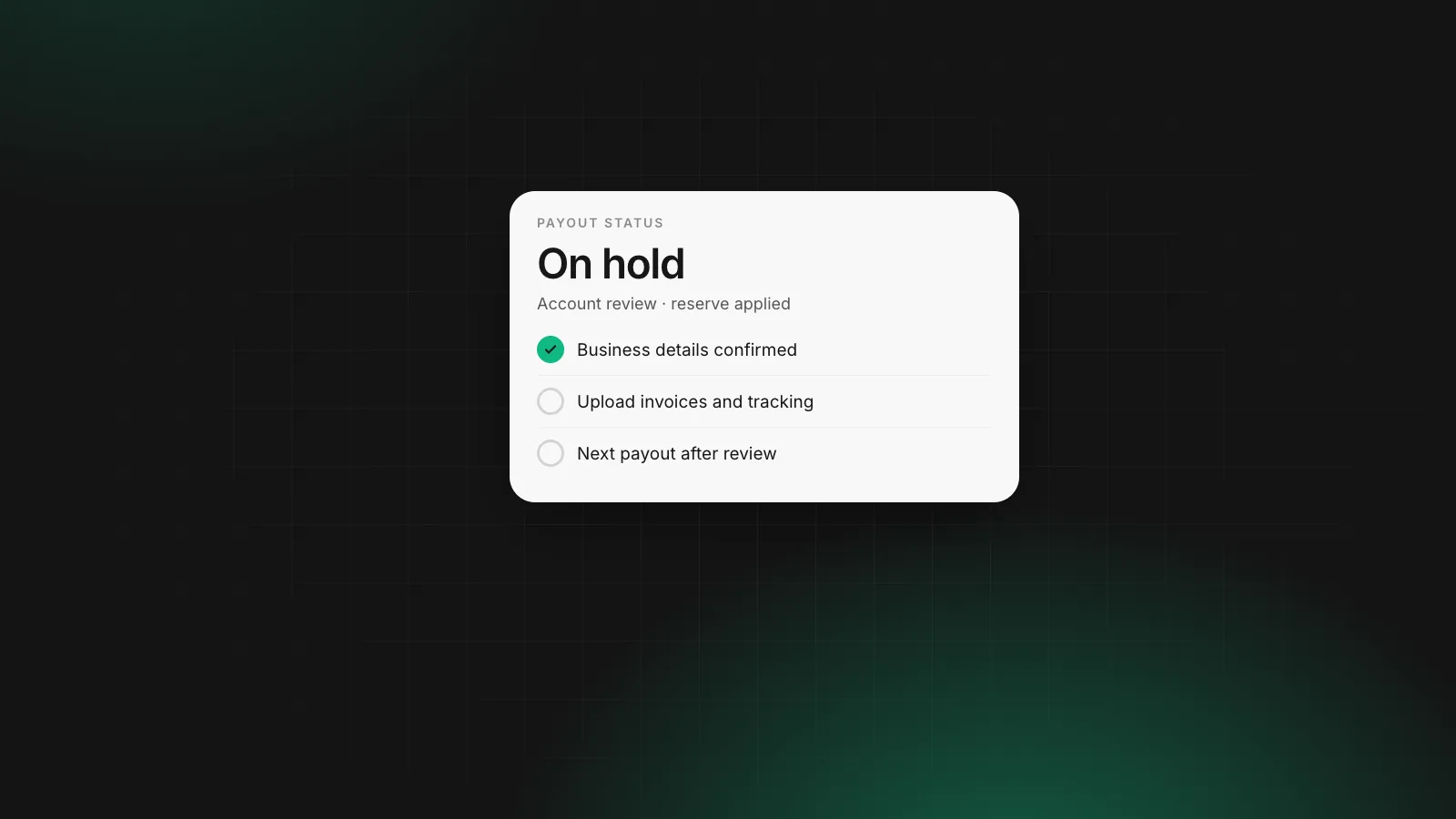
Few things worry an online business more than a payout that does not arrive. With Stripe, a delay usually has a cause you can find in the dashboard, and a fix that depends on which cause it is.
Why is my first Stripe payout slow?
New accounts start on a longer schedule. The first payout usually lands 7 to 14 days after the first successful payment, depending on your country and industry. After that, payouts move to your standard schedule, often two business days in the US. This is normal, and nothing you send will change it.
What triggers a Stripe account review?
Stripe monitors risk continuously. A review usually follows something that changes the risk picture:
- A sudden jump in volume or average payment size.
- A rise in refunds or disputes.
- Selling something different from what you described at sign-up.
- Customer complaints, or payments that look like card testing.
- Business details that do not match public records.
During a review, Stripe may pause payouts while it looks at your account, and ask for information in the dashboard.
What is a reserve?
A reserve holds part of your balance so Stripe can cover future refunds and chargebacks. There are three common types:
| Type | How it works |
|---|---|
| Rolling reserve | A percentage of each payment is held for a set number of days, then released |
| Fixed reserve | A set amount is held until Stripe removes the reserve |
| Minimum reserve | Your balance cannot drop below a set amount |
Reserves are common for businesses that take payment long before delivery: pre-orders, travel, events, annual subscriptions.
Could missing verification be the reason?
Yes. Stripe has to verify businesses and their owners under financial regulation. If a document expires, an owner changes, or the details do not match, payouts can stop until you update them. Check the dashboard for a banner asking for information.
What about disputes and negative balances?
Each dispute pulls the disputed amount plus a fee from your balance. If refunds and disputes exceed incoming payments, your balance goes negative and Stripe may debit your bank account or hold future payouts until it recovers. High dispute rates also put you at risk with the card networks' monitoring programmes. See chargebacks for international sellers.
What should you send Stripe during a review?
- Supplier invoices that show you have the stock or the service.
- Proof of fulfilment: tracking numbers, delivery confirmations or service logs.
- Your refund and cancellation policy, as published on your site.
- An explanation of any change in volume, such as a launch or a large order.
- Customer communications for any disputed payments.
Answer completely, the first time. Partial answers lead to more questions.
How do you avoid the next hold?
Tell Stripe before a planned spike. Keep your business description and website current. Publish clear policies. Use a recognisable statement descriptor so customers do not dispute payments they do not recognise. And keep a cash buffer outside Stripe, so a pause does not stop you paying suppliers.
Where your Stripe payouts land
Stripe pays out to a bank account in the business's name. Many companies outside the US connect USD account details in their own name, so US-dollar Stripe balances pay out in dollars instead of being converted. Our guide to using a business account alongside Stripe or Shopify Payments covers the setup.
Questions people ask
How long does Stripe hold payouts?
It depends on the reason. First payouts on new accounts usually arrive 7 to 14 days after the first payment. A review can take days. A rolling reserve may hold a share of each payment for 30 to 120 days, depending on the risk Stripe sees.
Why did Stripe put a reserve on my account?
Stripe applies reserves when it sees a higher chance of refunds or chargebacks it might have to cover. Common reasons are pre-orders, long delivery times, rising disputes or a sudden jump in volume.
Can I speed up a Stripe review?
Answer every request in the dashboard promptly and completely. Typical evidence includes invoices from suppliers, proof of delivery, your refund policy and a description of how you fulfil orders.
Should I have a business bank account for Stripe payouts?
Stripe pays out to an account in the business's name or, for sole proprietors, the owner's. A business account in the same legal name as the Stripe account avoids verification mismatches.
Sources
William covers what happens once a company starts moving money: getting the business verified, paying contractors and suppliers abroad, and keeping card spend under control. William writes for the founder or finance lead who has to make it work this week, and links every rule cited to the text it comes from.
More from William Sunjo M. →This article is general information, not legal, tax or financial advice. Rules and fees change; check the sources above and the provider’s current terms before you act on them.
- stripe payout delayed
- stripe hold
- stripe reserve
- payout schedule
- chargebacks
- online payments