Postponed VAT accounting: how UK importers avoid paying VAT upfront
Before 2021, UK importers paid import VAT at the border and reclaimed it weeks later. With postponed VAT accounting, a VAT-registered business declares the import VAT on its VAT return and reclaims it on the same return, so no cash leaves the business.
- Published
- Reading time
- 2 min read
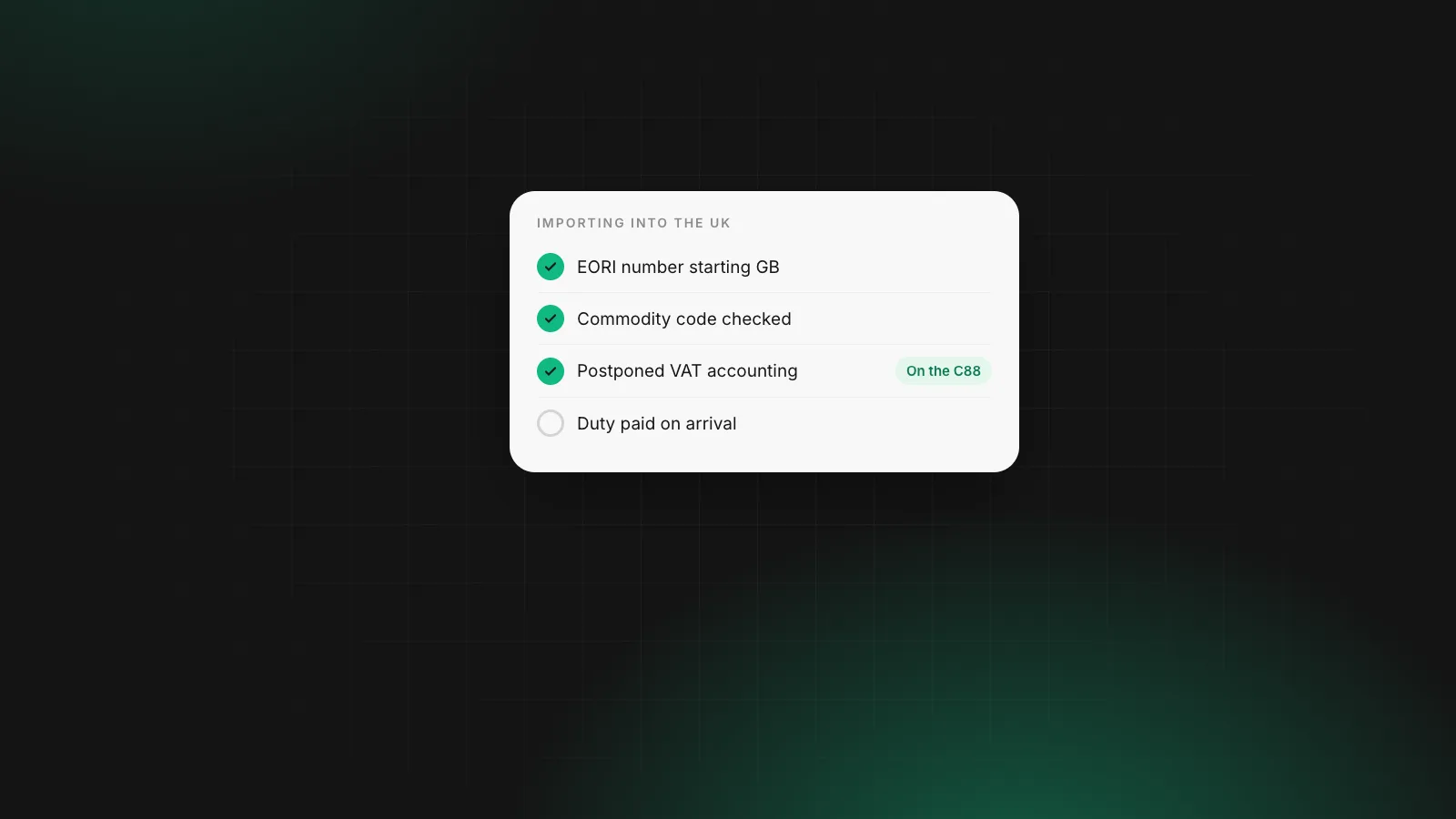
Import VAT is charged on most goods coming into the UK, normally at 20% of the customs value plus duty. For a business importing £50,000 of stock a month, paying that at the border and waiting for the next VAT return to reclaim it ties up thousands of pounds. Postponed VAT accounting (PVA) removes that gap.
What is postponed VAT accounting?
PVA lets a VAT-registered business account for import VAT on its VAT return instead of paying it when the goods arrive. On the same return, it reclaims that VAT as input tax, subject to the normal rules. For a fully taxable business, the two entries cancel out and no cash changes hands. It has been available since 1 January 2021 for imports from anywhere, including the EU.
How do you use it?
- Get a GB EORI number linked to your VAT registration. See what an EORI number is.
- Tell your customs broker, freight forwarder or courier that you want to use PVA.
- They enter your EORI and VAT number on the import declaration with the PVA indicator.
- Each month, download your postponed import VAT statement from the Customs Declaration Service.
- Enter the figures on your VAT return.
Which VAT return boxes do you fill?
| Box | What goes in |
|---|---|
| Box 1 | The import VAT from your monthly statement, as VAT due |
| Box 4 | The same import VAT, as VAT reclaimed (if you can reclaim it in full) |
| Box 7 | The value of the imported goods, excluding VAT |
If you cannot reclaim all of it, for example because part of your business makes exempt supplies, reclaim only the share you are entitled to.
What evidence do you need?
The monthly postponed import VAT statement is your evidence for reclaiming the VAT. Statements stay available for six months, so download each one and keep it with your VAT records. Where you have not yet received the statement by the time you file, HMRC allows an estimate that you adjust on the next return.
What does PVA not cover?
PVA covers import VAT only. Customs duty, excise duty and any other charges are still paid when the goods are released, either by you or by your broker, who will invoice you. If your supplier ships DDP (delivered duty paid), the supplier is the importer and handles both. See our Incoterms guide.
Common mistakes
- Not telling the courier. Many express couriers pay the VAT by default and add a fee. Ask for PVA in writing and check the first invoice.
- Forgetting the statement. HMRC does not send it; it sits in the Customs Declaration Service.
- Double counting. If the courier paid the import VAT and you used a C79 certificate, do not also enter it from a PVA statement.
How this fits with paying suppliers
PVA fixes the VAT side of the cash flow. The supplier payment is the other side. Goods from China, the US and the EU are usually priced in CNY, USD or EUR, and converting from GBP at your bank's rate on each invoice adds a hidden cost. A business account that holds USD and EUR beside GBP lets you pay in the supplier's currency. Our guide to paying EU suppliers from the UK covers the euro side.
Questions people ask
Is postponed VAT accounting mandatory?
No. It is optional for VAT-registered businesses. Most choose it because it removes a cash outflow at the border.
Can I use postponed VAT accounting if I am not VAT registered?
No. You need a VAT registration number and an EORI number linked to it. Businesses that are not registered pay import VAT on arrival, usually through their courier.
Where do I find my postponed import VAT statement?
On the Customs Declaration Service, through your Government Gateway account. Statements are produced monthly and available for six months, so download each one.
Does PVA work for parcels sent by courier?
Yes, for VAT-registered businesses. Give the courier your EORI and VAT number and ask them to use postponed VAT accounting on the declaration. Some couriers default to paying the VAT and billing you unless told otherwise.
Sources
William covers what happens once a company starts moving money: getting the business verified, paying contractors and suppliers abroad, and keeping card spend under control. William writes for the founder or finance lead who has to make it work this week, and links every rule cited to the text it comes from.
More from William Sunjo M. →This article is general information, not legal, tax or financial advice. Rules and fees change; check the sources above and the provider’s current terms before you act on them.
- postponed vat accounting
- import vat
- pva
- uk imports
- vat return
- uk