What is an EORI number, and how do you get one in the UK?
An EORI number identifies your business to customs. In Great Britain it starts with GB, and you need one before you import goods into or export goods out of the UK. Applying is free on GOV.UK and usually takes minutes to a few days.
- Published
- Updated
- Reading time
- 2 min read
If your business brings goods into the UK or sends them out, the first thing a courier or freight forwarder asks for is your EORI number. Without one, they cannot file the customs declaration, and your goods wait at the border.
What is an EORI number?
EORI stands for Economic Operator Registration and Identification. It is a reference that customs authorities use to identify a business on declarations. In Great Britain the number starts with GB, followed by 12 digits. If your business is VAT registered, HMRC usually builds it from your VAT number with 000 on the end, so VAT number 123456789 becomes GB123456789000.
Who needs one?
You need a GB EORI if your business:
- Imports goods into Great Britain from anywhere outside it, including the EU.
- Exports goods from Great Britain.
- Moves goods between Great Britain and the Channel Islands.
You need an XI EORI as well if you move goods into or out of Northern Ireland, make declarations there, or claim relief under the Windsor Framework.
You do not need one for services, or for goods you buy from a UK supplier who imported them.
How do you apply?
- Go to the Get an EORI number page on GOV.UK.
- Sign in with your Government Gateway details for the business.
- Enter your company registration number, VAT number if you have one, the business address and the date you started trading.
- Submit. HMRC often issues the number at once and emails confirmation.
It is free. Some websites charge for "EORI registration", which is filling in the same form for you.
What else do you need before the first import?
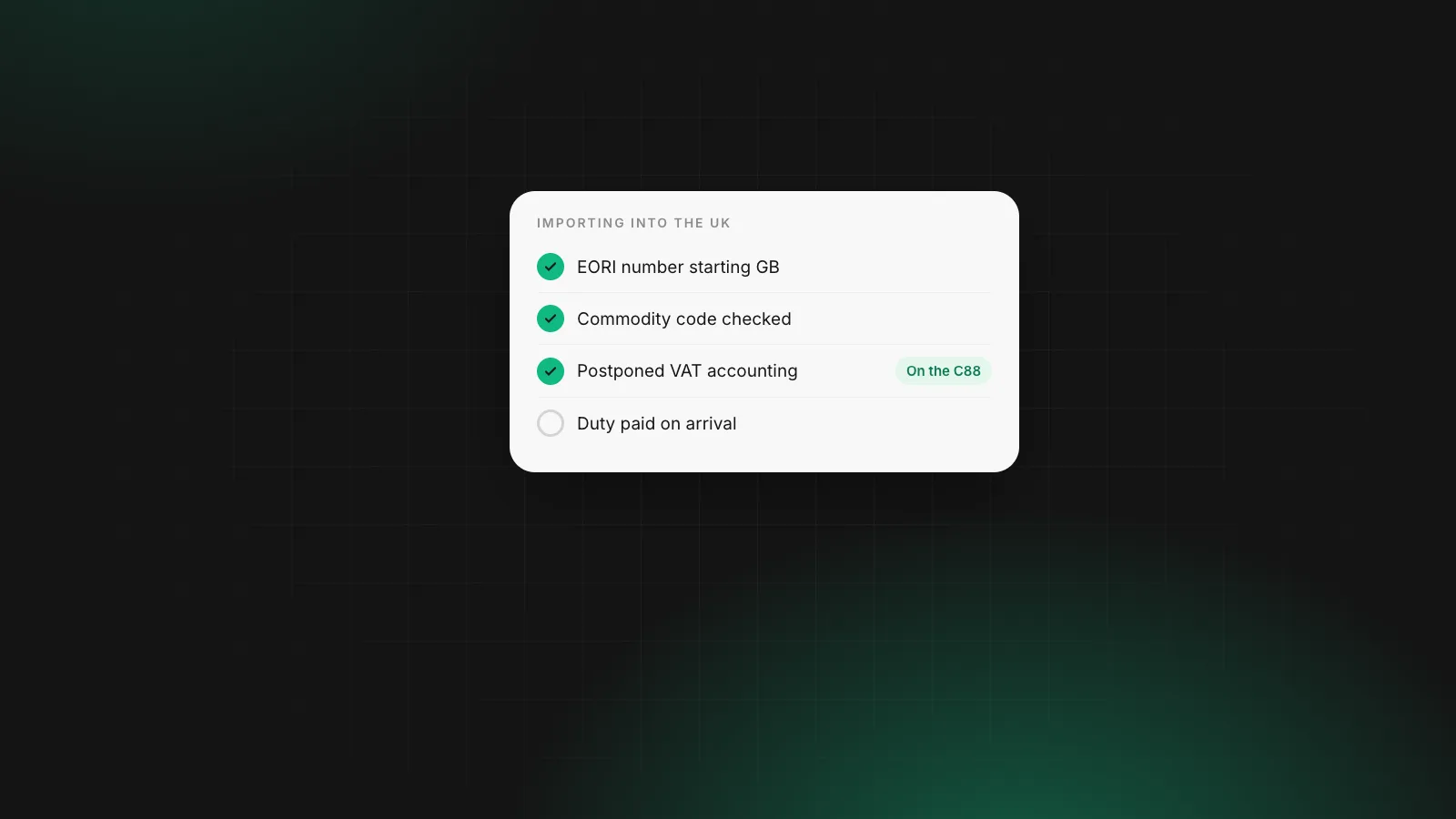
The EORI number is the start. For a first import, you will also need:
| Item | Why |
|---|---|
| Commodity code for each product | Sets the duty rate and any controls; look it up on the UK Trade Tariff |
| Customs value | Usually the price paid plus shipping and insurance to the UK border |
| Proof of origin | Can reduce duty under a trade agreement |
| A way to pay import VAT | Usually postponed VAT accounting if you are VAT registered |
| A customs broker or courier | Most businesses do not file their own declarations |
Our guide to postponed VAT accounting explains how VAT-registered importers avoid paying import VAT upfront.
How do Incoterms change who needs the EORI?
The importer of record is the party responsible for the import declaration. Under most Incoterms, that is the buyer. Under DDP (delivered duty paid), the seller takes it on, and needs a GB EORI itself, even if it is based abroad. If a supplier offers DDP to the UK, ask whose EORI goes on the declaration. See Incoterms explained for each term.
Paying for imported goods
Goods from China, the US or the EU are usually invoiced in CNY, USD or EUR. If you pay those invoices from GBP, every payment includes a conversion. Holding a USD or EUR balance lets you pay suppliers in their currency and convert when it suits you. Rivet's business accounts hold GBP, USD and EUR for registered companies and pay suppliers in 120+ countries.
Questions people ask
Do I need an EORI number to import from China to the UK?
Yes, if your business is the importer of record. Your courier or freight forwarder will need it to file the customs declaration, and goods can be held until you provide it.
How long does it take to get an EORI number?
HMRC often issues the number straight away online. If it needs to check your details, it can take up to a week.
Does a sole trader need an EORI number?
If the sole trader imports or exports goods commercially, yes. The EORI is for whoever makes the customs declaration or is named on it, regardless of business structure.
Can I use an EU EORI number in the UK?
Not for GB customs declarations. Since 1 January 2021, you need a GB EORI to trade with Great Britain, and an EU EORI to trade with the EU.
Sources
William covers what happens once a company starts moving money: getting the business verified, paying contractors and suppliers abroad, and keeping card spend under control. William writes for the founder or finance lead who has to make it work this week, and links every rule cited to the text it comes from.
More from William Sunjo M. →This article is general information, not legal, tax or financial advice. Rules and fees change; check the sources above and the provider’s current terms before you act on them.
- eori number
- importing to uk
- customs
- hmrc
- export
- uk