UK VAT registration threshold: when you must register, and when you can wait
The UK VAT registration threshold has been £90,000 since 1 April 2024. The test is a rolling 12-month total checked every month end, plus a forward look at the next 30 days. Overseas businesses selling in the UK have no threshold at all.
- Published
- Reading time
- 3 min read
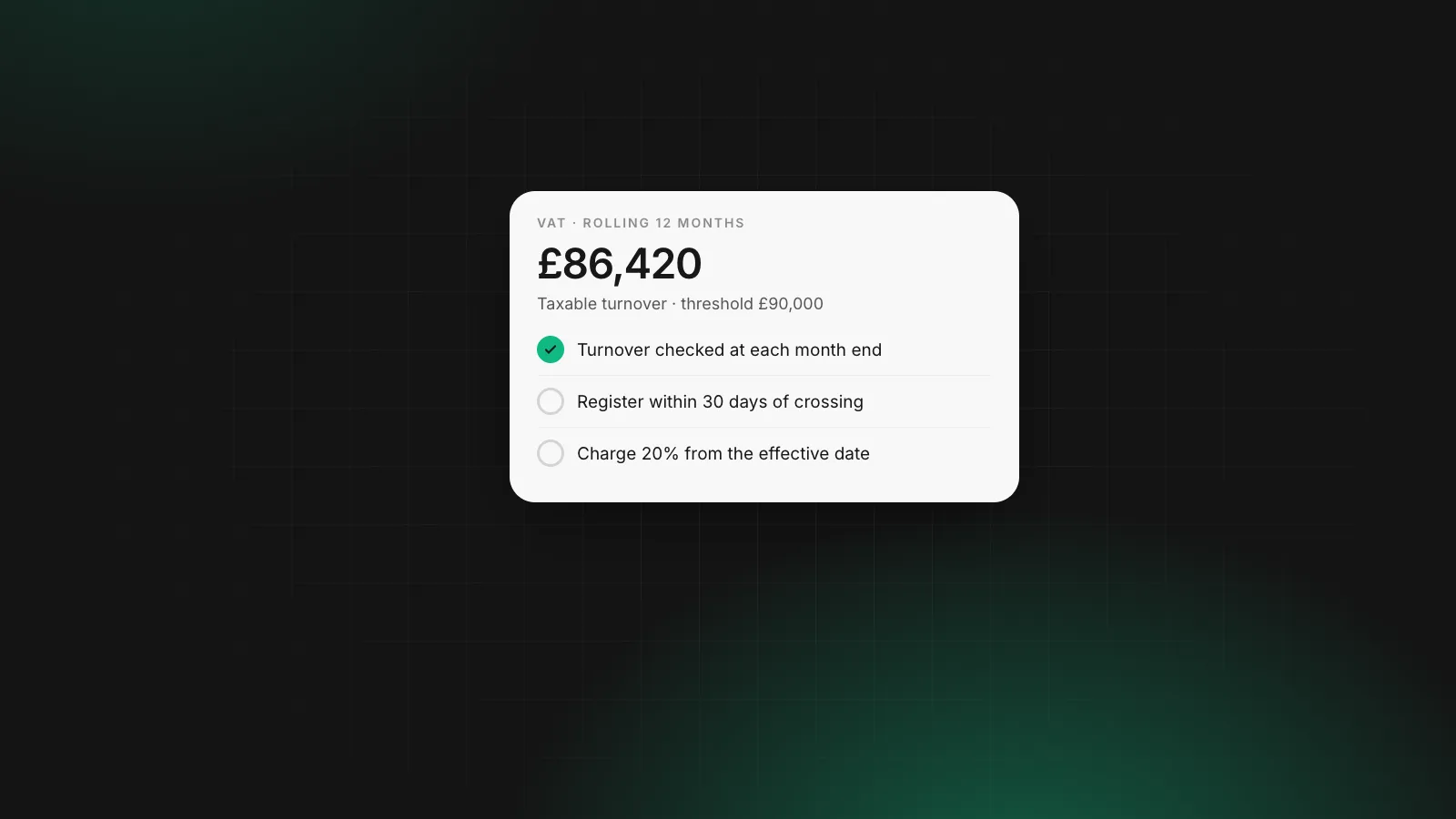
The UK VAT registration threshold is £90,000. Once your taxable turnover goes over it, you have 30 days to register, and from your registration date you charge VAT on taxable sales and send HMRC VAT returns. What trips people up is how the £90,000 is measured.
How is the £90,000 measured?
The threshold applies to taxable turnover over any rolling 12-month period, checked at the end of every month. It is not your annual turnover in your accounts, and it is not your tax year. At the end of each month, add up the taxable sales for that month and the 11 before it. If the total is over £90,000, you must register.
Taxable turnover means sales that would be standard rated (20%), reduced rated (5%) or zero rated (0%) if you were registered. Zero-rated sales count towards the threshold even though no VAT would be charged on them. Exempt sales and sales outside the scope of UK VAT do not count.
What are the two 30-day rules?
There are two tests, and either one can make you register.
| Test | When it applies | Register by | Registration date |
|---|---|---|---|
| Backward look | The last 12 months went over £90,000 | 30 days after the end of that month | First day of the second month after you went over |
| Forward look | You expect the next 30 days alone to go over £90,000 | By the end of those 30 days | The start of the 30 days |
The forward look catches the business that lands one large contract. A firm with £20,000 of sales over the year that signs a £100,000 order to be invoiced this month registers now, not after the order shows up in the rolling total.
Do overseas businesses get the £90,000 threshold?
No. A business with no establishment in the UK, which HMRC calls a non-established taxable person (NETP), must register from its first taxable supply in the UK. This catches overseas companies that hold stock in UK warehouses, sell to UK consumers, or run events in the UK.
There is one big exception in practice. When an overseas business sells goods of £135 or less to UK consumers through an online marketplace, the marketplace usually accounts for the VAT. Check how your marketplace handles it before you register.
UK companies owned by non-residents are UK established and get the normal threshold. Our guide to setting up a UK Ltd as a non-resident covers the company side.
Should you register voluntarily below the threshold?
You can register at any turnover. Voluntary registration usually helps when:
- Your customers are VAT-registered businesses, so the 20% you add is reclaimed by them and costs them nothing.
- You buy a lot of VAT-able equipment or services and want to reclaim that VAT.
- You want to look established to larger clients.
It usually hurts when you sell to consumers, who cannot reclaim the VAT, so either your prices rise or your margin falls by a sixth.
What changes once you are registered?
You put your VAT number on invoices, charge the right rate, keep digital records, and file returns through software under Making Tax Digital for VAT. Most businesses file quarterly. Payment is due one calendar month and seven days after the end of each VAT period.
If you sell to EU customers as well, the EU side has its own rules. See our guide to EU VAT OSS for non-EU sellers.
Can you deregister later?
Yes, if your taxable turnover for the next 12 months is expected to be £88,000 or less. You can also deregister when you stop trading or stop making taxable supplies. VAT may be due on stock and assets you still hold at the date you deregister.
How a business account helps with VAT
VAT you charge is not your money. Many companies move the VAT part of each payment into a separate balance as it arrives, so the quarterly bill is already set aside. A business account that can hold separate balances makes that a habit, not a scramble at the deadline.
Questions people ask
What is the VAT threshold for 2026/27?
£90,000 of taxable turnover over a rolling 12-month period. It has been at that level since 1 April 2024. The deregistration threshold is £88,000.
Is the VAT threshold based on profit?
No. It is based on the total value of taxable sales, before costs. Exempt sales, such as most insurance and some financial services, do not count.
What happens if I register for VAT late?
HMRC backdates your registration to the date you should have registered. You owe VAT on sales from that date even if you did not charge it, and there can be a late registration penalty.
Should I register for VAT voluntarily?
It can make sense if your customers are VAT-registered businesses that reclaim the VAT, or if you have large VAT-able costs to reclaim. It rarely helps if you sell mostly to consumers, because your prices effectively rise by 20%.
Sources
William covers what happens once a company starts moving money: getting the business verified, paying contractors and suppliers abroad, and keeping card spend under control. William writes for the founder or finance lead who has to make it work this week, and links every rule cited to the text it comes from.
More from William Sunjo M. →This article is general information, not legal, tax or financial advice. Rules and fees change; check the sources above and the provider’s current terms before you act on them.
- vat threshold
- vat registration
- uk vat
- hmrc
- non-established taxable person
- uk