M-Pesa Paybill vs Till number: which one does your business need?
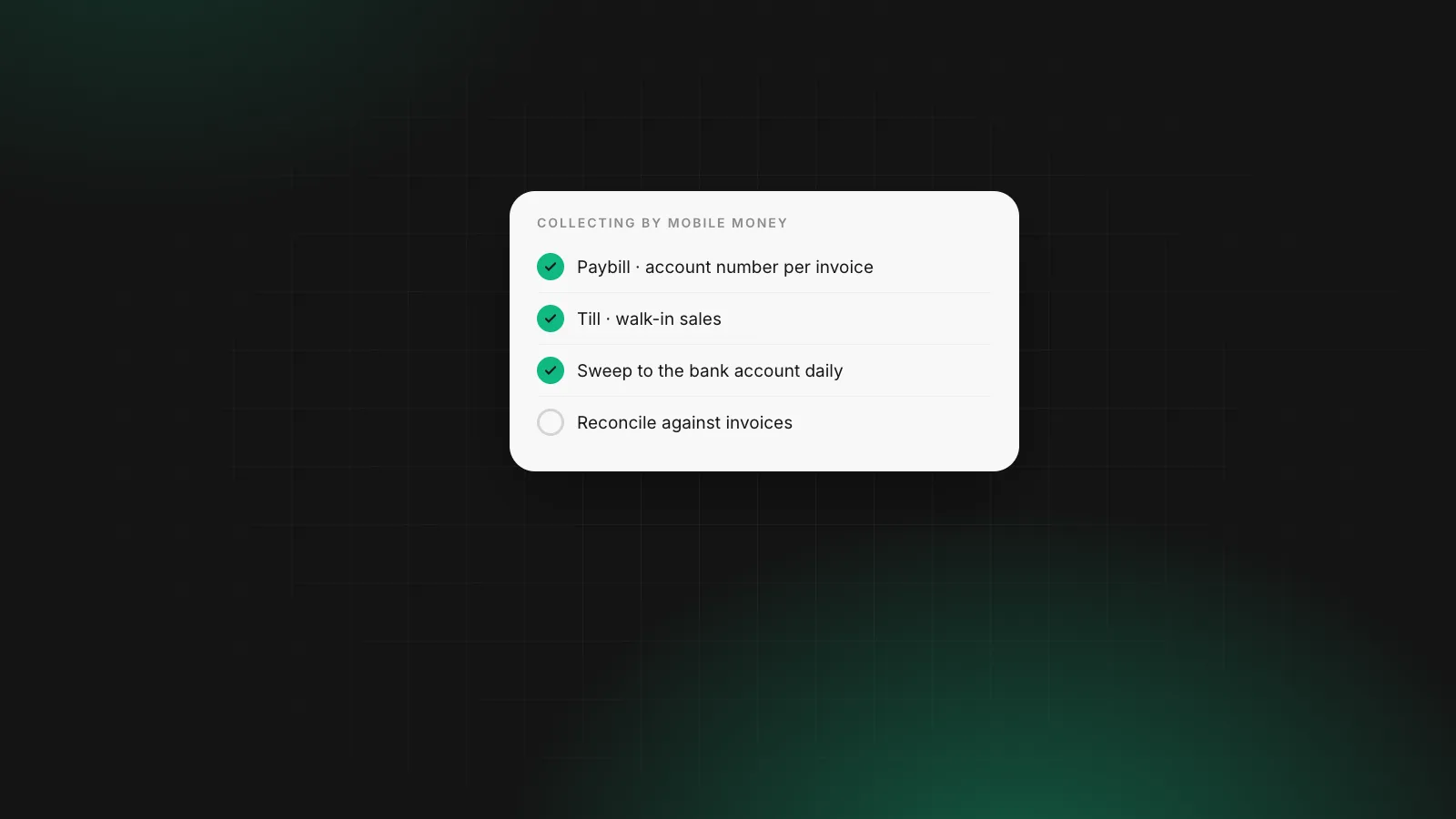
A Till number (Buy Goods) is for customers paying at the counter. A Paybill number is for payments against an account or invoice, where the customer enters an account number. Many Kenyan businesses use both: a Till for walk-in sales and a Paybill for clients paying invoices.
- Published
- Updated
- Reading time
- 2 min read
In Kenya, a business without an M-Pesa number turns away customers. Safaricom's Lipa na M-Pesa gives businesses two ways to collect: a Till number and a Paybill number. They look similar on a customer's phone, and they suit different kinds of sale.
What is the difference?
| Till number (Buy Goods and Services) | Paybill number | |
|---|---|---|
| Customer enters | Till number and amount | Business number, account number and amount |
| Suits | Shops, restaurants, walk-in services | Invoices, school fees, utilities, subscriptions, B2B clients |
| Matching payments | By time and amount | By account reference |
| Charges | Merchant pays, per Safaricom's Buy Goods tariff | Business or customer pays, depending on the tariff chosen |
| Settlement | To the business's bank account | To the business's bank account |
The Paybill's account number lets you tell, without guessing, which customer or invoice a payment belongs to.
When should you use a Till?
When customers pay at the moment of sale and there is no invoice to match: a shop, a café, a salon, a market stall. The customer enters the Till number and amount, and your staff see the confirmation SMS or the dashboard. It is quick at the counter, and customers usually pay no charge.
When should you use a Paybill?
When payments relate to an account or an invoice:
- Clients paying invoices, who enter the invoice number.
- Subscription or school-fee businesses, where the account number is the customer ID.
- Landlords collecting rent per unit.
- Any business that needs to reconcile payments to customers automatically.
Many businesses run both: a Till at the counter, a Paybill for account customers.
What does Safaricom ask for?
Requirements vary by product and change from time to time. Typically, a registered business provides its registration certificate, KRA PIN, the directors' or owner's IDs, a bank account in the business name for settlement, and sometimes a business permit. Check Safaricom's current list before applying.
How do you reconcile M-Pesa payments?
- Use invoice numbers as Paybill account references.
- Download statements from the M-Pesa business portal daily or weekly.
- Sweep collections to the bank on a schedule, so the bank statement shows one transfer per day.
- Match each payment to an invoice, then to the sweep.
KRA can see M-Pesa business data, and under eTIMS it validates declared income against electronic records. See eTIMS and expense deductions in Kenya.
What about clients outside Kenya?
Foreign clients do not pay by M-Pesa. They pay in USD, EUR or GBP by wire or local transfer. Our guide to KES business payments covers PesaLink and RTGS inside Kenya. A registered Kenyan company billing abroad can get USD account details in its own name from Rivet in the countries we support, and on Scale hold and convert KES in the same account.
Questions people ask
What is the difference between Paybill and Till?
A Till number takes a payment for goods or services with no account number. A Paybill number takes a payment against an account number the customer enters, such as an invoice or customer ID, which helps match payments to customers.
Can a sole proprietor get a Paybill number?
Safaricom offers Lipa na M-Pesa products to registered businesses and, for some products, to individuals running a business. Requirements differ by product; check Safaricom's current application requirements.
Who pays the transaction charges?
For Buy Goods (Till), the merchant usually pays a charge set in Safaricom's tariff. For Paybill, the business can choose a tariff where it bears the charge or one where the customer pays. Check the current tariff for your product.
How do I move money from M-Pesa to my bank?
Through the M-Pesa business portal or app, by setting up settlement to the business's bank account, either automatically or on request.
Sources
William covers what happens once a company starts moving money: getting the business verified, paying contractors and suppliers abroad, and keeping card spend under control. William writes for the founder or finance lead who has to make it work this week, and links every rule cited to the text it comes from.
More from William Sunjo M. →This article is general information, not legal, tax or financial advice. Rules and fees change; check the sources above and the provider’s current terms before you act on them.
- m-pesa paybill
- till number
- lipa na m-pesa
- kenya
- mobile money
- kes