SWIFT transfer fees, timing and tracking: what businesses actually pay
A SWIFT payment can cost three fees: one to send, one or more on the way, one to receive. Here is where each comes from and how to keep them down.
- Published
- Reading time
- 2 min read
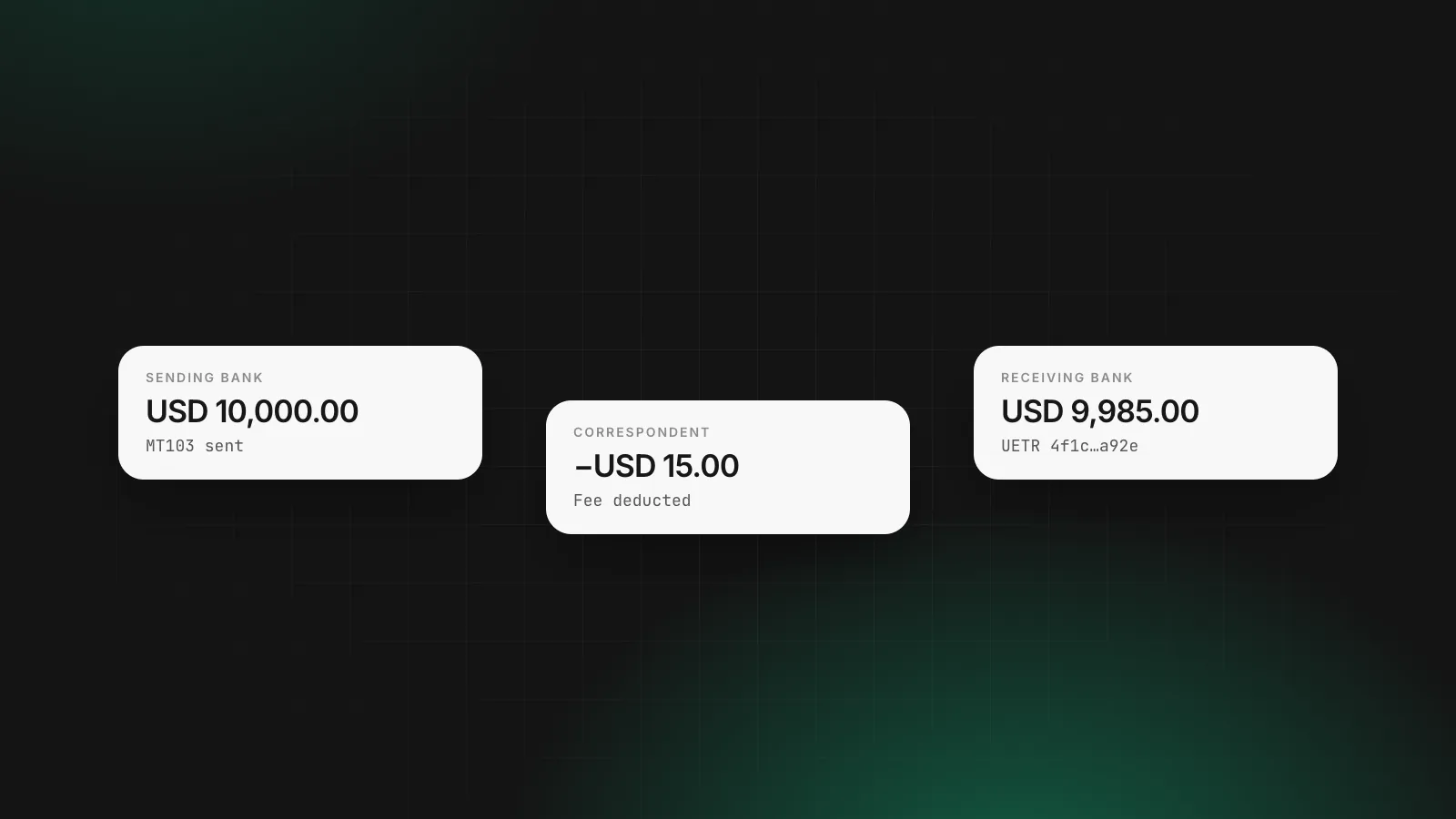
"Swift transfer fees" is one of the most searched payment questions, and the answers online rarely match what businesses see. The reason is that a SWIFT payment can carry up to three separate charges, from three different banks, and the sender picks who pays them.
Where SWIFT fees come from
- The sending bank charges to send the payment.
- One or more intermediary (correspondent) banks may deduct a fee as the payment passes through. This happens when the sending and receiving banks have no direct relationship in that currency.
- The receiving bank may charge to credit the account.
Published examples from providers' own pricing pages, read on 1 November 2026: Airwallex lists 15 to 25 USD per outgoing SWIFT transfer; Wise charges 6.11 USD to receive a USD wire or SWIFT payment. Traditional banks often charge more on both ends.
OUR, SHA and BEN: who pays
| Option | Sender pays | Receiver pays | What arrives |
|---|---|---|---|
| OUR | All fees, including intermediaries | Nothing (in principle) | The full amount |
| SHA | Sending bank's fee | Intermediary and receiving fees | The amount less deductions |
| BEN | Nothing | All fees | The amount less all fees |
SHA is the most common default. That is why an invoice for 5,000 USD often arrives as 4,975 USD. If you need the full amount, agree OUR with the client in your contract, or give them local details so the payment never crosses SWIFT.
How long does a SWIFT transfer take?
Swift says most payments on its gpi service reach the beneficiary's bank within an hour. That is the network part. The total time also includes the sending bank's processing, compliance checks on either side, and cut-off times in two time zones. In practice: same day to two business days on common routes, longer on less common ones or when a bank asks questions.
How to track a SWIFT transfer
Every gpi payment carries a UETR, a unique end-to-end transaction reference. When a payment is late:
- Ask the sender for the UETR, or for the MT103 confirmation, which includes it.
- Give it to your bank or provider. They can see where the payment is and which bank holds it.
- If an intermediary is holding it for a compliance check, the answer usually comes from that bank through the sender.
When to avoid SWIFT
SWIFT reaches almost every bank, which is its strength. Where a local rail is available, it is usually cheaper:
- USD from US clients: ACH or domestic wire to USD details.
- EUR from EU clients: SEPA to EUR details.
- GBP from UK clients: Faster Payments to GBP details.
- Paying a supplier: a local payout in their currency on their rail.
The rails comparison explains each, and stablecoin vs SWIFT covers routes where neither works well.
On Rivet
Rivet's payouts use the recipient's local rail in 120+ countries where available, so most never touch SWIFT. Where a wire is the only route, the fee is shown before you confirm. See Payouts.
Questions people ask
How much does a SWIFT transfer cost?
It depends on three parties. The sending bank charges a fee, intermediary banks can each deduct one, and the receiving bank may charge to credit the account. As published examples, Airwallex lists 15 to 25 USD to send a SWIFT transfer and Wise 6.11 USD to receive a USD wire.
How long does a SWIFT transfer take?
Swift reports that most payments on its gpi service reach the beneficiary's bank within an hour. The full time, including the receiving bank crediting the account, is often the same day to two business days, longer when compliance checks or cut-offs intervene.
What is the difference between a SWIFT transfer and a wire transfer?
A wire transfer is a bank-to-bank electronic payment. SWIFT is the messaging network banks use to send international wires. So an international wire is usually a SWIFT transfer. A domestic US wire goes through Fedwire, not SWIFT.
How do I track a SWIFT transfer?
Ask the sender for the UETR, the unique end-to-end transaction reference. Your bank or provider can use it to see where the payment is on the Swift gpi tracker. The MT103 confirmation the sending bank issues also shows the details.
Sources
Rashidatou writes Rivet's guides to how money moves between countries: the payment rails, what each one costs, and the account details a company needs to get paid in another currency. Every figure in Rashidatou's articles is traced to the scheme rulebook, the regulator or the provider's published price list, and those sources are listed at the end.
More from Rashidatou K. →This article is general information, not legal, tax or financial advice. Rules and fees change; check the sources above and the provider’s current terms before you act on them.
- swift transfer fees
- swift transfer time
- swift transfer tracking
- swift vs wire transfer
- uetr