Foreign exchange risk for small businesses: examples and simple ways to manage it
If you earn in one currency and spend in another, exchange rates move your profit without you doing anything. Here is how small businesses keep that under control.
- Published
- Reading time
- 2 min read
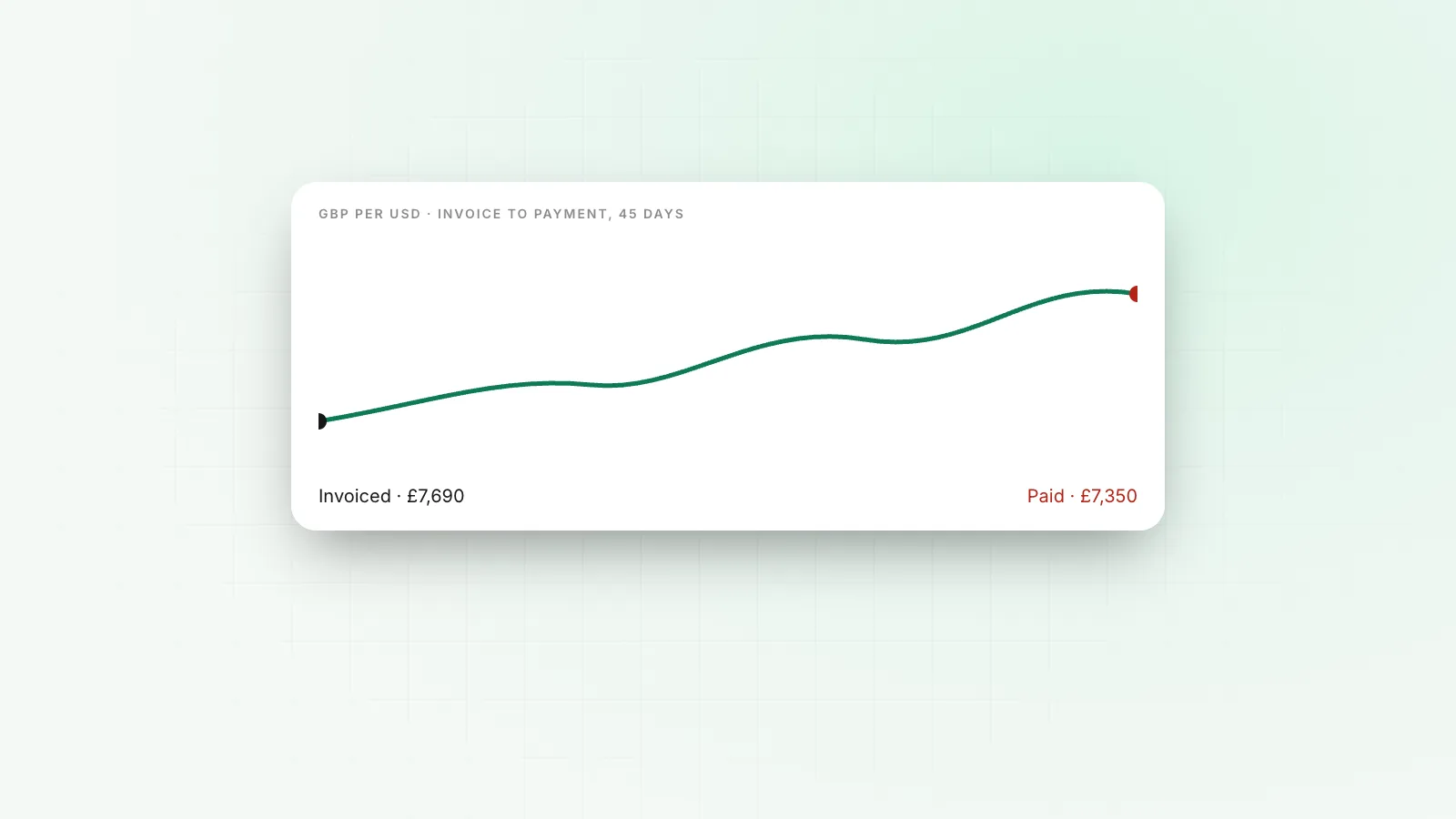
Any business that earns in one currency and spends in another carries foreign exchange risk, whether or not it thinks about it. Rates move every day. Over a quarter, a 5% move is common, and for a business on a 15% margin, that is a third of the profit.
What foreign exchange risk is
The chance that a change in exchange rates reduces your profit or the value of what you hold. It comes in three forms:
| Type | What it affects | Who it matters to |
|---|---|---|
| Transaction risk | Specific payments due in a foreign currency | Almost every exporter, importer and agency |
| Translation risk | How foreign balances and subsidiaries look in your accounts | Groups with entities abroad |
| Economic risk | Long-run competitiveness when rates shift | Businesses competing on price internationally |
Small businesses mostly deal with transaction risk.
Three examples
- An agency paid late. It invoices a US client in USD; the client pays in 45 days; meanwhile the local currency strengthens and the same dollars buy less.
- An importer paying a deposit and balance. It pays 30% of a supplier order now and 70% on shipment, in USD; its local currency weakens in between; the balance costs more than budgeted.
- A SaaS company billing in euros, paying staff in naira or pesos. Its revenue is stable in euros, but its local costs swing every month.
Ways to manage it
Match currencies
Pay costs in the currency you earn. An agency earning USD that pays software, ads and some contractors in USD only converts the remainder. This "natural hedge" costs nothing and removes much of the risk. The foreign currency accounts guide explains how.
Hold balances, convert on a schedule
Rather than converting everything on arrival, or waiting for a good rate, convert a fixed share every week or month. You will never hit the best rate, and never the worst.
Price for it
Invoice in your own currency where clients accept it, add a currency clause to long contracts, or include a margin for rate movement in quotes valid for a long time.
Forward contracts
A forward locks today's rate for a payment on a future date. It suits large, predictable payments, such as a supplier balance due in 90 days. It is a commitment: you must have the money on the date, and you give up gains if the rate moves your way.
Know your conversion cost too
Managing rate movements matters less if every conversion costs 3%. Measure your markup first with the mid-market rate guide.
On Rivet
Rivet lets a company hold USD, EUR and GBP side by side, pay suppliers and contractors from the matching balance, and convert when it chooses at a rate shown before confirming. See Bank accounts.
Questions people ask
What is foreign exchange risk, with an example?
A UK agency invoices a US client 10,000 USD when the rate is 1.30 USD per GBP, expecting about 7,690 GBP. When the client pays 45 days later, the rate is 1.36, so the same 10,000 USD converts to about 7,350 GBP. The agency lost 340 GBP to the rate alone.
What are the types of foreign exchange risk?
Transaction risk, on specific payments due in a foreign currency; translation risk, on how foreign assets and profits look in your reporting currency; and economic risk, on how long-run rate changes affect your competitiveness. Small businesses mostly face the first.
How do small businesses manage foreign exchange risk?
By matching currencies (paying costs in the currency they earn), holding foreign currency balances, converting on a schedule rather than all at once, invoicing in their own currency where clients accept it, and using forward contracts for large known payments.
Should a small business use forward contracts?
Only for predictable payments of meaningful size, such as a large supplier order due in three months. A forward removes the risk of the rate moving against you, and also the chance of it moving in your favour. It is a commitment, so you must have the money on the date.
Sources
Rashidatou writes Rivet's guides to how money moves between countries: the payment rails, what each one costs, and the account details a company needs to get paid in another currency. Every figure in Rashidatou's articles is traced to the scheme rulebook, the regulator or the provider's published price list, and those sources are listed at the end.
More from Rashidatou K. →This article is general information, not legal, tax or financial advice. Rules and fees change; check the sources above and the provider’s current terms before you act on them.
- foreign exchange risk
- foreign exchange risk example
- foreign exchange risk management
- fx risk
- currency risk