How to pay suppliers in China from abroad: methods, currency and safety checks
Most Chinese suppliers want a deposit up front and the balance before shipping, by bank transfer in USD. Here is how to pay safely and what each method costs.
- Published
- Reading time
- 2 min read
"How to pay vendors in china" and "how to pay china suppliers from nigeria" are searched by importers about to send their first deposit. The methods are simple. The risks are mostly about who you pay, not how.
The common payment terms
Most Chinese manufacturers use some version of:
| Term | How it works | Risk sits with |
|---|---|---|
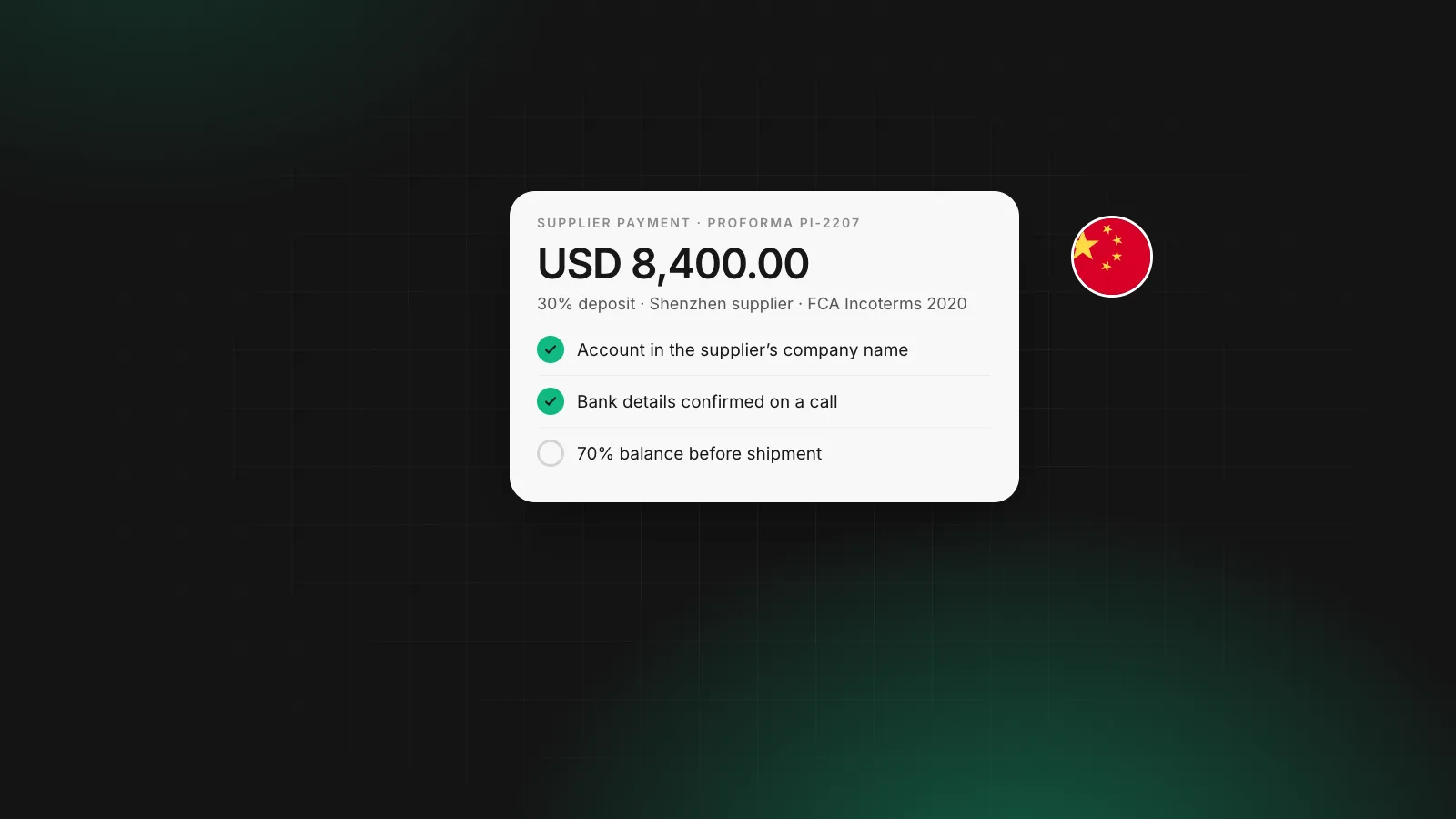
| 30% deposit, 70% before shipment | Deposit starts production; balance paid on inspection or photos | Buyer |
| 30% deposit, 70% against bill of lading copy | Balance paid once goods are shipped | Shared |
| Letter of credit | Bank pays on presentation of agreed documents | Shared, at a cost |
| Open account (net 30 to 90) | Pay after delivery | Supplier; only for trusted buyers |
The payment methods
Telegraphic transfer (T/T)
An international bank wire to the supplier's company account. This is what "T/T" on a proforma invoice means. Most suppliers accept USD; some accept CNY. Costs are the sending fee, any intermediary fees, and the conversion margin. See SWIFT fees and timing.
Trade platform payments
Marketplaces such as Alibaba offer payment protection: your money is held until you confirm delivery or the dispute window ends. Fees are higher than a wire, but for a first order with a new supplier the protection is worth it.
Letter of credit
For large orders, your bank issues a letter of credit promising to pay the supplier when they present shipping documents that match the terms. It protects both sides and costs bank fees. See letters of credit explained.
Stablecoins
Some suppliers accept USDT or USDC, especially for smaller orders. It settles in minutes but carries no buyer protection, and local rules on both sides apply. See stablecoin vs SWIFT.
USD or CNY?
Paying in USD is simplest if you earn dollars. Paying in CNY moves the conversion to your side: worth it only if your provider's CNY rate beats what the supplier's bank would give them, which may let you negotiate a lower price.
Safety checks before every payment
- Verify the supplier's business licence and that the company name matches the contract.
- Pay only to an account in that registered company name.
- Treat any request to pay a personal account, a different company or a new bank as fraud until proven otherwise.
- Confirm any change in bank details on a phone or video call with a contact you already know.
- Keep the proforma invoice, contract and payment confirmation together. The proforma vs commercial invoice guide explains which document is which.
On Rivet
Rivet's payouts send USD to supplier accounts abroad, with the cost of each payment shown before you confirm, and each payee saved once so the details cannot be changed by email. See Payouts.
Questions people ask
What is the best way to pay a supplier in China?
For established suppliers, a bank transfer to the supplier's company account, in USD or CNY, with deposit and balance terms agreed in the contract. For new suppliers and small orders, a trade platform's escrow gives more protection. For large orders, consider a letter of credit.
Should I pay Chinese suppliers in USD or CNY?
Most export suppliers accept USD, which is simplest if you hold dollars. Paying in CNY can avoid the supplier's conversion margin and may get a better price, if your provider offers a competitive CNY rate and the supplier's account accepts CNY from abroad.
How do I pay a supplier in China from Nigeria?
The same methods apply: a bank transfer to the supplier's company account, a trade platform, or a letter of credit through your bank. Check Central Bank of Nigeria rules on import payments and documentation, which require specific forms for many imports.
How do I avoid being scammed by a supplier?
Verify the company's registration, pay only to an account in the company's registered name, start with a small order, use escrow or a letter of credit for new relationships, and confirm any change in bank details on a call with someone you already know.
Sources
William covers what happens once a company starts moving money: getting the business verified, paying contractors and suppliers abroad, and keeping card spend under control. William writes for the founder or finance lead who has to make it work this week, and links every rule cited to the text it comes from.
More from William Sunjo M. →This article is general information, not legal, tax or financial advice. Rules and fees change; check the sources above and the provider’s current terms before you act on them.
- how to pay suppliers in china
- how to pay vendors in china
- pay china suppliers from nigeria
- telegraphic transfer
- import payments