Deel alternatives when you only need to pay contractors
Deel bundles contracts, compliance and payments into one price per contractor. If you only need the payment part, you may be paying for a lot you do not use.
- Published
- Updated
- Reading time
- 2 min read
"Deel cheaper alternative" is a common search, and so is "why is Deel so expensive". The answer to the second explains the first. Deel charges per contractor per month for a bundle of contracts, compliance and payments. If you need the bundle, the price makes sense. If you need the payment, it does not.
Prices below are from Deel's pricing page, read on 1 November 2026.
What Deel charges
| Plan | Price |
|---|---|
| Contractors | From 49 USD per contractor per month |
| Contractor of Record | From 325 USD per contractor per month |
| Employer of Record (EOR) | From 599 USD per employee per month |
For ten contractors, the Contractors plan alone is at least 490 USD a month, or 5,880 USD a year, before FX and withdrawal costs.
What you get for that
- Contract templates adapted to each country
- Collection of invoices and tax forms
- Compliance checks and document storage
- Payment in many currencies and methods
- Support for you and the contractor
When you need only the payment
Many companies already have contractor agreements, collect invoices by email, and keep tax forms on file. For them, Deel's per-contractor price buys mainly the payout. A payout tool charges per payment instead, so ten contractors paid once a month cost ten payment fees.
What you take on without a platform:
- Contracts. Use a lawyer's template for your main countries.
- Tax forms. Collect a W-8BEN from every non-US individual contractor of a US company, before the first payment.
- Invoices. Ask for one per payment, with the contractor's details and yours.
- Classification. Check that each person is really a contractor.
- Records. Keep the contract, form, invoice and payment proof together.
The international contractors guide has a full checklist.
When to keep Deel or another EOR
If you want to employ someone full time in a country where you have no company, you need an employer there. That is what an EOR does, and a payout tool cannot replace it. The same goes for contractors who are, in practice, employees: misclassification penalties can cost more than any EOR fee.
The alternatives
| Need | Options |
|---|---|
| Contracts, compliance and payments | Deel, Remote, Oyster, Rippling |
| EOR in a country without your entity | Deel, Remote, Oyster, Papaya Global |
| Payouts to contractors you already contract with | Business account with bulk payouts |
Paying contractors from Rivet
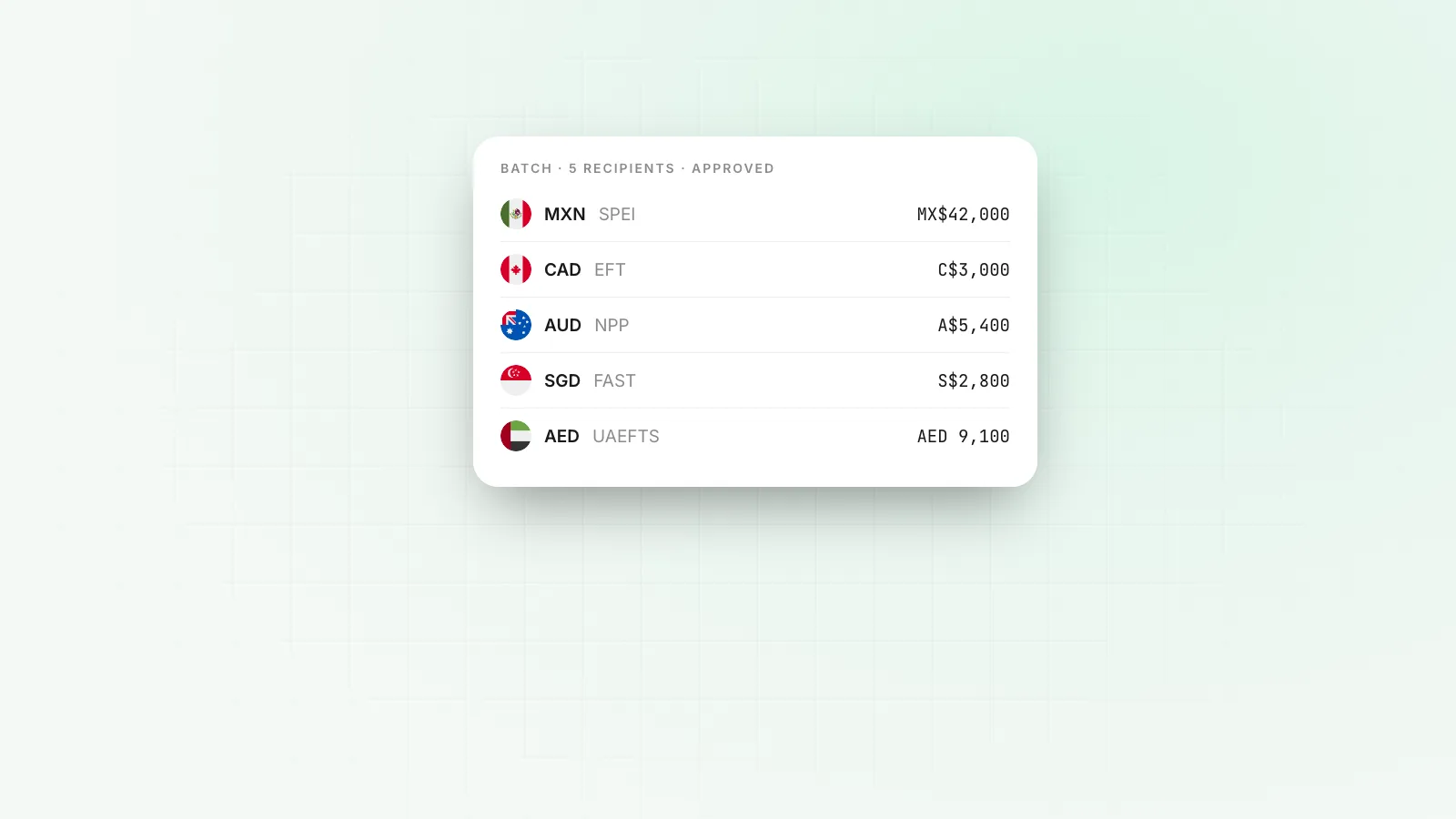
Rivet's Payouts pays contractors in 120+ countries from one file. Each contractor is paid in their own currency on their local rail, or in USDC or USDT where there is no local rail, and you see the cost of every leg before you confirm. There is no per-contractor monthly fee. The Gusto and QuickBooks guide covers the payroll-tool route if your team is mostly in the US.
Questions people ask
Why is Deel so expensive?
Deel's price per contractor covers localised contracts, compliance checks, invoice collection, document storage, support and payouts. For a company that needs all of that across many countries, the price can be fair. For a company that only needs to send money to contractors it already has agreements with, most of it goes unused.
What are the top alternatives to Deel?
Remote, Rippling, Oyster and Papaya Global compete across contractors and EOR. For contractor payments alone, payout tools and business accounts with bulk payouts are cheaper, because they charge per payment instead of per contractor per month.
Rippling or Deel?
Rippling grew from HR and IT for US teams and added global payroll; Deel grew from global contractors and EOR. A mostly US team often prefers Rippling, a mostly international one Deel. Both cost more than payouts alone.
Do I need an EOR to pay contractors abroad?
No. A real independent contractor invoices your company and you pay the invoice. An EOR is for employees, where you need someone to employ the person locally. The risk is misclassification: treating an employee as a contractor. Ask a local adviser if the person works only for you, full time, under your direction.
Sources
William covers what happens once a company starts moving money: getting the business verified, paying contractors and suppliers abroad, and keeping card spend under control. William writes for the founder or finance lead who has to make it work this week, and links every rule cited to the text it comes from.
More from William Sunjo M. →This article is general information, not legal, tax or financial advice. Rules and fees change; check the sources above and the provider’s current terms before you act on them.
- deel alternatives
- deel cheaper alternative
- why is deel so expensive
- contractor payouts
- eor