Cyprus ship managers: paying crew wages to the Philippines, India and beyond
Ship management companies in Limassol pay thousands of seafarers every month, mostly in the Philippines, India and Eastern Europe. Wages are agreed in dollars and spent in pesos and rupees. How the money travels decides what the seafarer's family receives.
- Published
- Reading time
- 2 min read
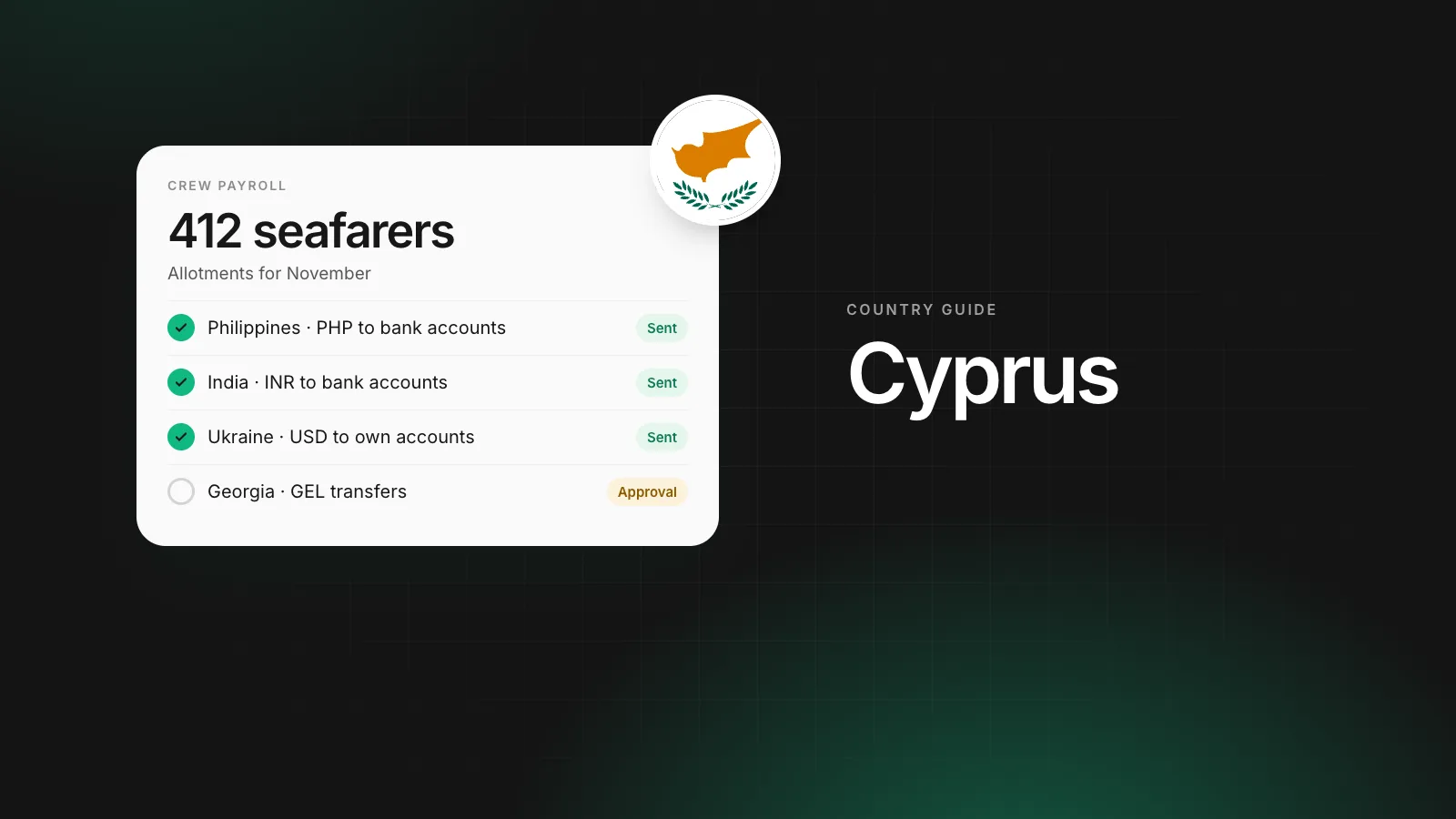
A Limassol ship management company runs 30 vessels with 400 seafarers, most from the Philippines, India, Ukraine and Georgia. Wages are set in dollars. Each month it sends allotments to families: a set part of each seafarer's pay. For years they went out as dollar SWIFT transfers. Families in Manila and Mumbai received varying amounts in pesos and rupees after their banks converted and deducted fees, and the crewing agencies forwarded the complaints.
Wages in dollars, lives in pesos
Crew wage scales are set in US dollars, often under collective agreements negotiated with seafarers' unions. The Maritime Labour Convention requires that seafarers can send part of their pay home, and most do through allotments.
The problem is the last step. A dollar transfer to a Philippine or Indian bank is converted by that bank at its own rate, sometimes after an intermediary fee. The family receives an amount the seafarer cannot predict, and complaints come back through the crewing agency to the ship manager.
Local currency allotments
Paying allotments in pesos or rupees to the family's local bank account, on local rails, changes this. The ship manager converts at a rate it sees before confirming, and the family receives the expected amount, often the same day.
Some seafarers prefer dollars to their own account to save or to convert later. Ask each one at signing on, and record the choice in the allotment instruction.
Controls
Crew payroll is a fraud target: a call or message claiming a seafarer's family has changed bank accounts. Two rules prevent most of it:
- Bank details are taken and verified at signing on, through the crewing agency.
- Changes are confirmed with the seafarer directly, not through the family or by email alone, and a second person approves the first payment to new details.
One batch
Sending 400 allotments as 400 individual transfers is slow and error prone. A bulk payout, uploaded once from the payroll system and approved by two people, goes out together and leaves one record per seafarer for audits.
Paying into Cyprus: the local rail
| What | Detail |
|---|---|
| Local rail | SEPA Instant Credit Transfer |
| Run by | European Payments Council scheme, run by each bank |
| Settlement | Under ten seconds, 24/7 |
| Published fee | By the EU Instant Payments Regulation, no more than the bank charges for a standard SEPA transfer |
Source: European Payments Council: SEPA Instant Credit Transfer. Checked when this guide was last updated; the scheme's own page has the current figures.
Where Rivet fits
A Rivet business account holds dollars on US account details in the company's own name, with euro and sterling details from the Growth plan, and sends bulk payouts to 120+ countries, including the Philippines and India, on local rails where available. Rates show before you confirm, and from the Growth plan payouts can require a second approver. Rivet is not a bank; regulated partner institutions hold the funds.
See also bulk payments explained.
Questions people ask
Why are crew wages in dollars?
International shipping prices most things in dollars, and collective agreements such as those negotiated with ITF-affiliated unions set wage scales in dollars.
What is an allotment?
The part of a seafarer's wages paid directly to a nominated person or account at home each month, usually a family member.
Should allotments be paid in dollars or local currency?
Ask the seafarer. Many prefer local currency to a family bank account so the amount is predictable; some prefer dollars to their own account.
How can ship managers reduce payroll errors?
Keep crew bank details verified at signing on, confirm changes through the crewing agency, and send allotments in one approved batch.
Sources
Rashidatou writes Rivet's guides to how money moves between countries: the payment rails, what each one costs, and the account details a company needs to get paid in another currency. Every figure in Rashidatou's articles is traced to the scheme rulebook, the regulator or the provider's published price list, and those sources are listed at the end.
More from Rashidatou K. →This article is general information, not legal, tax or financial advice. Rules and fees change; check the sources above and the provider’s current terms before you act on them.
- cyprus
- ship management
- crew wages
- philippines
- india
- usd