CAD business accounts: how to receive and pay Canadian dollars
Canadian clients pay suppliers by EFT, wire or Interac e-Transfer. With CAD details in your company's name, they pay you the same way. Here is how it works.
- Published
- Reading time
- 2 min read
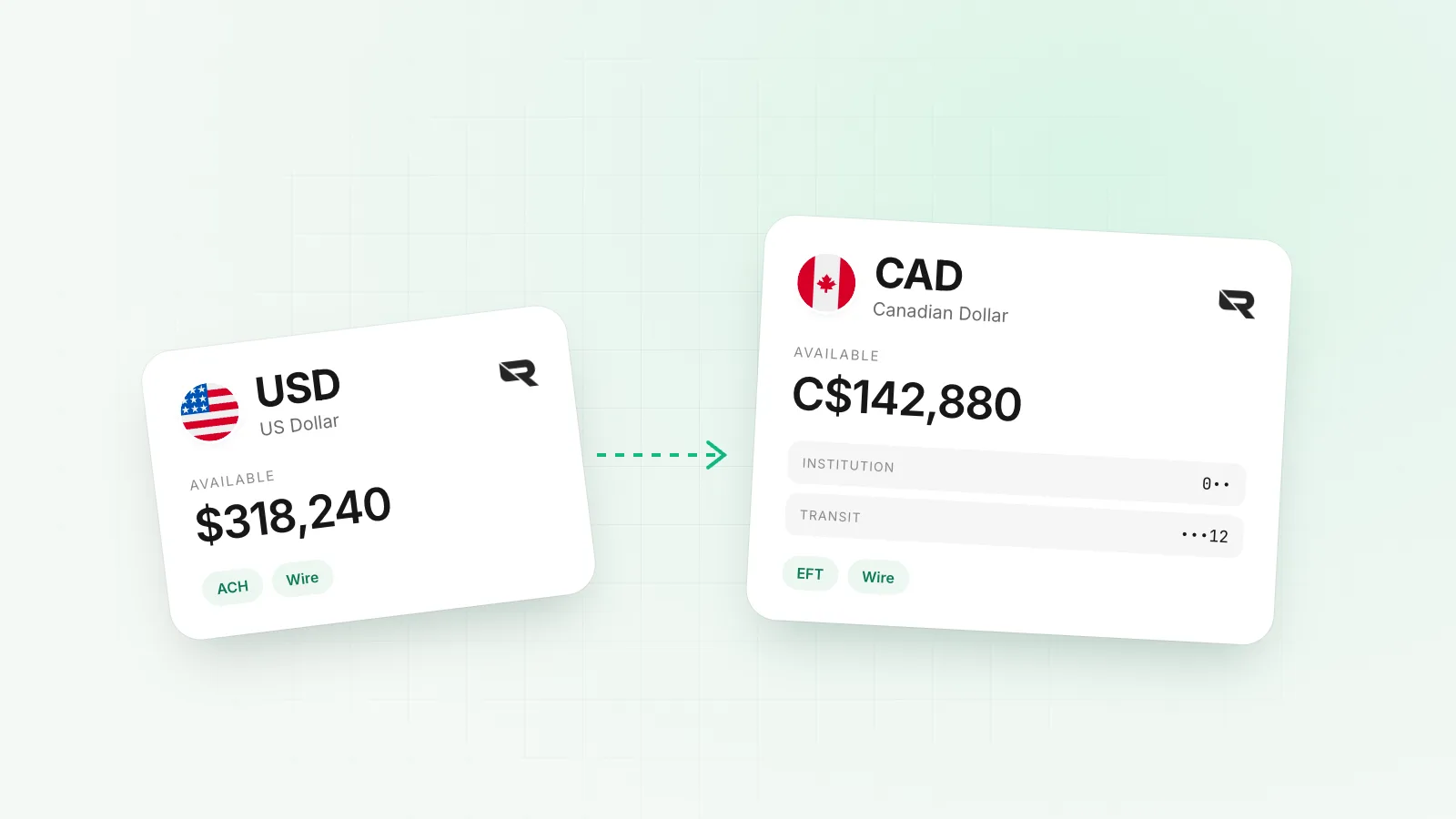
Canada is the US's largest trading partner and a big market for agencies, software companies and exporters. Many founders bill Canadian clients in USD by default, and the client's bank converts at its own rate, or the client asks to pay in CAD. A CAD account in your company's name fixes both.
How Canadian account details work
| Field | Format | What it identifies |
|---|---|---|
| Institution number | 3 digits | The bank |
| Transit number | 5 digits | The branch |
| Account number | Usually 7 to 12 digits | The account |
For electronic payments, the institution and transit numbers are often written together as a routing number (a leading 0, then the institution and transit numbers). For international wires into Canada, a SWIFT code is used as well.
How Canadian businesses pay
| Rail | Used for | Timing |
|---|---|---|
| EFT (ACSS batch) | Supplier payments, payroll | 1 to 2 business days |
| Lynx | Large, urgent payments (wires) | Same day, real-time settlement |
| Interac e-Transfer | Smaller payments | Usually near-instant |
| Real-Time Rail | Instant payments, being built by Payments Canada | Instant, when live |
Canadian accounts payable teams pay most suppliers by EFT in regular runs. Giving them EFT details is the easiest way to get paid on time.
Why bill in CAD
- The client pays in its own currency, with no conversion on its side.
- You choose when to convert, at a rate you can see. See mid-market rate and FX markups.
- If you have Canadian costs, such as contractors, software or ad spend, you pay them from the CAD balance without converting twice.
Paying in Canada
To pay a Canadian contractor or supplier, you need their name, institution, transit and account numbers, or an email for Interac e-Transfer if your provider supports it. A local EFT payout avoids a SWIFT wire and its intermediary fees. See bulk payments explained.
CAD on Rivet
Rivet's Scale plan adds local CAD account details in your company's name, beside USD, EUR and GBP, so Canadian clients pay you by EFT like a local supplier. On every plan you can pay out to Canadian accounts in CAD. See Bank accounts and Pricing.
Questions people ask
Can a non-Canadian company open a CAD account?
Canadian banks usually want a Canadian presence. Several payment providers issue CAD account details to companies registered elsewhere, so Canadian clients can pay them by EFT like a local supplier. Check which countries the provider accepts.
What is a transit number?
A five-digit number that identifies the branch where an account is held in Canada. Together with the three-digit institution number and the account number, it lets a payer send an EFT or wire to the account.
How long does an EFT take in Canada?
Usually one to two business days, through Payments Canada's batch system. Large-value wires through Lynx settle the same day. Interac e-Transfer is typically near-instant but has lower limits.
Should I invoice Canadian clients in CAD or USD?
In CAD if you can receive it cheaply. Many Canadian businesses prefer paying in their own currency, and invoicing in CAD avoids their bank converting at its own rate. Hold the CAD or convert it at a rate you can see.
Sources
Rashidatou writes Rivet's guides to how money moves between countries: the payment rails, what each one costs, and the account details a company needs to get paid in another currency. Every figure in Rashidatou's articles is traced to the scheme rulebook, the regulator or the provider's published price list, and those sources are listed at the end.
More from Rashidatou K. →This article is general information, not legal, tax or financial advice. Rules and fees change; check the sources above and the provider’s current terms before you act on them.
- cad business account
- canadian dollar account
- receive cad
- eft canada
- transit number