AED business accounts: receiving and paying UAE dirhams
The dirham is pegged to the dollar, and UAE payments run on IBANs and, increasingly, instant rails. Here is how AED works for a business.
- Published
- Reading time
- 2 min read
The UAE is a hub for trading companies, agencies and founders who have moved there from across the world. "Dubai business bank account" is one of the most searched banking phrases in the region. Whether your company is in the UAE or sells into it, AED payments follow a few clear rules.
How UAE account details work
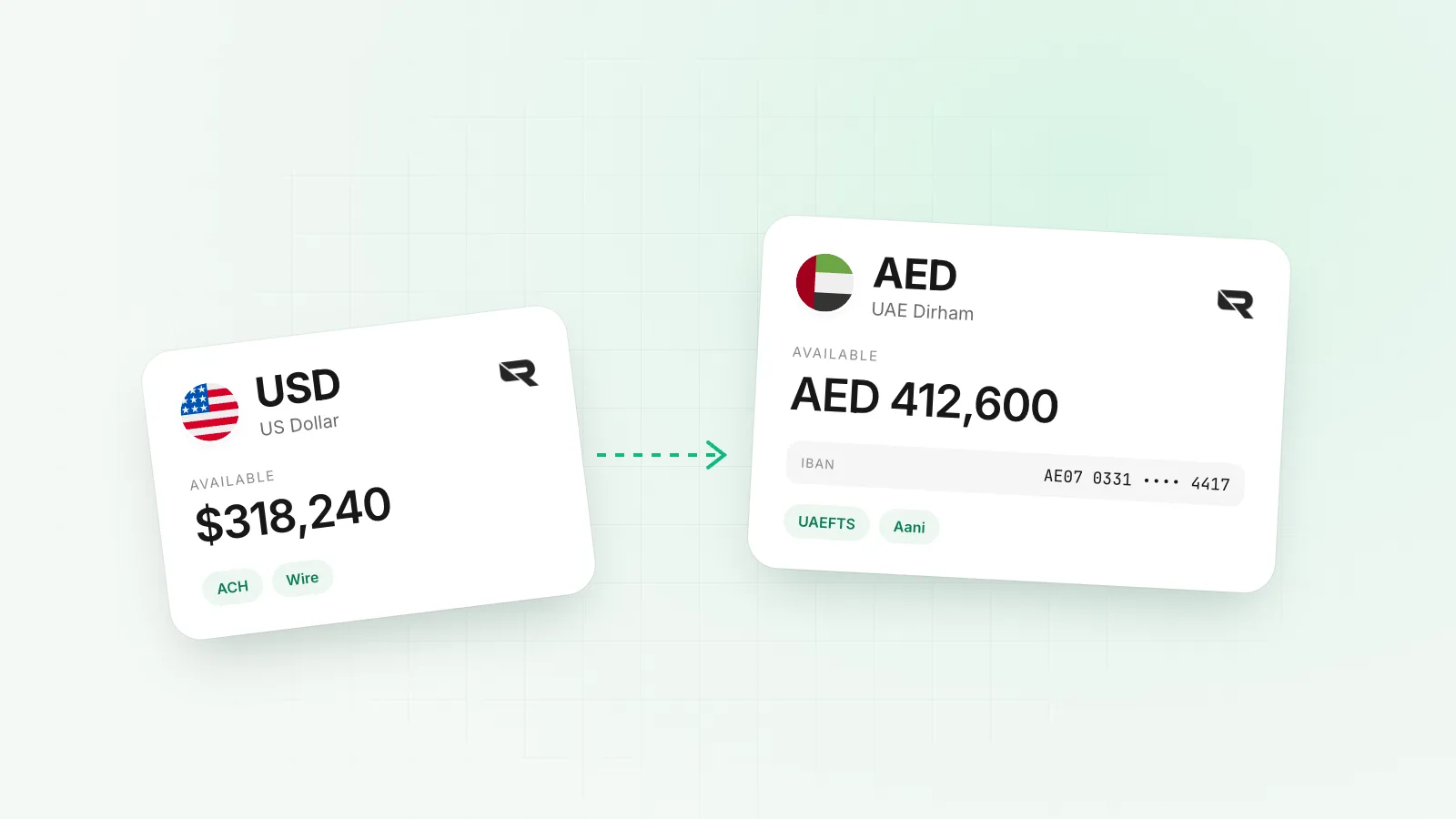
UAE accounts use IBANs: 23 characters, starting with AE.
| Part | Characters | Meaning |
|---|---|---|
| Country code | 2 | AE |
| Check digits | 2 | Validates the IBAN |
| Bank code | 3 | Identifies the bank |
| Account number | 16 | Identifies the account |
A payer inside the UAE needs the IBAN and the account name. A payer abroad sending an international wire also needs the bank's SWIFT code.
The rails
| Rail | Run by | Used for |
|---|---|---|
| UAEFTS | Central Bank of the UAE | Domestic dirham transfers between banks |
| Aani | Al Etihad Payments (Central Bank subsidiary) | Instant payments, including by mobile number, 24/7 |
| International wires | Swift | Payments into and out of the UAE |
The dollar peg
The Central Bank of the UAE has pegged the dirham at 3.6725 per US dollar for decades. For a business, that means:
- Converting between AED and USD carries little rate risk.
- The margin your provider charges is the main cost of conversion. See mid-market rate and FX markups.
- AED moves with the dollar against EUR, GBP and other currencies.
Common setups
- A UAE company selling abroad invoices in USD, EUR or GBP, holds those balances, and converts to AED for local salaries and rent.
- A company outside the UAE selling into it invoices UAE clients in AED or USD; with the peg, many UAE clients are happy to pay in USD.
Paying in the UAE
To pay a UAE supplier or contractor you need their name and IBAN. A local AED payment avoids a SWIFT wire. See how to pay suppliers abroad for the safety checks that apply anywhere.
AED on Rivet
Rivet's Scale plan lets a company hold and convert AED beside its USD, EUR and GBP balances, and USDC or USDT convert to AED at a rate shown before you confirm. On every plan you can pay UAE accounts in dirhams. Local AED receiving details are issued where we offer them; ask at onboarding. See Ramps and Pricing.
Questions people ask
What does a UAE IBAN look like?
It has 23 characters: AE, two check digits, a three-digit bank code and a sixteen-digit account number. A payer in the UAE needs the IBAN and account name; a payer abroad also needs the bank's SWIFT code.
What is Aani?
Aani is the UAE's instant payments platform, launched in 2023 by Al Etihad Payments, a subsidiary of the Central Bank of the UAE. It lets account holders send money in seconds, including by mobile number.
Is the dirham pegged to the dollar?
Yes. The Central Bank of the UAE keeps the dirham at 3.6725 per US dollar. Converting between AED and USD is therefore low-risk on rate, though providers still charge a margin.
Can a company outside the UAE receive AED?
Yes, through a provider that holds AED balances and can receive transfers in dirhams. UAE clients then pay in their own currency. Check how the provider receives: a local UAE IBAN, or an international wire.
Sources
Rashidatou writes Rivet's guides to how money moves between countries: the payment rails, what each one costs, and the account details a company needs to get paid in another currency. Every figure in Rashidatou's articles is traced to the scheme rulebook, the regulator or the provider's published price list, and those sources are listed at the end.
More from Rashidatou K. →This article is general information, not legal, tax or financial advice. Rules and fees change; check the sources above and the provider’s current terms before you act on them.
- aed business account
- uae dirham account
- uae iban
- aani
- uaefts