How to charge statutory late payment interest in the UK
Under the Late Payment of Commercial Debts (Interest) Act 1998, a UK business can charge another business interest at 8% above the Bank of England base rate on an overdue invoice, plus fixed compensation of £40, £70 or £100. You do not need a clause in the contract.
- Published
- Reading time
- 3 min read
Small UK businesses are owed billions in late payments at any one time, and most never ask for the interest the law already gives them. If another business pays you late, you can charge statutory interest and a fixed amount of compensation without any clause in your contract.
What does the Late Payment Act allow?
The Late Payment of Commercial Debts (Interest) Act 1998 applies to contracts for goods or services between businesses, and between a business and a public sector body. If the buyer pays late, the supplier can claim:
- Interest at 8% a year above the reference Bank of England base rate.
- A fixed sum for the cost of recovering the debt.
- Reasonable recovery costs above that fixed sum, if they were higher.
It does not apply to sales to consumers.
When is a payment "late"?
| Situation | Payment is late after |
|---|---|
| A payment date was agreed | That date |
| No date agreed | 30 days after the later of the invoice or delivery |
| Public authority buyer | 30 days maximum |
| Business buyer, agreed terms | Up to 60 days, longer only if not grossly unfair to the supplier |
The reference base rate is the Bank of England rate on 31 December for debts that became late between 1 January and 30 June, and on 30 June for debts that became late between 1 July and 31 December. It stays fixed for the life of that debt.
How much is the fixed compensation?
| Debt | Fixed sum |
|---|---|
| Up to £999.99 | £40 |
| £1,000 to £9,999.99 | £70 |
| £10,000 or more | £100 |
You can claim this once per invoice, which adds up for businesses that invoice monthly.
How do you calculate the interest?
- Add 8% to the reference base rate. If the base rate was 4%, the statutory rate is 12%.
- Multiply the debt by that rate to get annual interest.
- Divide by 365 to get daily interest.
- Multiply by the number of days the debt has been late.
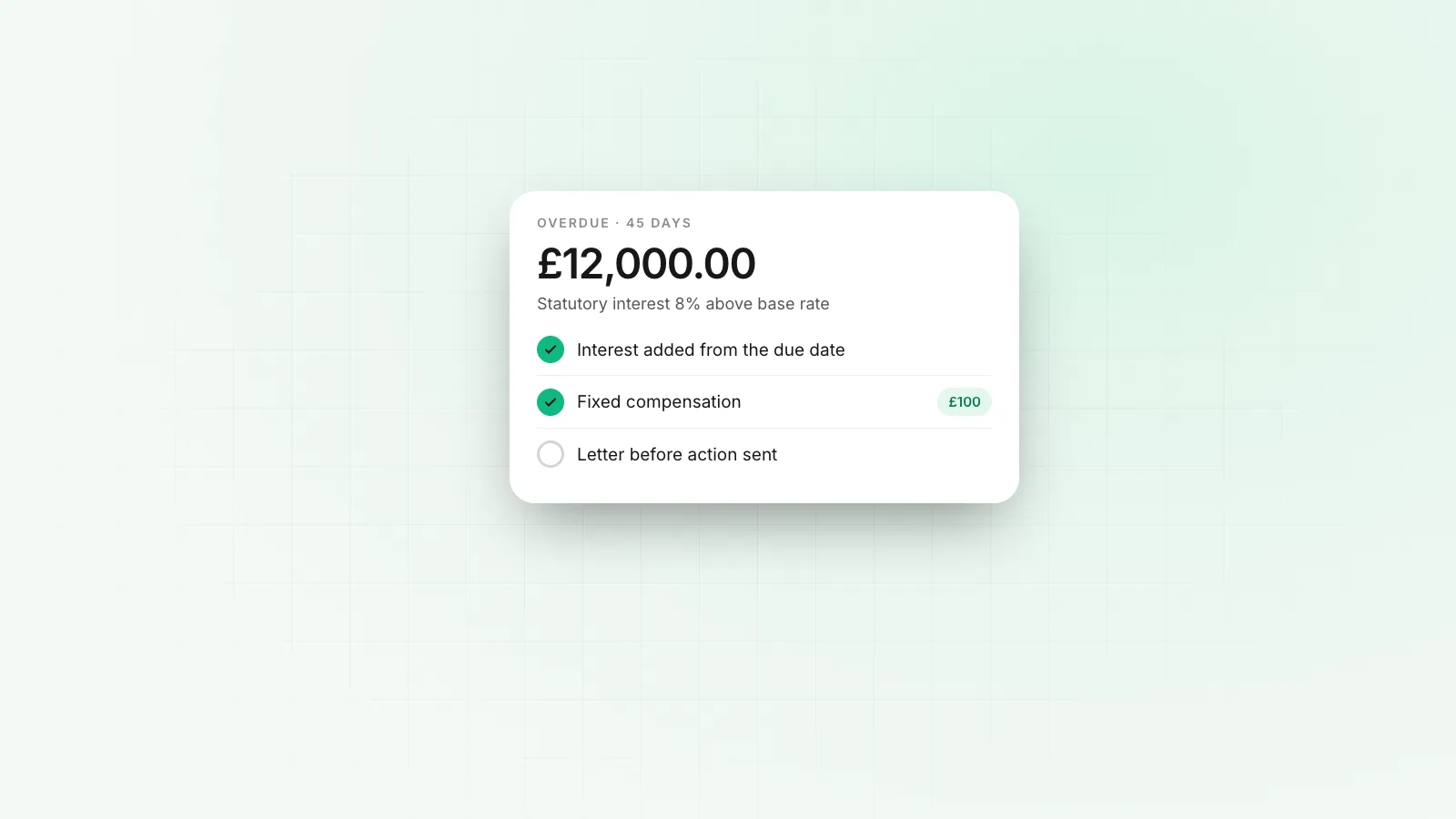
A worked example: a £12,000 invoice, 45 days late, with a reference base rate of 4%.
| Step | Amount |
|---|---|
| Annual interest at 12% | £1,440.00 |
| Daily interest | £3.95 |
| 45 days | £177.53 |
| Fixed compensation | £100.00 |
| Total claim on top of the invoice | £277.53 |
Use the actual base rate for your debt's reference date. The Bank of England publishes every change.
How do you ask for it?
- Put a line in your terms and on every invoice: "We charge statutory interest and compensation on late payments under the Late Payment of Commercial Debts (Interest) Act 1998."
- When an invoice goes overdue, send a reminder that states the amount of interest building up each day.
- If it is still unpaid, send a final demand with the interest and compensation calculated to a date.
- If that fails, a letter before action, then a claim in the small claims track or through a debt recovery service.
Most clients pay when they see the daily interest figure, because it turns a vague delay into a cost their finance team has to explain.
Can the contract override the Act?
A contract can set its own remedy for late payment, but it has to be substantial. A clause that sets a token rate or waives interest entirely can be struck out, and statutory interest then applies.
Overseas clients
Where the contract is under English law, the Act can apply to an overseas client too. Enforcing a judgment abroad is a separate question. With international clients, the faster fix is usually to remove reasons for delay: send local account details in their currency, and state the terms clearly. Our guide to getting international clients to pay on time covers that side. Rivet gives companies USD, EUR and GBP account details in their own name, so clients abroad pay by a domestic transfer instead of a wire.
Questions people ask
Do I need a late payment clause to charge interest?
No. Statutory interest applies automatically to business-to-business contracts unless the contract sets out its own substantial remedy for late payment. Mentioning it in your terms still helps, because clients take it more seriously when they have seen it.
How do I calculate statutory interest?
Take the debt, multiply by 8% plus the reference base rate, divide by 365 to get daily interest, then multiply by the number of days late. Add the fixed compensation once per invoice.
Can I charge late payment interest to an overseas client?
The Act applies where the contract is governed by UK law. If the contract is under another country's law, that country's rules apply. EU countries have their own statutory late payment interest under the Late Payment Directive.
Will charging interest damage the client relationship?
It can. Many businesses use it selectively: they mention it in the terms, waive it for clients who pay reliably, and claim it on persistent late payers or at the point of recovery.
Sources
William covers what happens once a company starts moving money: getting the business verified, paying contractors and suppliers abroad, and keeping card spend under control. William writes for the founder or finance lead who has to make it work this week, and links every rule cited to the text it comes from.
More from William Sunjo M. →This article is general information, not legal, tax or financial advice. Rules and fees change; check the sources above and the provider’s current terms before you act on them.
- late payment interest
- late payment act
- overdue invoice
- b2b payments
- accounts receivable
- uk