How South African businesses receive international payments
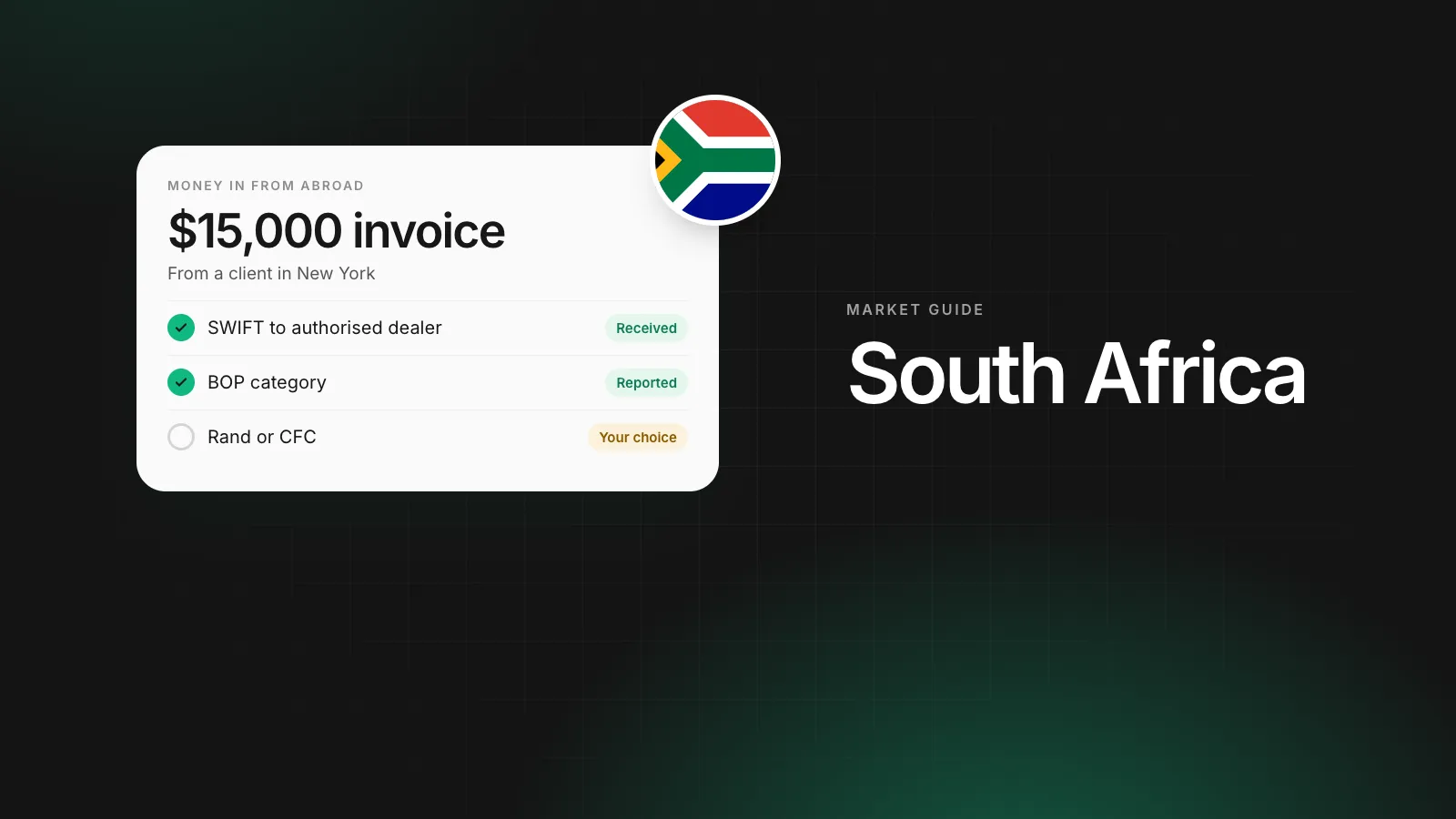
A foreign client's payment to a South African company arrives by SWIFT and is reported to the Reserve Bank with a balance of payments category. The bank then converts it or credits a CFC account.
- Published
- Reading time
- 1 min read
"Best way to receive international payments in South Africa" is one of Google's top regional completions. For companies, the route runs through an authorised dealer bank.
What happens to an inbound payment
- The client pays by SWIFT to your bank.
- The bank receives it and asks for, or applies, a BOP category.
- The bank converts to rand or credits your CFC account.
- The payment is reported to the SARB.
Documents to have ready
| Document | Why |
|---|---|
| Invoice | What the payment is for |
| Contract | The relationship |
| Client details | Name, country |
Fees
Banks charge an inbound SWIFT fee, and intermediaries may deduct fees on the way. The conversion margin is often the largest cost.
Converting or holding
If you pay foreign costs, a CFC account lets you hold the currency. Otherwise, the bank converts on arrival or when you instruct.
Founders with a foreign company
Some South African founders contract with foreign clients through a US LLC or UK Ltd they own. That raises exchange control and tax questions; take advice before you set it up. See South African founders with a US LLC.
Paying into South Africa: the local rail
| What | Detail |
|---|---|
| Local rail | Real-time clearing (RTC) and PayShap for instant transfers; EFT for batch payments |
| Run by | BankservAfrica |
| Settlement | RTC and PayShap in seconds; EFT within one to two business days |
Source: BankservAfrica. Checked when this guide was last updated; the scheme's own page has the current figures.
Where Rivet fits
South African exchange control decides whether a South African company may hold proceeds abroad, so Rivet does not pitch offshore accounts to South African-registered companies. Rivet serves registered companies in supported countries, including foreign companies owned by South African founders where eligible. Rivet is not a bank; regulated partner institutions hold the funds. See ZAR business payments.
Questions people ask
How do South African companies receive international payments?
By SWIFT into their bank account, which converts to rand or credits a CFC account, with the payment reported under the BOP system.
What is a BOP code?
A balance of payments category describing why money crossed the border, such as services exports. Banks report it to the SARB.
How long does it take?
Usually one to three business days, longer if the bank needs documents or the BOP category is unclear.
Can the company keep the dollars?
Exporters can hold foreign currency in a CFC account at an authorised dealer, subject to exchange control rules.
Sources
Alexia compares the accounts, cards and payment tools companies weigh before they switch, and writes Rivet's market guides for founders in a specific country. Prices in Alexia's comparisons come from each provider's own pricing page on the date given in the article, rules come from the regulator or tax authority that sets them, and every source is listed at the end.
More from Alexia M. →This article is general information, not legal, tax or financial advice. Rules and fees change; check the sources above and the provider’s current terms before you act on them.
- bop reporting
- swift
- cfc account
- exporters
- south africa