ZAR payments for business: EFT, PayShap and exchange control in South Africa
Inside South Africa, rand moves by EFT, real-time clearing, PayShap and the SAMOS system for large payments. Money crossing the border is subject to exchange control: South African businesses receive foreign currency through authorised dealers, report it with a balance of payments code, and convert it or hold it in a CFC account.
- Published
- Reading time
- 2 min read
South Africa has a sophisticated banking system, and inside the country rand moves quickly. The complexity is at the border. Exchange control means every rand going out and every dollar coming in is reported, coded and handled by an authorised dealer bank.
How do rand payments move inside South Africa?
| Rail | Speed | Used for | Notes |
|---|---|---|---|
| EFT (standard) | Same or next business day, in batches | Supplier payments, payroll | The default for most transfers |
| Real-time clearing (RTC) | Seconds | Urgent payments | Usually a fee per payment |
| PayShap | Seconds, 24/7 | Smaller instant payments | Pay by ShapID, scheme limit R50,000 |
| SAMOS (RTGS) | Real time, business hours | Large-value payments | Run by the South African Reserve Bank |
| DebiCheck | Scheduled | Debit orders with customer confirmation | Replaced most older debit orders |
PayShap launched in 2023 and lets people pay with a ShapID, such as a phone number, linked to a bank account. The scheme maximum was raised to R50,000 per transaction, but each bank sets its own limit, and some are much lower. Check yours.
How does exchange control affect businesses?
The South African Reserve Bank's Financial Surveillance Department administers exchange control, mostly through authorised dealers, which are the banks licensed to deal in foreign exchange. For a business, that means:
- Every cross-border payment goes through an authorised dealer.
- Each payment carries a balance of payments (BOP) category code that says what it is for, such as exports of goods or services income.
- Larger or unusual payments need supporting documents, such as invoices and contracts.
What happens when a South African business receives foreign currency?
Export proceeds generally have to be repatriated within six months of shipment. Once received, foreign currency must be converted to rand or placed in a Customer Foreign Currency (CFC) account within 30 days. The CFC account lets a business hold USD, EUR or GBP and use it to pay foreign suppliers, under the rules in the Currency and Exchanges Manual for Authorised Dealers.
The SARB updated several limits in 2026 to implement Budget reforms, mostly for individuals. Check with your bank's foreign exchange desk for the current rules that apply to your business.
Has the grey listing ended?
Yes. The FATF removed South Africa from its grey list in October 2025, after about two and a half years. Banks still apply strong anti-money-laundering checks, but correspondent banks abroad treat South African payments with less friction than during the listing.
How does a foreign company pay South African suppliers?
| Method | What arrives | Watch for |
|---|---|---|
| SWIFT wire in USD | USD, converted by the receiving bank unless placed in a CFC | Receiving bank fees, the bank's FX rate, BOP reporting |
| Local ZAR payout through a provider | Rand by EFT | Provider's FX margin and fee |
| SWIFT wire in ZAR | Rand | Sending bank's conversion rate |
For regular rand payments to staff or contractors, a local payout avoids the receiving bank converting at its own rate. See how to pay international contractors.
ZAR with Rivet
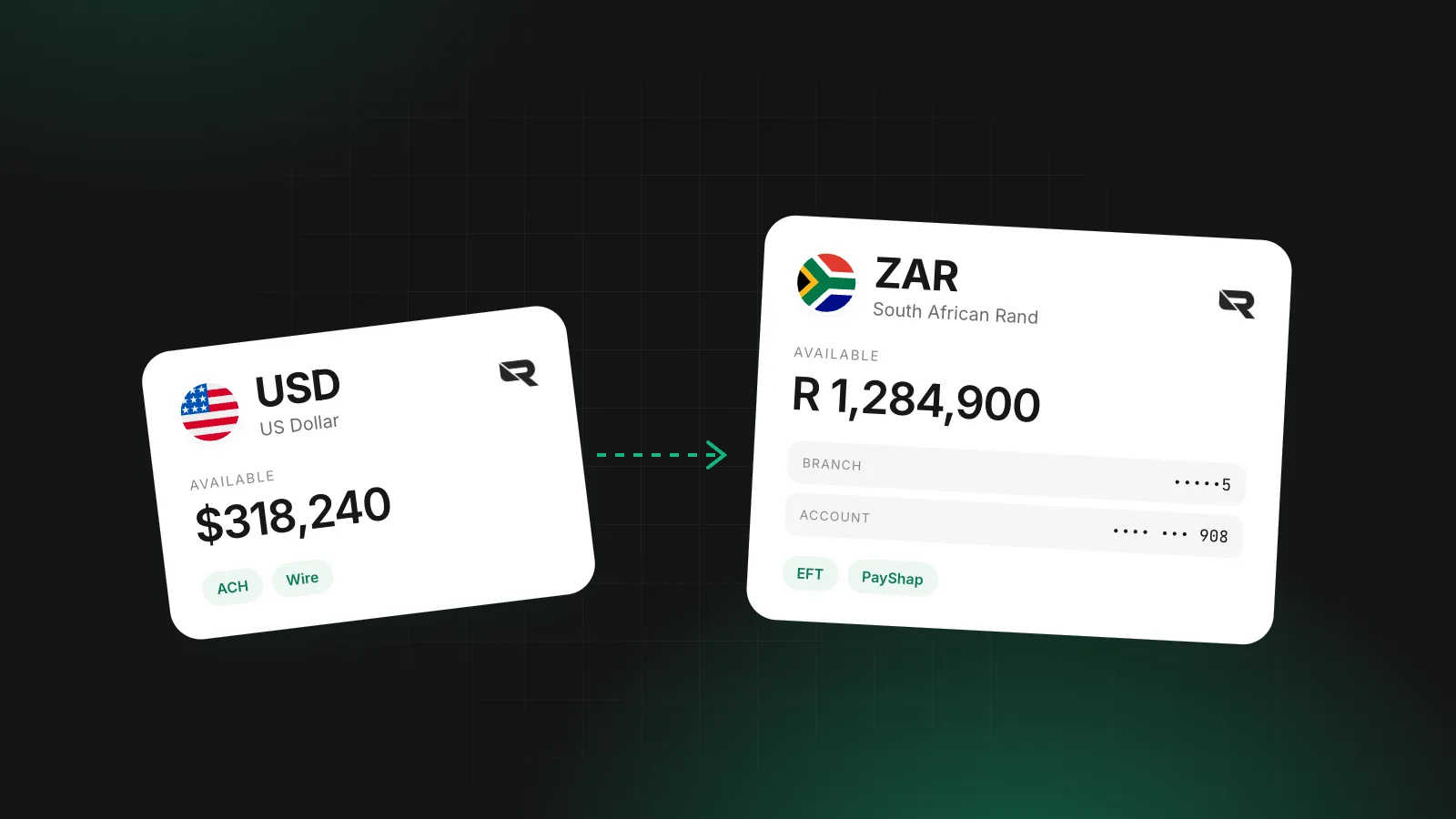
Rivet's Scale plan holds ZAR next to USD, EUR and GBP. Registered companies can hold, convert and pay out rand from the same account, with local details where we issue them; ask at onboarding. Bulk payouts pay South African recipients alongside recipients in other countries from one batch.
Questions people ask
What is PayShap?
South Africa's rapid payments service, launched in 2023. It lets bank customers send instant payments using a ShapID such as a phone number, instead of full account details. Each bank sets its own limits within the scheme maximum.
Can a South African business hold US dollars?
Yes, in a Customer Foreign Currency (CFC) account at an authorised dealer bank, subject to exchange control rules on how it is funded and used.
Why does my bank ask for a reason code on foreign payments?
Every cross-border payment into or out of South Africa is reported to the Reserve Bank with a balance of payments (BOP) category code that describes what the payment is for. Your bank needs it to process the payment.
Is South Africa still on the FATF grey list?
No. The FATF removed South Africa from its list of jurisdictions under increased monitoring in October 2025.
Sources
Rashidatou writes Rivet's guides to how money moves between countries: the payment rails, what each one costs, and the account details a company needs to get paid in another currency. Every figure in Rashidatou's articles is traced to the scheme rulebook, the regulator or the provider's published price list, and those sources are listed at the end.
More from Rashidatou K. →This article is general information, not legal, tax or financial advice. Rules and fees change; check the sources above and the provider’s current terms before you act on them.
- zar
- south african rand
- payshap
- exchange control
- cfc account
- south africa