South African companies paying overseas suppliers
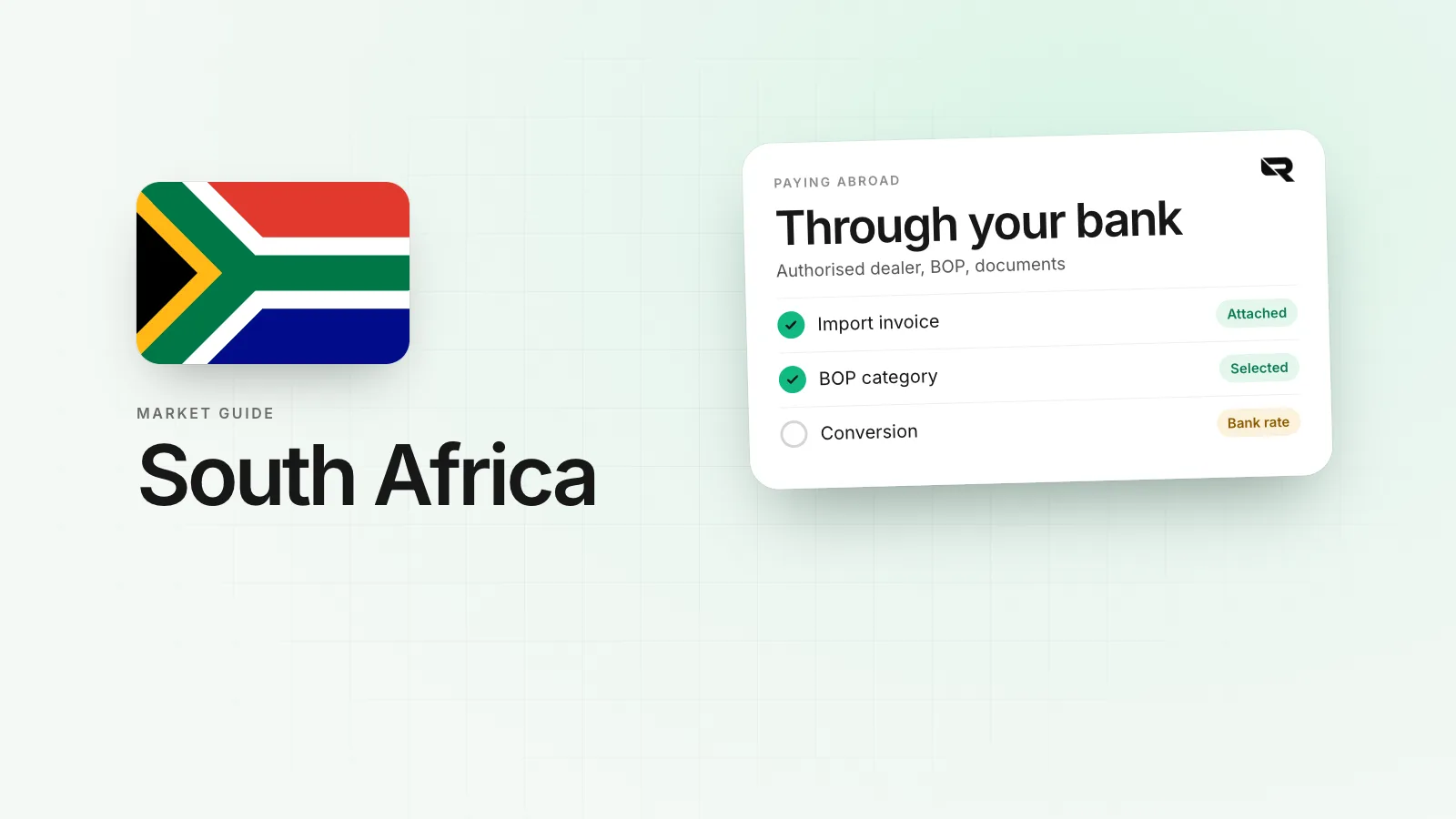
A South African company paying a supplier abroad does it through an authorised dealer bank, with a BOP category and supporting documents. The personal R1 million allowance is for individuals, not companies.
- Published
- Reading time
- 1 min read
"South Africa international transfer limit" is one of the top completions after "South Africa international transfer". The limits people quote are personal allowances. Companies work differently.
Companies vs individuals
| Individuals | Companies | |
|---|---|---|
| Single discretionary allowance | Yes, per year | No |
| Foreign investment allowance | Yes, with tax clearance | No |
| Paying for imports and services | Yes | Yes, through an authorised dealer with documents |
Paying a supplier
- Get the supplier's invoice.
- Instruct your bank with the beneficiary details and BOP category.
- Provide documents: invoice, and for goods, the customs or transport record.
- The bank converts rand and sends by SWIFT.
Costs
- Bank's outgoing fee.
- Intermediary fees.
- Conversion margin on ZAR.
Holding foreign currency
If the company earns foreign currency, a CFC account lets it pay foreign suppliers without converting twice.
Paying into South Africa: the local rail
| What | Detail |
|---|---|
| Local rail | Real-time clearing (RTC) and PayShap for instant transfers; EFT for batch payments |
| Run by | BankservAfrica |
| Settlement | RTC and PayShap in seconds; EFT within one to two business days |
Source: BankservAfrica. Checked when this guide was last updated; the scheme's own page has the current figures.
Where Rivet fits
South African exchange control decides how a South African company pays and holds funds abroad, so Rivet does not pitch offshore accounts to South African-registered companies. Rivet serves registered companies in supported countries, including foreign companies owned by South African founders where eligible. Rivet is not a bank; regulated partner institutions hold the funds. See South African companies paying offshore SaaS.
Questions people ask
Is there a limit on international transfers for South African companies?
Companies do not use the individual allowances. Payments for genuine imports and services are allowed through authorised dealers with documents. Other transfers may need approval.
What is a BOP code?
A category describing the reason for a cross-border payment, reported to the SARB by the bank.
What documents are needed?
Usually the supplier's invoice and, for goods, the customs declaration or transport document. Banks may ask for more.
How long does it take?
Usually one to three business days by SWIFT after the bank processes it.
Sources
Alexia compares the accounts, cards and payment tools companies weigh before they switch, and writes Rivet's market guides for founders in a specific country. Prices in Alexia's comparisons come from each provider's own pricing page on the date given in the article, rules come from the regulator or tax authority that sets them, and every source is listed at the end.
More from Alexia M. →This article is general information, not legal, tax or financial advice. Rules and fees change; check the sources above and the provider’s current terms before you act on them.
- paying overseas suppliers
- bop
- authorised dealer
- exchange control
- south africa