South African companies paying offshore software and services: VAT on imported services
When a Cape Town company subscribes to a US software platform or hires a UK consultancy, VAT can still apply. Foreign suppliers of electronic services may register in South Africa and charge VAT, and for other imported services the South African company may have to account for it.
- Published
- Reading time
- 2 min read
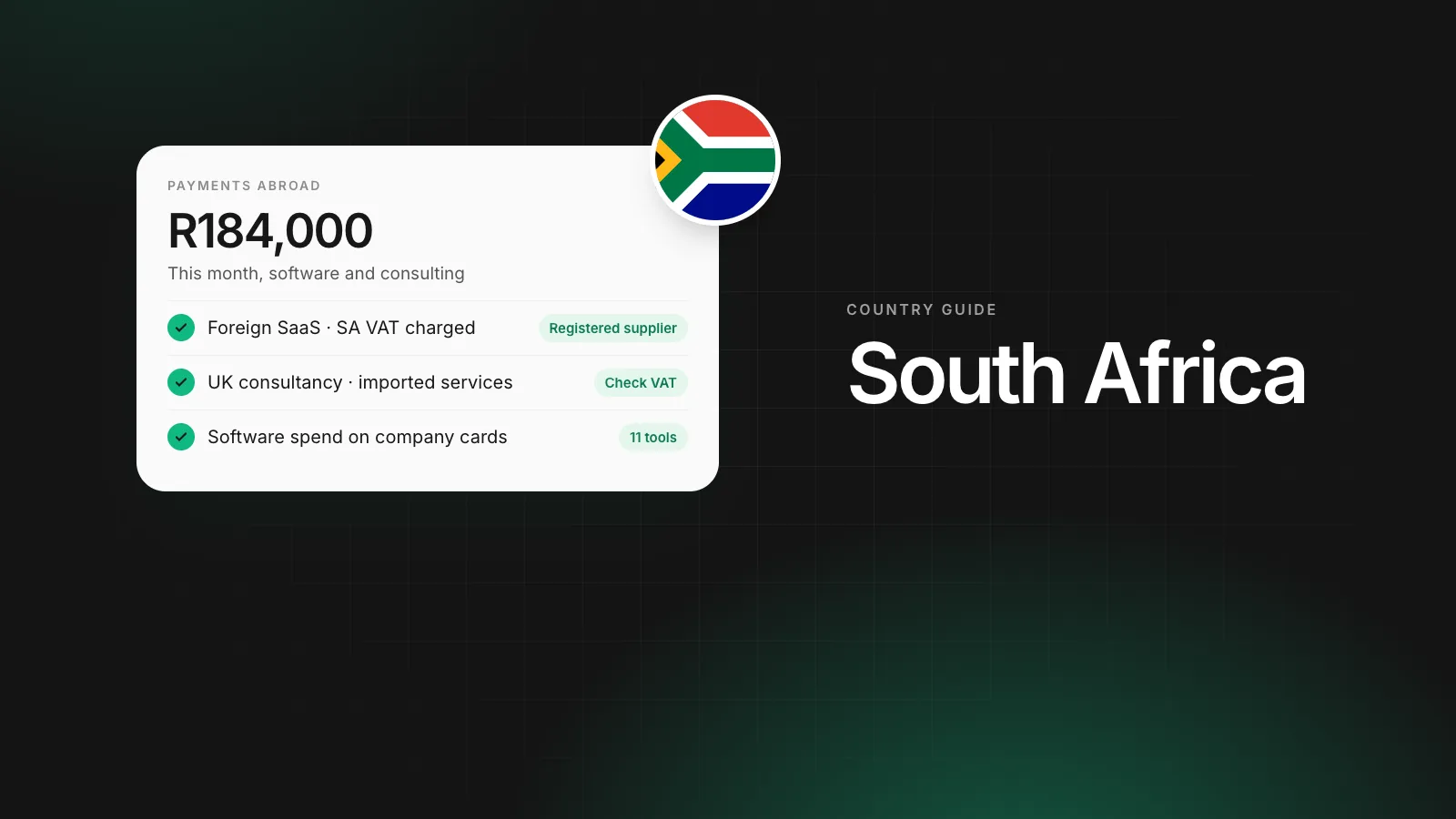
A Cape Town insurance broker spends about R184,000 a month abroad: a US CRM, a European document platform, cloud hosting and a UK consultancy. Its accountant checks two VAT questions each month: whether the foreign software providers are charging South African VAT, and whether the UK consultancy's fee is an imported service on which the broker must account for VAT itself.
Electronic services
Foreign suppliers of electronic services to South African recipients must register for South African VAT once their South African sales pass the threshold. Since 2019 the rules cover a wide range of B2B digital services, not only consumer services, with some exceptions, such as certain services supplied within a group. Registered suppliers charge VAT on their invoices.
Imported services
For other services from non-residents, such as consulting from London, the South African recipient may have to account for VAT on imported services. This mainly affects recipients that do not use the services wholly to make taxable supplies, such as partly exempt businesses in financial services. Fully taxable VAT-registered businesses are usually not affected.
Exchange control
Payments abroad go through authorised dealers. Most routine service payments are straightforward with an invoice. Larger or unusual payments may need more documentation.
Controlling spend
Software subscriptions accumulate. Separate cards per tool or team, each with an owner and a limit, keep spend visible and easy to cancel.
Paying into South Africa: the local rail
| What | Detail |
|---|---|
| Local rail | Real-time clearing (RTC) and PayShap for instant transfers; EFT for batch payments |
| Run by | BankservAfrica |
| Settlement | RTC and PayShap in seconds; EFT within one to two business days |
Source: BankservAfrica. Checked when this guide was last updated; the scheme's own page has the current figures.
Where Rivet fits
Rivet opens business accounts for registered companies after verification. South African companies should follow exchange control rules on holding funds abroad and check with their authorised dealer. South African founders' companies registered elsewhere can use a Rivet business account with Visa company cards, per-card limits and US account details on every plan. Rivet is not a bank; regulated partner institutions hold the funds.
Questions people ask
Do foreign SaaS providers charge South African VAT?
Many must. Foreign suppliers of electronic services to South African recipients register for VAT once they pass the threshold and charge VAT on their invoices.
What is VAT on imported services?
VAT that a South African recipient may have to account for when it buys services from a non-resident supplier and does not use them fully to make taxable supplies.
Does a VAT-registered company pay VAT on imported services?
Usually not, if the services are used wholly to make taxable supplies. Partly exempt businesses may.
Are there exchange control rules for paying foreign software?
Payments abroad go through authorised dealers, which may ask for invoices. Most routine service payments are straightforward.
Sources
Rashidatou writes Rivet's guides to how money moves between countries: the payment rails, what each one costs, and the account details a company needs to get paid in another currency. Every figure in Rashidatou's articles is traced to the scheme rulebook, the regulator or the provider's published price list, and those sources are listed at the end.
More from Rashidatou K. →This article is general information, not legal, tax or financial advice. Rules and fees change; check the sources above and the provider’s current terms before you act on them.
- south africa
- vat
- imported services
- sars
- saas
- electronic services