Paying a remote team abroad: payroll, EOR or contractor payouts?
Hiring abroad is easy. Paying people correctly abroad depends on whether they are employees or contractors, and whether you have a company in their country.
- Published
- Updated
- Reading time
- 2 min read

A company that hires its first person abroad usually asks "how do we pay them?" The better first question is "what are they to us?" An employee and a contractor are paid in different ways, and the wrong answer costs more than any fee.
The three ways to pay someone abroad
| Your own local entity | Employer of record (EOR) | Contractor payouts | |
|---|---|---|---|
| Legal relationship | Employee of your local company | Employee of the EOR | Independent contractor |
| Who runs payroll and taxes | You, or your payroll provider | The EOR | The contractor |
| Benefits and leave | You provide locally required ones | The EOR provides them | None from you |
| Set-up | Register a company, local bank, payroll | Sign with an EOR | A contract and a tax form |
| Typical cost | Entity upkeep plus payroll fees | Deel lists EOR from 599 USD per employee per month | A payment fee per payout |
| When it fits | Many staff in one country | A few employees in a country | Real independent work |
Your own entity
Once you have more than a handful of employees in one country, your own subsidiary is usually cheapest per head. It also means accounts, tax filings and a local bank account in that country.
Employer of record
An EOR employs the person locally on your behalf: contract, payroll, taxes, benefits. You direct the work. It is the fastest compliant way to employ someone in a country where you have no company, and the most expensive per person. Deel alternatives compares the main providers.
Contractor payouts
A real independent contractor runs their own business, invoices you, and handles their own taxes. You pay the invoice. This is the cheapest route by far, and it is right for freelancers, agencies and specialists who work for several clients.
It is wrong for someone who works full time for you, on your schedule, with your tools, and for nobody else. Most countries look at the substance of the relationship, not the contract's title. Reclassification can bring back payroll taxes, social contributions, penalties and claims for benefits.
How teams usually mix them
- Home country: own payroll.
- Two or three key hires abroad who want employment: EOR.
- Designers, developers, writers and media buyers who freelance: contractor payouts.
Paying contractors well
- A written contract that reflects independent work.
- A tax form on file: W-8BEN for non-US individuals paid by a US company.
- An invoice for every payment.
- Payment in the contractor's currency, on their local rail, on a predictable date.
The international contractors guide covers each step, and the Gusto and QuickBooks guide covers payroll tools.
On Rivet
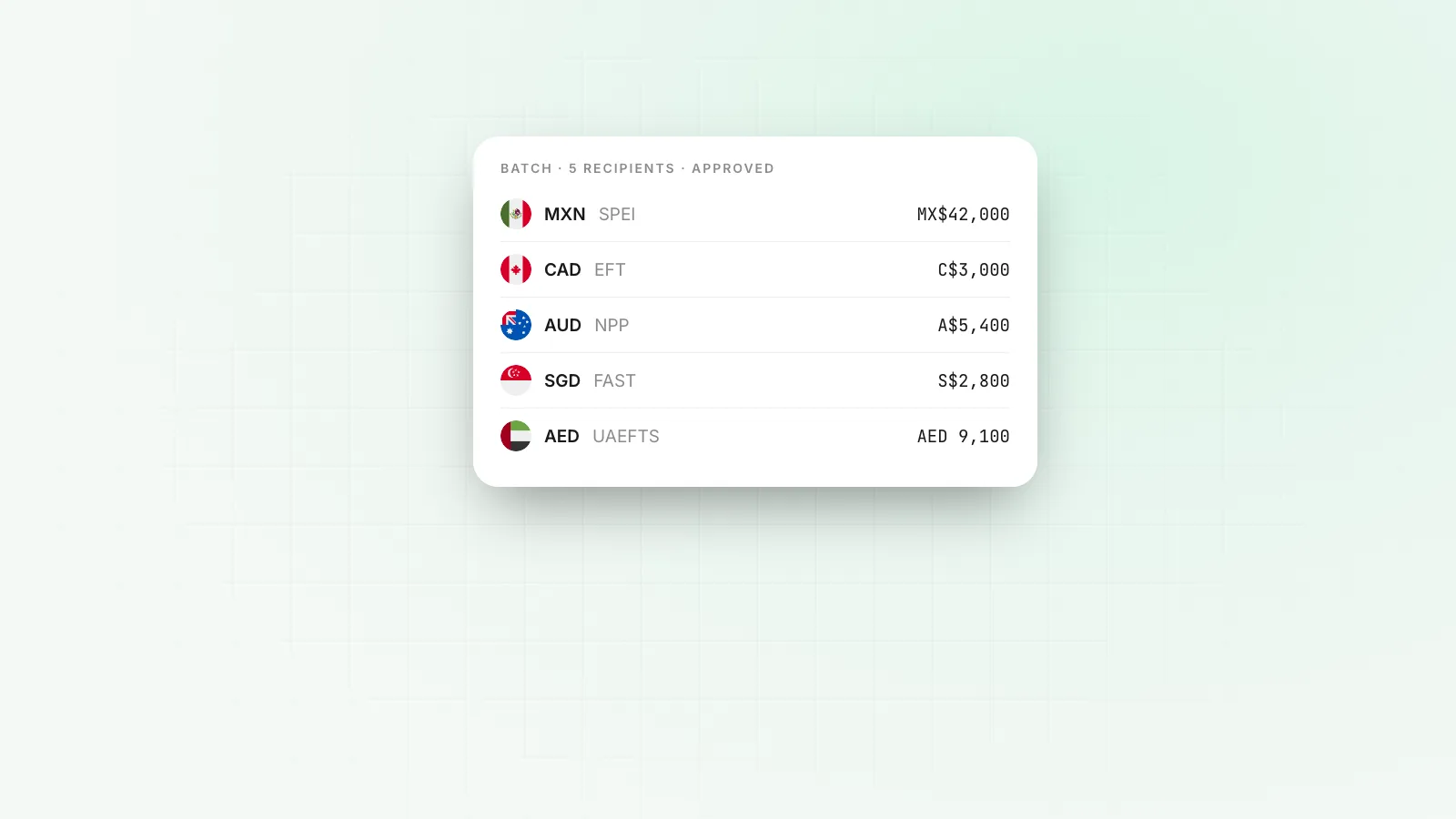
Rivet does not run payroll or act as an EOR. It pays contractors and suppliers in 120+ countries in one batch from Payouts, each in their own currency on their local rail, or in USDC or USDT where there is no local rail, with the cost of every leg shown before you send.
Questions people ask
How do I pay remote employees in another country?
Either through your own registered entity in that country, running local payroll, or through an employer of record, which employs the person on your behalf. You cannot normally pay someone as an employee in a country where neither you nor an EOR is the legal employer.
What is an employer of record?
A company that legally employs a worker in their country on your behalf. It runs local payroll, withholds taxes, provides required benefits and holds the employment contract, while the worker does your work. You pay the EOR a monthly fee plus the employment cost.
Can I pay remote workers as contractors?
Yes, if they really are independent contractors: they control how they work, can work for others, invoice you and carry their own business risk. If they work full time for you under your direction, many countries would treat them as employees.
What payroll taxes apply to remote employees abroad?
Usually those of the country where the employee works, not where your company is. Social contributions, income tax withholding and mandatory benefits differ by country. An EOR or local payroll provider handles them; contractor payouts do not.
Sources
William covers what happens once a company starts moving money: getting the business verified, paying contractors and suppliers abroad, and keeping card spend under control. William writes for the founder or finance lead who has to make it work this week, and links every rule cited to the text it comes from.
More from William Sunjo M. →This article is general information, not legal, tax or financial advice. Rules and fees change; check the sources above and the provider’s current terms before you act on them.
- payroll for remote employees
- payroll for remote teams
- employer of record
- eor
- contractor payouts