Maltese companies with clients outside the euro area: collecting dollars and pounds
Malta's service companies sell heavily to the UK and the US, partly for language and historical reasons. Those clients pay in pounds and dollars. Into a euro account, each payment is converted at the bank's rate, and US wires often lose a fee on the way.
- Published
- Reading time
- 2 min read
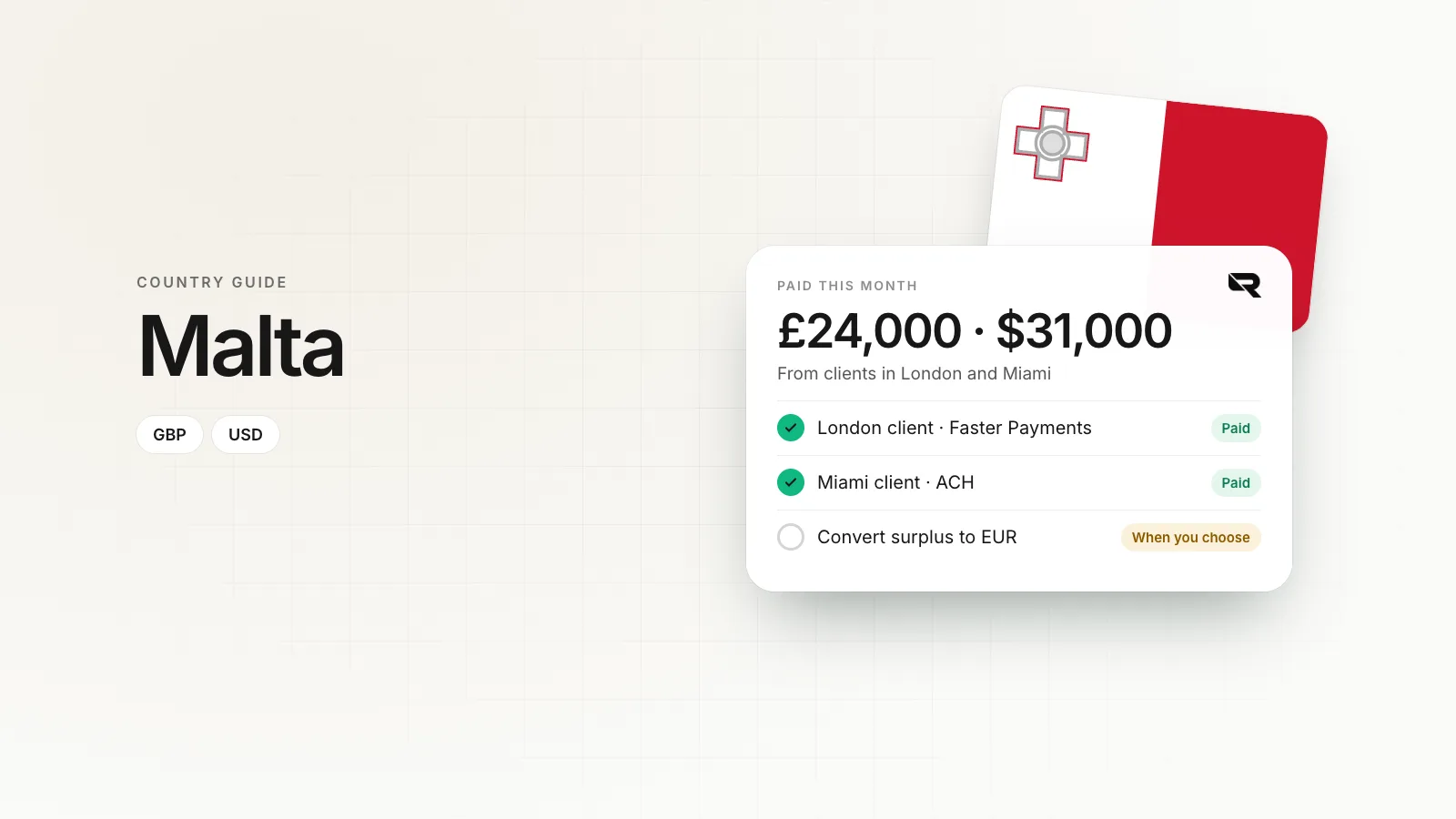
A Sliema digital agency works for a retailer in London and a hospitality group in Miami. London pays in pounds by international transfer, which the agency's bank converts into euros. Miami wires dollars, which arrive a week late and $35 short, converted too. The agency's costs include a London freelancer paid in pounds and US software paid in dollars, so it buys both currencies back each month.
VAT on services abroad
For most services a Maltese company sells to businesses in the UK or US, the place of supply is the client's country. The invoice carries no Maltese VAT and states the reason. Keep evidence that the client is a business: company details and a signed engagement letter.
The W-8BEN-E
A US client will usually ask for Form W-8BEN-E before paying. It confirms your company is foreign. For services performed in Malta, payments are generally made without US withholding, and the Malta-US tax treaty covers other income types.
Collect on their rails
UK businesses pay each other by Faster Payments; US businesses by ACH. Asked to pay a Maltese IBAN, both have to send an international transfer, which costs them more and takes longer.
Sterling and US account details in your company's own name change that. The London client pays by Faster Payments, usually in seconds. The Miami client pays by ACH, usually in one to two business days. Both amounts arrive in full, in the invoiced currency.
Keep pounds and dollars for their costs
Many Maltese service companies have costs in the same currencies their clients pay in: UK freelancers, US software, advertising, travel. Paying those from matching balances avoids converting euros back into pounds and dollars. The surplus is converted to euros when you need it, at a rate you see first.
Paying into Malta: the local rail
| What | Detail |
|---|---|
| Local rail | SEPA Instant Credit Transfer |
| Run by | European Payments Council scheme, run by each bank |
| Settlement | Under ten seconds, 24/7 |
| Published fee | By the EU Instant Payments Regulation, no more than the bank charges for a standard SEPA transfer |
Source: European Payments Council: SEPA Instant Credit Transfer. Checked when this guide was last updated; the scheme's own page has the current figures.
Where Rivet fits
A Rivet business account gives a Maltese company US account details in its own name on every plan and, from the Growth plan, sterling details for Faster Payments and euro details with an IBAN. Payments are matched to invoices, balances can be held or converted at a rate shown before you confirm, and Visa company cards spend from any balance. Rivet is not a bank; regulated partner institutions hold the funds.
See also the GBP business account guide.
Questions people ask
Do Maltese companies charge VAT to UK clients?
For most services to UK businesses, no. The place of supply is the UK, and the invoice states that Maltese VAT does not apply.
Can a Maltese company invoice in pounds?
Yes. Record the invoice in euros at a documented rate. Where VAT appears, show it in euros too.
Why do US clients pay late?
Many US accounts payable teams need extra approval for international wires. US account details make the payment domestic.
Should I keep pounds and dollars?
If you have costs in them, yes. Pay those costs from the matching balance and convert the rest when you need euros.
Sources
Rashidatou writes Rivet's guides to how money moves between countries: the payment rails, what each one costs, and the account details a company needs to get paid in another currency. Every figure in Rashidatou's articles is traced to the scheme rulebook, the regulator or the provider's published price list, and those sources are listed at the end.
More from Rashidatou K. →This article is general information, not legal, tax or financial advice. Rules and fees change; check the sources above and the provider’s current terms before you act on them.
- malta
- gbp
- usd
- services
- vat
- w-8ben-e