Japanese companies receiving USD from overseas clients
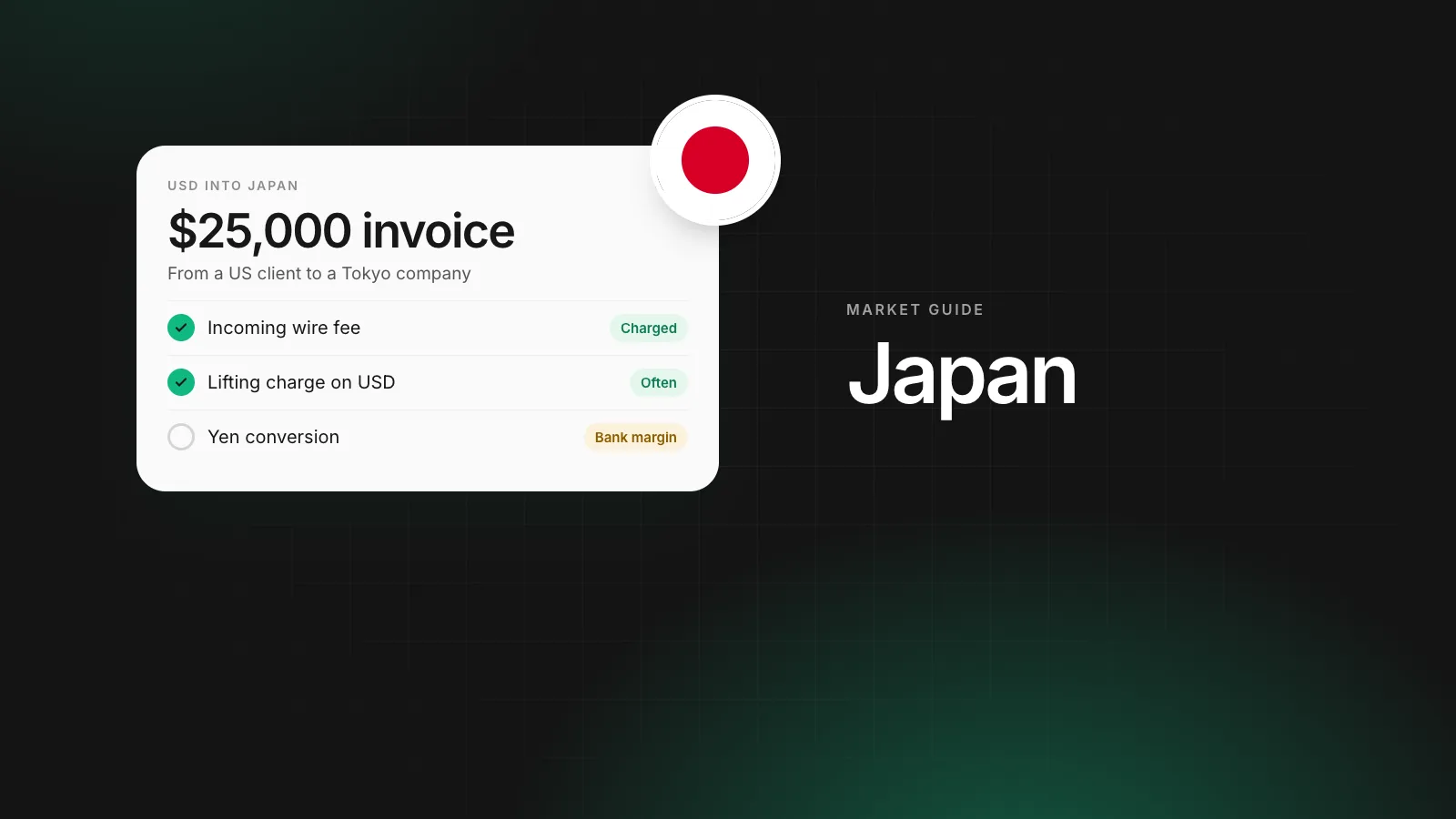
A US client's wire to a Japanese bank meets an incoming fee, often a lifting charge if it stays in dollars, and a conversion margin if it becomes yen. Large receipts also bring a reporting rule.
- Published
- Reading time
- 2 min read
Google suggests "Japan money transfer" and "Japan wire transfer" well before anything about receiving, but for a Japanese company selling software, design or consulting abroad, receiving is the costly direction.
What happens to a US$25,000 wire
- The US client's bank sends a SWIFT payment. An intermediary bank may take a fee.
- The Japanese bank charges an incoming remittance fee.
- If credited in yen, the bank converts at its rate, which includes a margin.
- If credited to a USD account, many banks charge a lifting charge instead.
The company invoiced $25,000 and receives somewhat less, with the gap spread across three lines on the statement.
The reporting rule
Under Article 55 of the Foreign Exchange and Foreign Trade Act, a payment or receipt above 30 million yen between Japan and abroad must be reported to the Minister of Finance. Sources differ on whether the bank or the company files for a given transaction, so ask your bank before your first large receipt. The rule does not stop or delay the payment.
Ways to keep more of the invoice
- Ask clients to send on OUR terms so intermediary fees are theirs.
- Hold USD and pay USD costs from it: cloud services, ads, overseas contractors.
- Convert yen needs in larger, planned amounts instead of every receipt.
- Give US clients US details they can pay by ACH, where your provider supports Japanese companies.
Consumption tax on exports
Services supplied to overseas businesses are often export transactions for consumption tax and exempt, but the rules on place of supply are detailed. Our article on Japan's qualified invoice system covers the invoice side.
Paying into Japan: the local rail
| What | Detail |
|---|---|
| Local rail | Zengin System |
| Run by | Japanese Banks' Payment Clearing Network (Zengin-Net) |
| Settlement | Within the day in core hours; the More-Time System settles around the clock for participating banks |
Source: Zengin-Net. Checked when this guide was last updated; the scheme's own page has the current figures.
Where Rivet fits
Rivet gives registered companies USD details for ACH and wires on the free Starter plan, and EUR and GBP details on Growth, with conversion shown before you confirm. Check our eligibility list for Japanese companies. Rivet is not a bank; regulated partner institutions hold the funds. See receive USD payments from US clients.
Questions people ask
What is a lifting charge?
A fee some Japanese banks charge when a foreign currency payment is credited in the same currency, without converting to yen. It is often a percentage with a minimum.
Do I have to report receiving money from abroad?
Receipts above 30 million yen per transaction must be reported under FEFTA. Banks often guide or handle this; confirm with your bank, since sources differ on who files.
Should I convert USD to yen straight away?
Only what you need for yen costs. Keeping dollars to pay dollar costs avoids a second conversion and its margin.
Can US clients pay a Japanese company by ACH?
Only into US account details. A Japanese bank account receives an international wire.
Sources
Alexia compares the accounts, cards and payment tools companies weigh before they switch, and writes Rivet's market guides for founders in a specific country. Prices in Alexia's comparisons come from each provider's own pricing page on the date given in the article, rules come from the regulator or tax authority that sets them, and every source is listed at the end.
More from Alexia M. →This article is general information, not legal, tax or financial advice. Rules and fees change; check the sources above and the provider’s current terms before you act on them.
- japan receive usd
- japan international transfer
- foreign currency account japan
- fefta
- lifting charge