Irish companies with US clients: collecting dollars without losing a slice of every invoice
An Irish company billing American clients usually receives dollars as an international wire into a euro account. The bank converts on arrival at its own rate, and an intermediary fee can come off the top. US account details change both.
- Published
- Reading time
- 3 min read
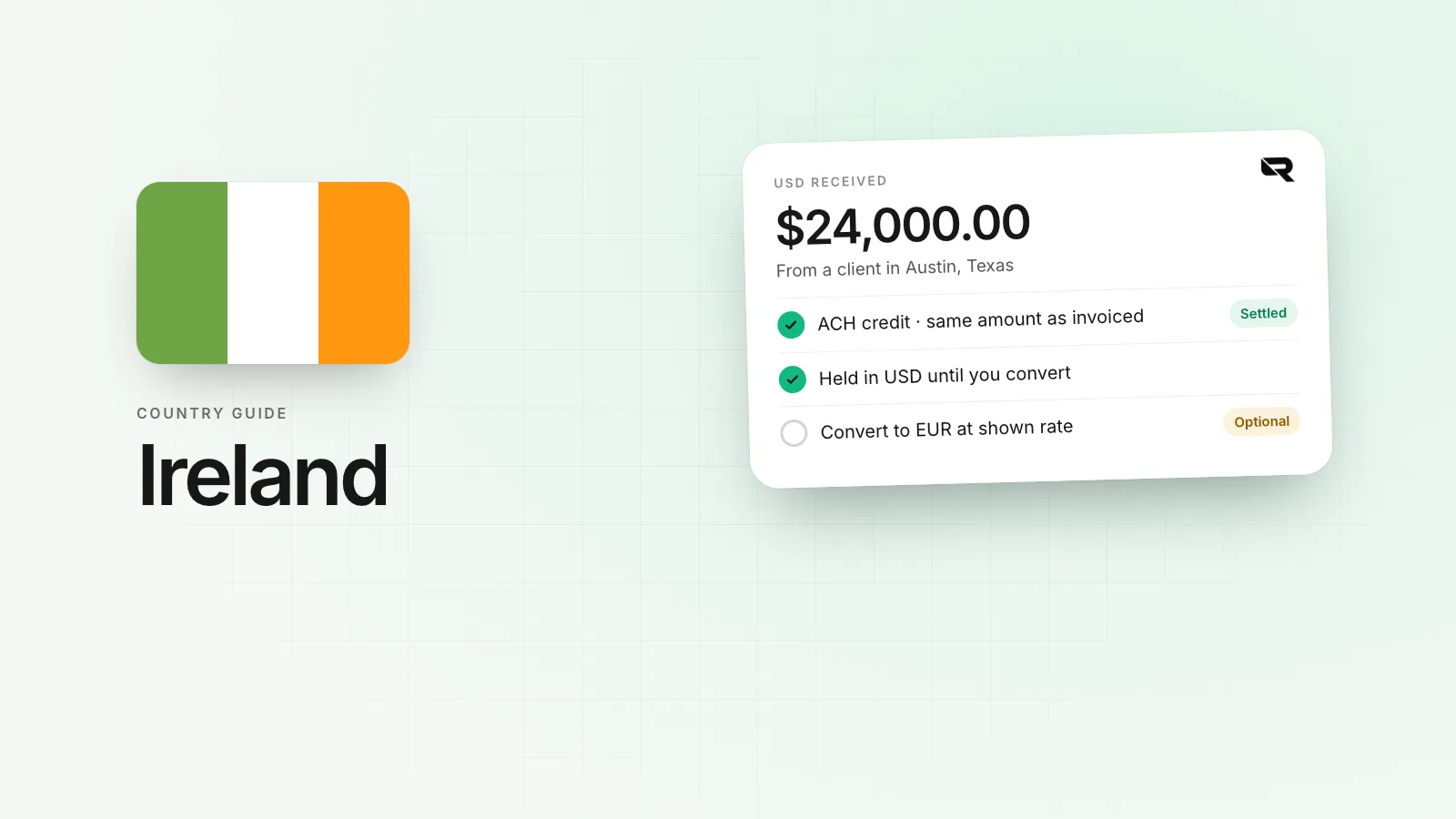
A Galway analytics firm invoices a client in Austin for $24,000. The client pays on time. The firm's euro account shows the equivalent of about $23,700. Nobody stole anything: an intermediary bank took a fee in transit, and the Irish bank converted at its own rate on arrival.
That gap repeats on every invoice, and with American revenue growing it stops being small change.
Why dollar wires shrink
An international wire from a US bank often passes through one or more correspondent banks before reaching Ireland. Each can take a fee. The sender chooses who pays charges, but American accounts payable teams rarely tick "OUR" (sender pays all), so fees come out of the amount.
Then the money lands in a euro account. The bank converts dollars to euros at a rate that includes its margin, typically wider than the rates you see quoted on financial sites. You have no choice about timing either: the conversion happens the day the money arrives.
What American clients prefer
US companies pay each other by ACH, a domestic bank transfer. It is cheap, it is in every accounts payable system, and it needs only an account number and a routing number. An international wire, in contrast, often needs a separate approval, a SWIFT code and a beneficiary address, and some smaller US companies simply pay late because of it.
Giving a US client American account details in your company's name turns a foreign payment into a domestic one for them. The full invoice amount arrives, usually within one to two business days.
The W-8BEN-E
Before the first payment, the client's finance team will probably ask for a W-8BEN-E. It confirms that your company is not a US person. Without it, a US payer may withhold tax on certain payments. With it, and a claim under the Ireland-US tax treaty, payments for services you perform outside the US are generally paid gross.
Fill it in once per client, sign it as an authorised person, and update it if your company's details change. Our W-8BEN vs W-8BEN-E guide walks through the boxes most companies need.
Deciding when to convert
Holding dollars has a second benefit: you choose when to convert. If the company pays AWS, US contractors or advertising in dollars, much of that revenue never needs to become euros. The rest can be converted when you need it, at a rate you see before confirming.
That also gives you room to manage currency risk. See our guide to foreign exchange risk for small businesses.
Paying into Ireland: the local rail
| What | Detail |
|---|---|
| Local rail | SEPA Instant Credit Transfer |
| Run by | European Payments Council scheme, run by each bank |
| Settlement | Under ten seconds, 24/7 |
| Published fee | By the EU Instant Payments Regulation, no more than the bank charges for a standard SEPA transfer |
Source: European Payments Council: SEPA Instant Credit Transfer. Checked when this guide was last updated; the scheme's own page has the current figures.
Where Rivet fits
A Rivet business account gives an Irish company US account details in its own name on every plan, for ACH and wire payments, so American clients pay domestically. From the Growth plan the same account adds euro details with an IBAN and sterling details for UK clients. Dollars can be held, converted at a rate shown before you confirm, or paid out to 120+ countries. Rivet is not a bank; regulated partner institutions hold the funds, and accounts open after the company passes verification.
Questions people ask
Why does a US payment arrive short in my Irish bank account?
Two reasons are common: an intermediary bank deducted a fee as the wire passed through, and your bank converted dollars to euros at a rate with a margin built in. The invoice was paid in full; you received less.
Can an Irish company have a US dollar account?
Yes. Irish banks offer foreign currency accounts, and payment platforms offer US account details that let American clients pay by ACH. Check which one the client's accounts payable team can pay without an international wire.
What is the W-8BEN-E and why do US clients ask for it?
It is an IRS form a foreign company gives a US payer to show it is not a US person. With it, the client does not need to withhold US tax on most service payments, and the company can claim benefits under the Ireland-US tax treaty.
Should I convert dollars to euros straight away?
Only if you need euros. If you pay US software vendors, ad platforms or contractors in dollars, keeping a dollar balance avoids converting twice.
Sources
Rashidatou writes Rivet's guides to how money moves between countries: the payment rails, what each one costs, and the account details a company needs to get paid in another currency. Every figure in Rashidatou's articles is traced to the scheme rulebook, the regulator or the provider's published price list, and those sources are listed at the end.
More from Rashidatou K. →This article is general information, not legal, tax or financial advice. Rules and fees change; check the sources above and the provider’s current terms before you act on them.
- ireland
- usd account
- ach
- w-8ben-e
- us clients
- fx