FDIC insurance and fintech business accounts: how coverage works
Fintech business accounts are not banks. Deposits sit at partner banks, and FDIC insurance passes through only if records show whose money is whose. That is the question to ask.
- Published
- Reading time
- 1 min read
Search "is Mercury a trustworthy bank" or "is Relay bank legit" and you are asking a deposit insurance question. Fintech accounts are not banks, and their coverage depends on how they hold your money.
How it works
| Layer | Role |
|---|---|
| You | The customer |
| Fintech | The app and account provider |
| Partner bank | Holds the deposits; FDIC member |
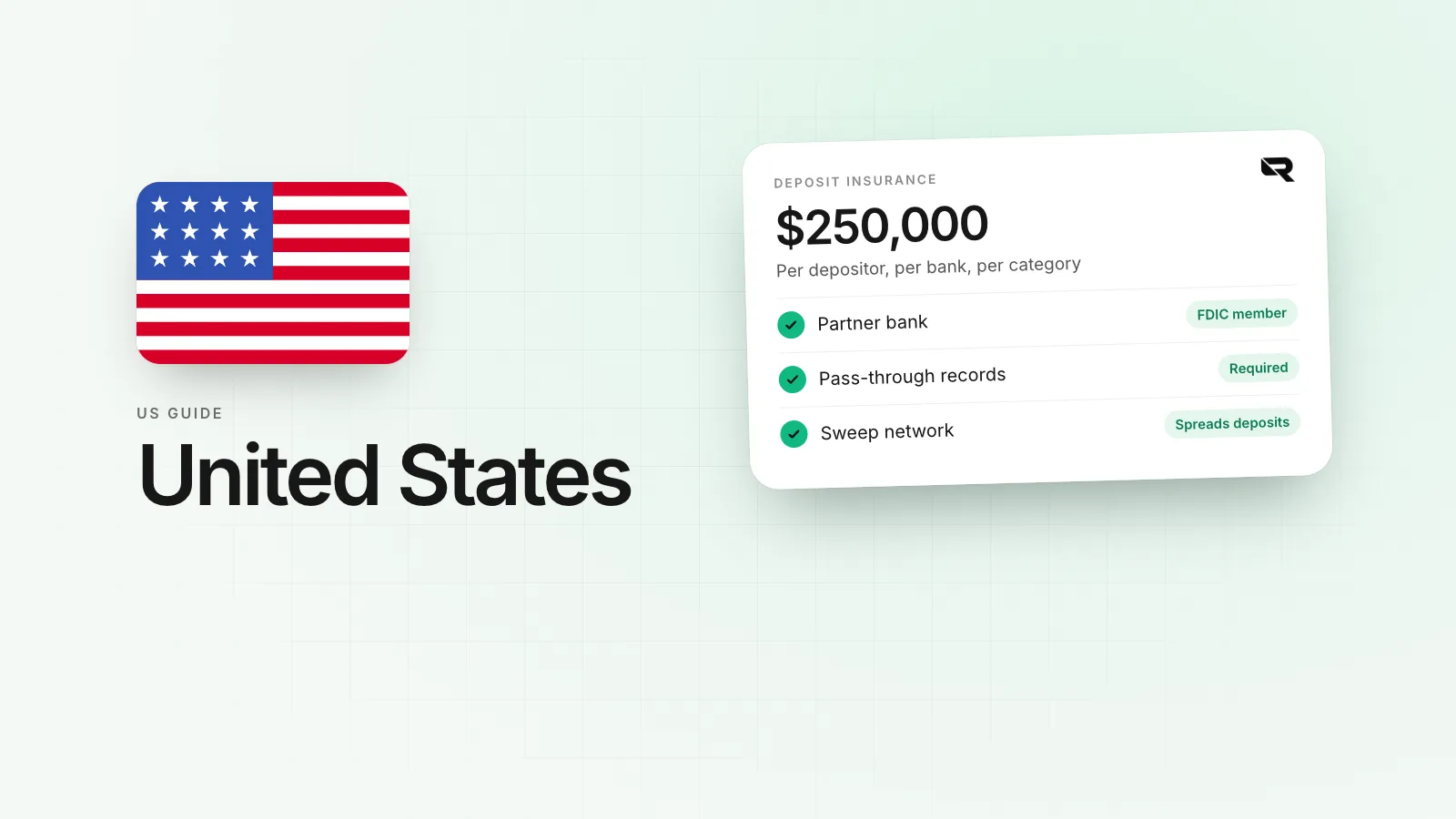
| FDIC | Insures up to $250,000 per depositor per bank per category |
Pass-through insurance treats each customer as the depositor, if records show who owns what.
Sweep networks
Some providers spread balances across many partner banks. Mercury, for example, advertises up to $5M of coverage this way. Each bank covers up to $250,000.
Synapse
In 2024, Synapse, a middleware firm between fintech apps and banks, went bankrupt. Records did not reconcile, and some end users waited months for funds. The FDIC proposed stronger recordkeeping rules for custodial accounts afterwards.
Questions to ask
- Which banks hold my money?
- Is coverage pass-through, and on what conditions?
- Is there a sweep network?
- Who keeps the ledger?
Non-bank money
Funds in treasury products, stablecoins or e-money are not FDIC deposits. Ask how they are protected.
Paying into the United States: the local rail
| What | Detail |
|---|---|
| Local rail | ACH for batch payments; RTP and FedNow for instant transfers |
| Run by | Nacha for ACH; The Clearing House for RTP; the Federal Reserve for FedNow |
| Settlement | Same-day ACH within the business day, standard ACH the next; RTP and FedNow in seconds, 24/7, where both banks take part |
Source: Nacha: Same Day ACH. Checked when this guide was last updated; the scheme's own page has the current figures.
Where Rivet fits
Rivet is not a bank. Regulated partner institutions hold and move customer funds, and Rivet keeps a ledger of every balance change. Ask us which partner holds your balance and how. See is Wise or Payoneer safe for business money.
Questions people ask
Are fintech business accounts FDIC insured?
The fintech is not. Deposits held at its partner bank can be insured on a pass-through basis if conditions are met. Read the disclosures.
What is pass-through insurance?
Coverage that passes from a custodial account at a bank to each underlying owner, if the bank's or fintech's records identify each owner and amount.
What happened with Synapse?
Synapse, a middleware company between fintechs and banks, went bankrupt in 2024. Some end users could not access funds while records were reconciled.
What should I ask a provider?
Which banks hold the money, how pass-through coverage works, whether a sweep network is used, and how records are kept.
Sources
Alexia compares the accounts, cards and payment tools companies weigh before they switch, and writes Rivet's market guides for founders in a specific country. Prices in Alexia's comparisons come from each provider's own pricing page on the date given in the article, rules come from the regulator or tax authority that sets them, and every source is listed at the end.
More from Alexia M. →This article is general information, not legal, tax or financial advice. Rules and fees change; check the sources above and the provider’s current terms before you act on them.
- fdic insurance
- fintech business account
- pass-through insurance
- sweep network
- synapse
- us