Is Wise or Payoneer safe for business money? Safeguarding explained
People search "is Wise safe" and "is Payoneer safe" every day. The honest answer is about how the money is held, not whether the app is legitimate.
- Published
- Reading time
- 2 min read
"Is wise safe" and "is payoneer safe" are among the most searched questions about either company. Both are legitimate, regulated businesses used by millions of people. The useful question for a business is narrower: how is your money protected while it sits there, and what are the realistic ways to lose access to it?
Payment company or bank?
Wise, Payoneer, PayPal and Airwallex are payment or e-money companies, not banks. Some fintechs, Revolut among them, now hold banking licences in certain countries, so check which entity holds your account. That matters because the two are protected differently.
| Bank | Payment or e-money company | |
|---|---|---|
| Main protection | Deposit insurance (FSCS 120,000 GBP in the UK; FDIC 250,000 USD in the US) | Safeguarding |
| What happens if it fails | Insurer pays eligible depositors, usually quickly | Safeguarded money is returned through administration, often slowly |
| Lends out your money | Yes | No; customer funds are kept separate |
What safeguarding means
Regulators such as the UK's FCA require payment and e-money firms to keep customer money separate from their own, in safeguarding accounts at banks or in approved low-risk assets. If the firm fails, that money belongs to customers, not creditors.
It is real protection. It is also slower than deposit insurance: past UK failures took months to return money, and administrators' costs come out first.
What about FDIC "pass-through" coverage?
In the US, some fintechs hold customer money at partner banks in accounts set up so that FDIC insurance can pass through to each customer. That only works if the bank and the fintech keep accurate records of who owns what. FDIC insurance covers the bank failing, not the fintech.
The more likely risk: a freeze
For a business, a provider going bust is rare. An account review is common. When activity does not match what you declared, providers restrict the account while they investigate, and funds can be held for days or weeks. See why business accounts get closed.
How to spread the risk
- Keep a second business account with a different provider, set up and verified before you need it.
- Do not leave more than a few months of costs in any single payment company.
- Keep your KYB file current: ownership, activity, expected volumes.
- Move surplus cash to a bank deposit or a treasury product if you hold large balances.
On Rivet
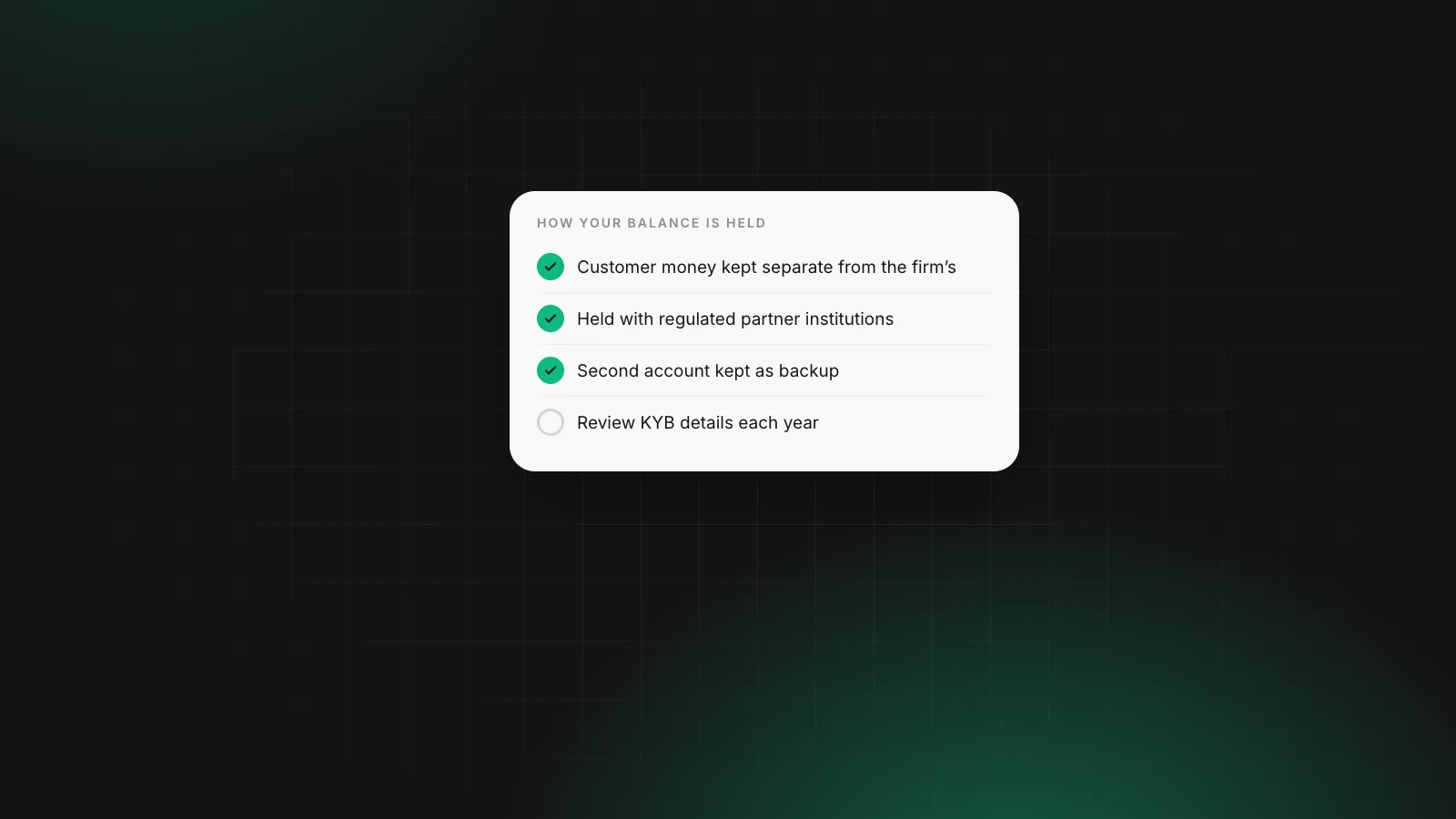
Rivet is not a bank. Funds are held by regulated partner institutions, and Rivet's role is to give your company account details, cards and payouts on top. We recommend every business keep more than one account, ours included. See Services for how Rivet works.
Questions people ask
Is Wise safe for business?
Wise is a regulated payment and e-money company in the countries it operates in, and it safeguards customer money. It is not a bank, so UK FSCS deposit protection does not apply to most balances. For most businesses, the practical risk is an account review, not the firm failing.
Is Payoneer safe to store money?
Payoneer is licensed as a money transmitter and e-money issuer in various jurisdictions and safeguards customer funds. Like other payment companies, it is not a bank. Holding large balances for long periods with any single payment company concentrates risk.
What happens to my money if a payment company goes bust?
Safeguarded money should be returned to customers through an administration process, after the administrator's costs. In past UK cases, this has taken months. That is why safeguarding is protection, but slower and less certain than deposit insurance.
Is Payoneer safer than PayPal?
Both are regulated payment companies that safeguard customer money. Neither is a bank. The difference for a business is fees, which countries they serve, and how each handles reviews and holds.
Sources
William covers what happens once a company starts moving money: getting the business verified, paying contractors and suppliers abroad, and keeping card spend under control. William writes for the founder or finance lead who has to make it work this week, and links every rule cited to the text it comes from.
More from William Sunjo M. →This article is general information, not legal, tax or financial advice. Rules and fees change; check the sources above and the provider’s current terms before you act on them.
- is wise safe
- is payoneer safe
- safeguarding
- fscs
- fdic