Australian startups with offshore teams in the Philippines and India: contractors, EOR and payments
Australian startups often hire developers, designers and support staff in Manila and Bengaluru. Some engage contractors directly, others use an employer of record. Both work, if the arrangement matches how people actually work and the money reaches them in their own currency.
- Published
- Reading time
- 1 min read
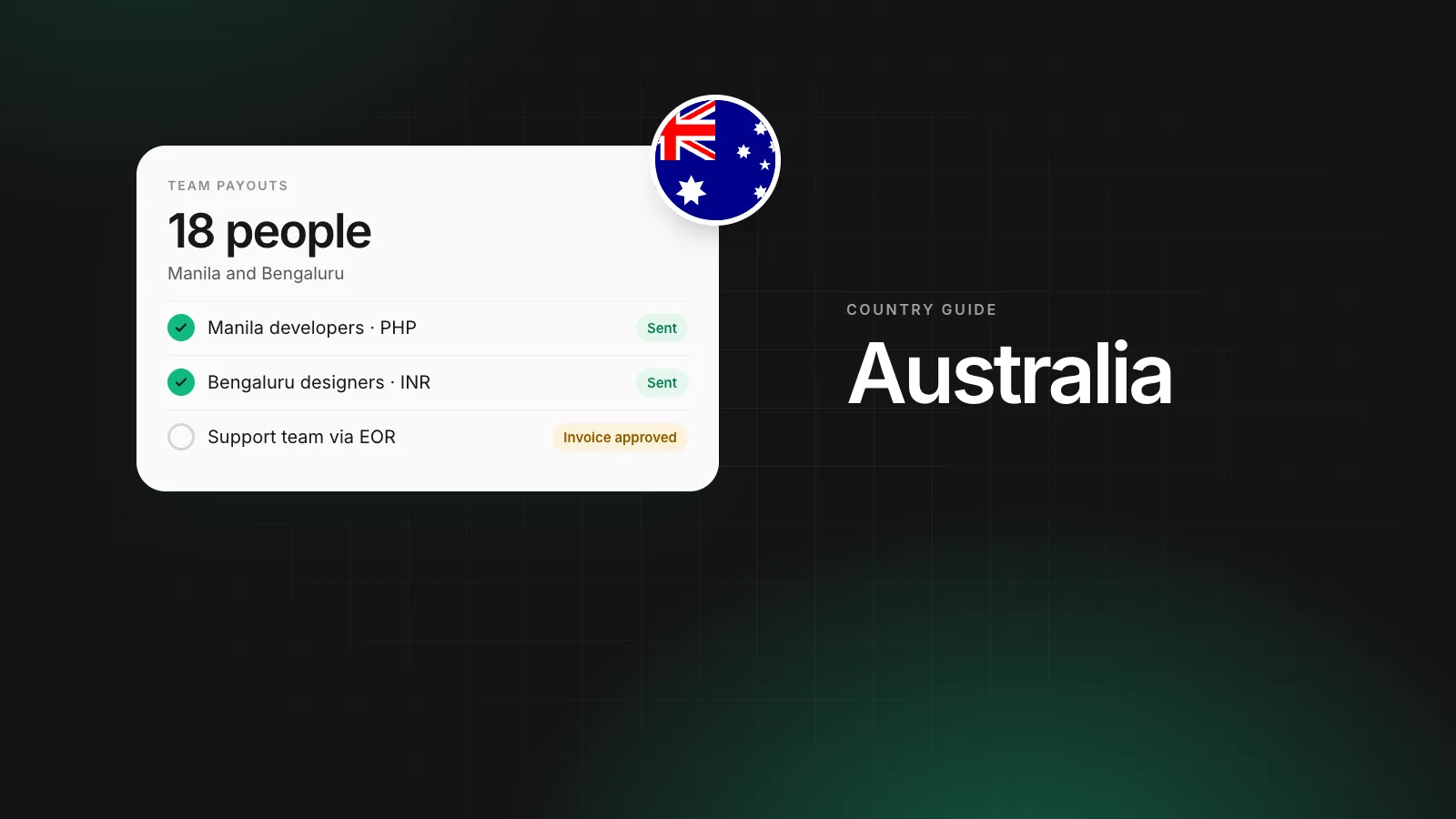
A Sydney fintech has 18 people offshore: eight developers in Manila, six designers and analysts in Bengaluru, and four customer support staff in Cebu employed through an employer of record. The developers and designers invoice monthly as contractors. The support staff are on the EOR's local payroll, and the EOR invoices the fintech.
Contractors or EOR
Contractors suit project-based, independent work: defined deliverables, own tools, own hours, other clients allowed. The startup pays their invoices.
Employers of record employ people locally and handle payroll, benefits and local compliance, invoicing the startup a fee on top of employment costs. They suit people who work full time, under your direction, for the long term.
Misclassification is judged under the worker's local law. In the Philippines and India, long-term, exclusive, full-time contractor arrangements can be treated as employment.
Records for the ATO
For contractor payments, keep:
- The contract.
- Each invoice.
- Proof of payment and the exchange rate used.
These support the deduction in the startup's tax return.
Paying in local currency
AUD by SWIFT to Manila or Bengaluru is converted by the contractor's bank, often with fees. Paying pesos and rupees on local rails delivers the invoiced amount. Indian contractors' banks need a clear purpose on each payment, such as "software development services", to classify it as an export of services.
Paying into Australia: the local rail
| What | Detail |
|---|---|
| Local rail | New Payments Platform (Osko and PayID) |
| Run by | NPP Australia |
| Settlement | Seconds, 24/7 |
Direct Entry (BECS) still carries batch payroll and supplier runs, settling several times a day.
Source: NPP Australia. Checked when this guide was last updated; the scheme's own page has the current figures.
Where Rivet fits
A Rivet business account pays contractors in 120+ countries, including the Philippines and India, in local currency where available. Bulk payouts send the month together, rates show before you confirm, and from the Growth plan a second approver can be required. Rivet is not a bank; regulated partner institutions hold the funds.
Questions people ask
Should we use contractors or an EOR?
Contractors suit independent, project-based work. When people work full time under your direction for a long period, an employer of record reduces misclassification risk.
What does the ATO expect for offshore contractor payments?
Records showing the payment was a business expense: contracts, invoices and proof of payment, with the exchange rate used.
How do Indian contractors receive payments?
In rupees, through their bank, which needs a clear purpose to classify the payment as an export of services.
How do Filipino contractors prefer to be paid?
Usually pesos to a bank account or e-wallet. Ask and record it.
Sources
William covers what happens once a company starts moving money: getting the business verified, paying contractors and suppliers abroad, and keeping card spend under control. William writes for the founder or finance lead who has to make it work this week, and links every rule cited to the text it comes from.
More from William Sunjo M. →This article is general information, not legal, tax or financial advice. Rules and fees change; check the sources above and the provider’s current terms before you act on them.
- australia
- offshore teams
- philippines
- india
- contractors
- eor