USD account details explained: routing number, account number and SWIFT code
A US client asks for your bank details and you send five lines of numbers. Here is what each one does, which ones the client needs, and the mistakes that bounce payments.
- Published
- Updated
- Reading time
- 2 min read
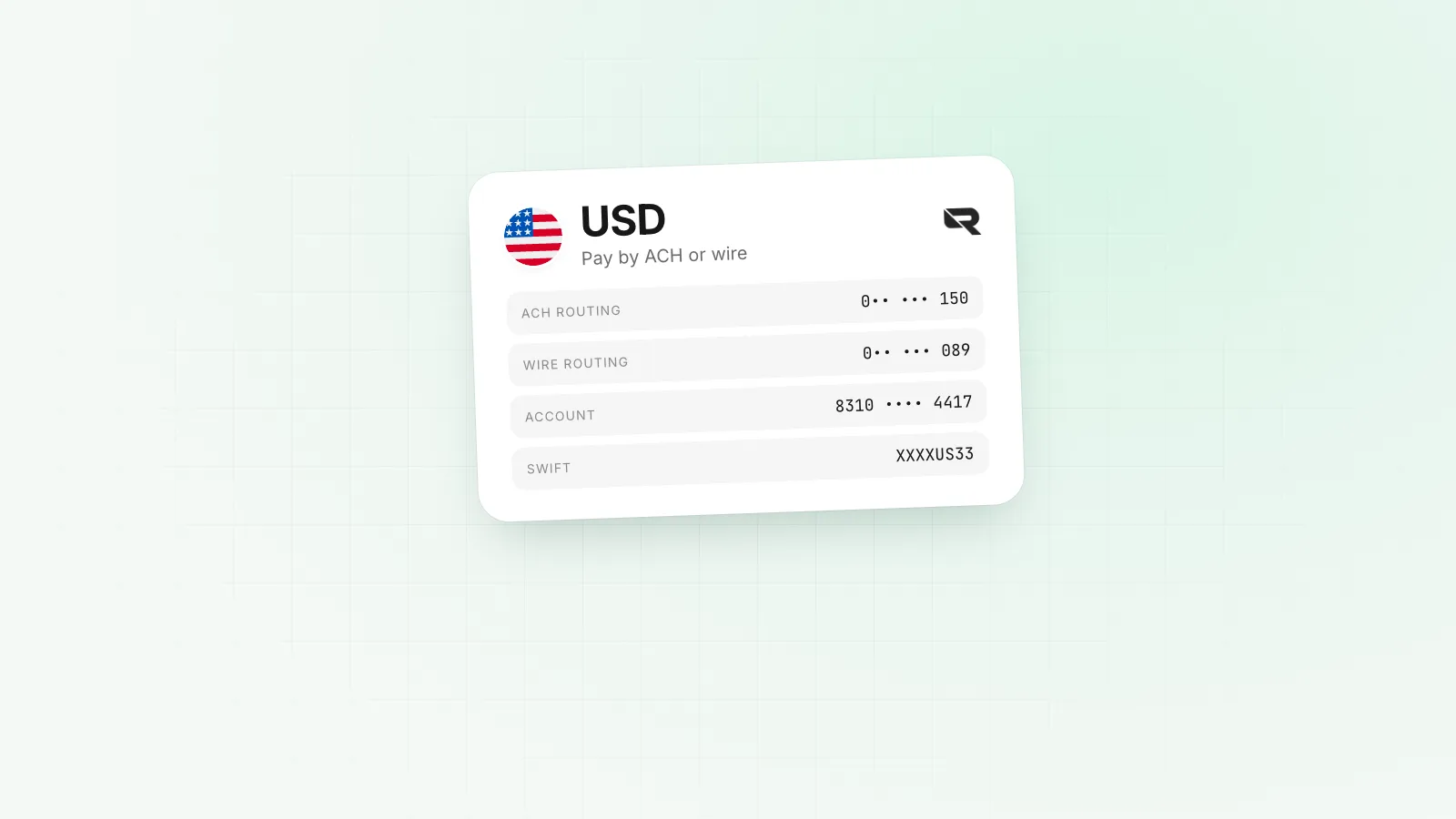
"Usd account number example" and "dollar account number sample" are searched by founders filling in a client's vendor form for the first time. The form asks for six fields, two of which look the same. Here is what each one is for.
The lines in a set of US account details
| Field | What it is | Example format |
|---|---|---|
| Account name | The legal name the account is held in | Your company's registered name |
| Account number | Identifies your account at the bank | 8 to 17 digits |
| ACH routing number | Identifies the bank for ACH payments | 9 digits |
| Wire routing number | Identifies the bank for incoming wires | 9 digits; may match the ACH number |
| Account type | Checking or savings | Usually checking |
| Bank name and address | The bank holding the account | As published by the bank or provider |
| SWIFT/BIC code | For international wires only | 8 or 11 characters |
Routing numbers: ACH and wire
The ABA routing number is a 9-digit code that identifies a US financial institution. The American Bankers Association created the system, and every US bank has at least one.
Some banks use the same routing number for ACH and wires; others publish a separate number for incoming wires. Using the ACH number for a wire, or the reverse, can delay or bounce the payment. If your details list both, label them clearly on your invoices.
Account number
The account number identifies your account at that bank. US account numbers have no fixed length and no check digits, so a typo can send money to the wrong account or get it returned. Ask clients to copy and paste, not retype.
SWIFT code
A SWIFT/BIC code identifies a bank on the SWIFT network. US clients paying by ACH or domestic wire do not use it. Clients outside the US sending an international wire need it, along with the account number and often the wire routing number. US accounts do not have IBANs; the IBAN guide explains what to give a European payer.
A layout to put on invoices
Pay by ACH or domestic wire (US)
Account name:    [Your Company Ltd]
Account number:  [xxxxxxxxxx]
ACH routing:     [xxxxxxxxx]
Wire routing:    [xxxxxxxxx]
Account type:    Checking
Bank:            [Bank name, address]

Pay by international wire (outside the US)
SWIFT/BIC:       [XXXXXXXX]
Reference:       [Invoice number]
The mistakes that bounce payments
- Account name does not match the invoice or vendor record.
- Wrong routing number for the rail.
- Missing or wrong reference, so the payment cannot be matched.
- Details sent as an image the client retypes.
Protecting clients from fake bank-detail changes
The FBI's Internet Crime Complaint Center reports business email compromise as one of the costliest forms of fraud. The common version: an email "from" a supplier announces new bank details. Tell clients, in writing, that you will never change your details by email alone, and that any change will be confirmed by phone.
USD details on Rivet
Rivet issues USD details in your company's name on the free Starter plan, with the routing and account numbers for ACH and wires, so US clients pay you like any US supplier. See Bank accounts, or ACH vs wire for which rail to ask for.
Questions people ask
What does a USD account number look like?
US account numbers are usually between 8 and 17 digits, with no letters. The routing number is always 9 digits. Unlike an IBAN, there is no country code or check digits at the start.
Is the ACH routing number the same as the wire routing number?
Sometimes, not always. Many banks use the same number for both, but some publish a separate routing number for incoming wires. Use the one your bank or provider lists for each rail.
Do US clients need my SWIFT code?
No, not for ACH or a domestic wire. A SWIFT/BIC code is used for international wires, when the payer's bank is outside the US. Include it on your details for clients abroad.
What is the account type, checking or savings?
Some US payment forms ask whether the account is checking or savings. Business accounts used for payments are normally checking accounts. If your provider states the account type, use what it says.
Sources
Rashidatou writes Rivet's guides to how money moves between countries: the payment rails, what each one costs, and the account details a company needs to get paid in another currency. Every figure in Rashidatou's articles is traced to the scheme rulebook, the regulator or the provider's published price list, and those sources are listed at the end.
More from Rashidatou K. →This article is general information, not legal, tax or financial advice. Rules and fees change; check the sources above and the provider’s current terms before you act on them.
- usd account number example
- routing number
- ach routing number
- wire routing number
- swift code