UAE e-invoicing: the timeline for businesses from 2026 and what to prepare
The UAE Ministry of Finance has set out mandatory e-invoicing for B2B and B2G transactions, delivered through accredited service providers on a five-corner, Peppol-based model. Larger businesses go first. Every VAT-registered business will be affected.
- Published
- Reading time
- 2 min read
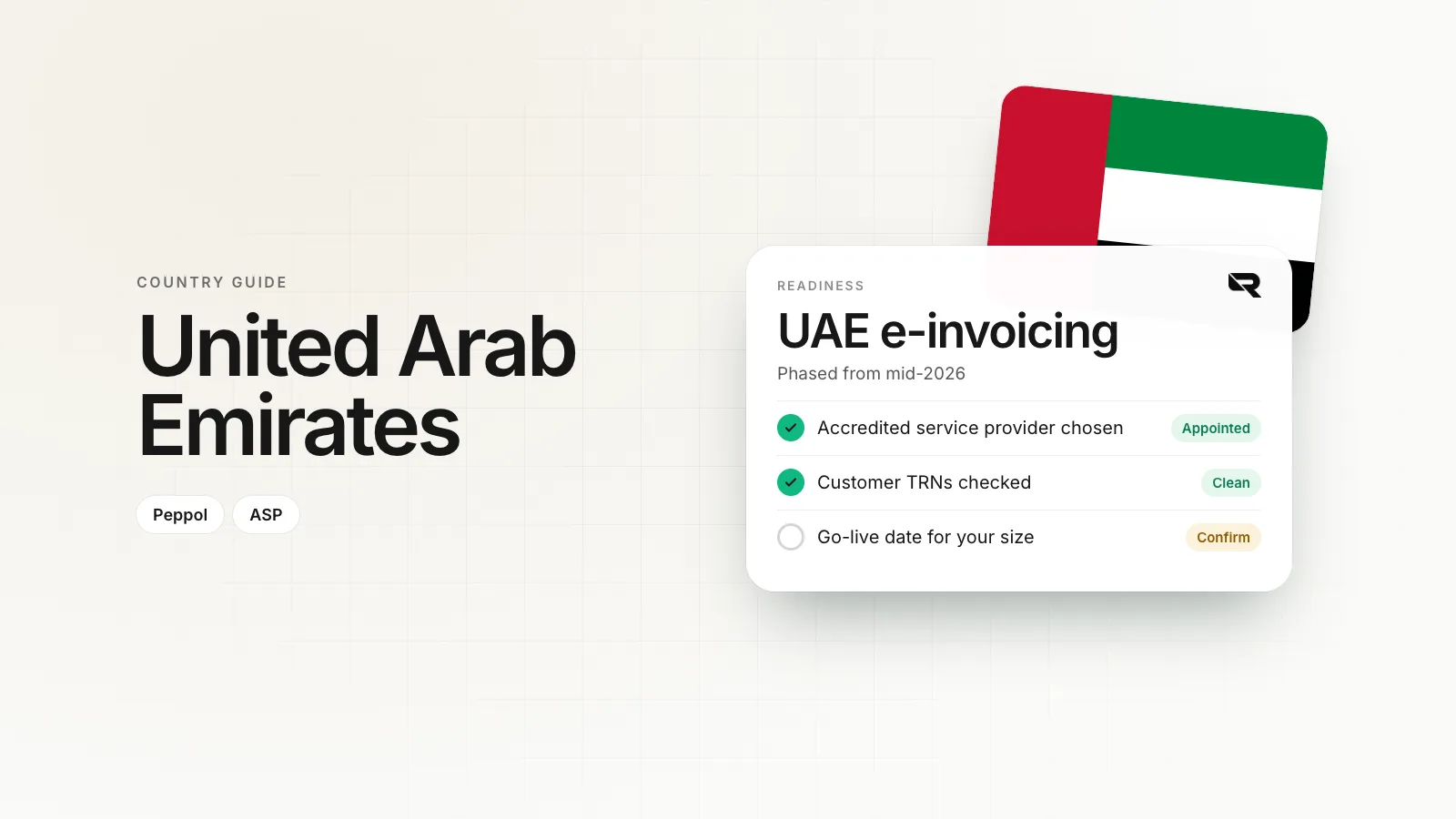
A Dubai trading company sends 300 invoices a month to customers across the UAE and the Gulf. Its VAT invoices are PDFs today. Under the UAE's e-invoicing programme, its domestic invoices will travel as structured data through an accredited service provider, which also reports them to the Federal Tax Authority. Its accounting team has a go-live date to confirm and a provider to choose.
The model
The UAE chose a decentralised, five-corner model based on Peppol:
- the seller sends an invoice through its accredited service provider (ASP),
- the ASP exchanges it with the buyer's ASP on the network,
- both report the invoice data to the FTA.
The Ministry of Finance publishes the UAE data dictionary and specifications that ASPs implement.
The timeline
The programme starts with a pilot and voluntary adoption, then mandatory phases by business size, larger businesses first, running from 2026 into 2027. The Ministry has issued decisions setting the dates. Check the latest one for the date that applies to your company.
Steps to take now
- Appoint an ASP, or confirm your ERP provider's plan to connect to one.
- Clean customer data. Each UAE customer's TRN and legal name must be correct.
- Map your invoices. Separate domestic B2B, B2G, B2C and exports, since each has its own treatment.
- Plan receiving. Supplier invoices will arrive as structured data. Decide how they are approved.
Foreign clients
The programme is built around transactions between UAE businesses and with government. Exports and other cross-border invoices have their own treatment in the detailed rules. VAT on exports remains zero-rated when the conditions are met.
The payment side
E-invoicing changes how invoices travel, not how clients pay. Foreign clients still pay UAE accounts by international transfer. US, EU and UK clients pay faster when they can use their own domestic rails. See our AED business account guide.
Paying into the United Arab Emirates: the local rail
| What | Detail |
|---|---|
| Local rail | Aani instant payments |
| Run by | Al Etihad Payments, owned by the Central Bank of the UAE |
| Settlement | Seconds, around the clock |
UAEFTS carries larger same-day transfers between banks.
Source: Al Etihad Payments: Aani. Checked when this guide was last updated; the scheme's own page has the current figures.
Where Rivet fits
Rivet is not an accredited service provider. A Rivet business account accepts registered companies after verification, including UAE mainland and free zone companies, with US account details on every plan and euro and sterling details from the Growth plan, so foreign clients pay locally. Rivet is not a bank; regulated partner institutions hold the funds.
Questions people ask
When does e-invoicing start in the UAE?
The Ministry of Finance published a phased timeline beginning with a pilot and voluntary adoption in 2026 and mandatory phases by business size from 2026 into 2027. Check the latest Ministry decision for your date.
What is an accredited service provider?
A provider approved by the authorities to exchange e-invoices between businesses on the network and report invoice data to the FTA.
Is the UAE using Peppol?
Yes. The model is based on Peppol's five-corner architecture, with the UAE's own data specifications.
Do invoices to foreign clients go through the system?
The model focuses on transactions between UAE businesses and with government. Exports and other cross-border invoices are addressed in the detailed rules; confirm with your provider.
Sources
William covers what happens once a company starts moving money: getting the business verified, paying contractors and suppliers abroad, and keeping card spend under control. William writes for the founder or finance lead who has to make it work this week, and links every rule cited to the text it comes from.
More from William Sunjo M. →This article is general information, not legal, tax or financial advice. Rules and fees change; check the sources above and the provider’s current terms before you act on them.
- uae
- e-invoicing
- peppol
- fta
- vat
- ministry of finance