Mercury vs Relay: which business account fits your company in 2026
Mercury and Relay are the two online business accounts US founders compare most. Mercury is built around free wires and a startup toolkit. Relay is built around many checking accounts for budgeting. Neither is a multi-currency account.
- Published
- Updated
- Reading time
- 2 min read
"Mercury bank vs Relay bank" is the most typed Mercury comparison on Google. That makes sense. Both are online business accounts for US companies, both start free, and both sit on partner banks. They are built for different jobs.
Prices below are from each provider's pricing page, read on 4 November 2026.
The plans side by side
| Mercury | Relay | |
|---|---|---|
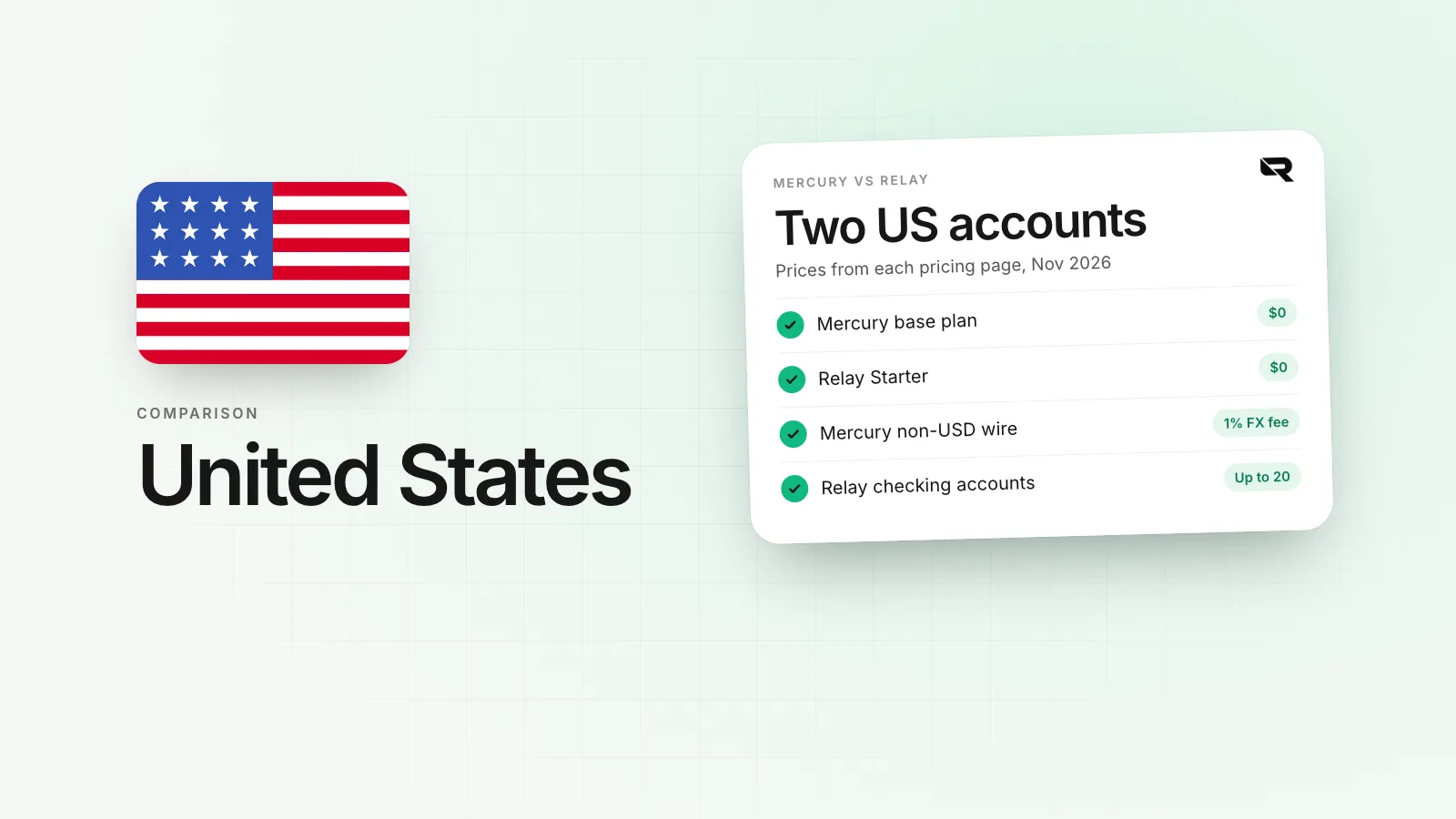
| Free plan | Mercury, $0 | Starter, $0 |
| Paid plans | Plus $29.90, Pro $299 a month | Grow $30, Scale $120 a month (listed at $90 on a limited-time discount) |
| Domestic wires | $0 on all plans | Not listed on the pricing page |
| International wires | $0 in USD; 1% FX fee if converted | Not listed; international payments run through a partner |
| Checking accounts | Multiple accounts | Up to 20 per business (50 on Scale) |
| Cards | Debit and IO credit card, 1.5% cash back | Up to 50 debit cards per cardholder per account |
| Partner banks | Choice Financial Group, Column N.A. | Thread Bank |
Mercury: wires and a startup toolkit
Mercury's headline is free wires. Domestic wires and USD international wires cost $0 on every plan, and for $15 you can send a wire on OUR terms so intermediary fees do not come out of the recipient's amount. A wire converted to another currency costs 1%. Card spend in another currency costs 3%. Mercury also sells treasury, payroll and bookkeeping, and it advertises FDIC coverage up to $5M through partner banks and their sweep networks.
Relay: many accounts, one business
Relay's appeal is structure. You can open up to 20 checking accounts and label them for taxes, payroll, owner pay and operating spend. Bookkeepers like it because the money is already sorted before month end. Relay's pricing page says additional transaction fees apply but did not show wire or FX amounts when we checked.
What neither does
Both hold US dollars. If a client in Germany wants to pay by SEPA, or a contractor in Mexico wants pesos, you are sending a converted wire and paying the spread. For a company whose revenue and costs are mostly in the US, that is fine. For one that earns or pays in several currencies every month, it is the main cost.
Paying into the United States: the local rail
| What | Detail |
|---|---|
| Local rail | ACH for batch payments; RTP and FedNow for instant transfers |
| Run by | Nacha for ACH; The Clearing House for RTP; the Federal Reserve for FedNow |
| Settlement | Same-day ACH within the business day, standard ACH the next; RTP and FedNow in seconds, 24/7, where both banks take part |
Source: Nacha: Same Day ACH. Checked when this guide was last updated; the scheme's own page has the current figures.
Where Rivet fits
Rivet is a multi-currency business account. The free Starter plan gives your company USD details for ACH and wires. Growth adds EUR and GBP details in the company's name, local payouts to 120+ countries and FX from 0.50%, shown before you confirm. Rivet is not a bank; regulated partner institutions hold the funds. Compare our plans on Pricing, or read Mercury alternatives for non-US companies if your owners live abroad.
Questions people ask
Is Mercury or Relay better for a startup?
Mercury suits venture-backed startups that send wires and want treasury and credit products in one place. Relay suits small businesses that split money into many accounts for taxes, payroll and spending. Both are fintech companies working with partner banks.
Does Relay charge for wires?
Relay's pricing page says additional transaction fees apply but did not list wire amounts when we checked in November 2026. Check the fee schedule in your Relay account before you rely on it for international payments.
Can a non-US resident open Mercury or Relay?
Both are built for US-registered businesses. Neither pricing page states its rules for owners who live abroad, so check the eligibility page before you apply. Rivet accepts US LLCs whose owners live in supported countries.
Which is cheaper for international payments?
Mercury publishes $0 for USD international wires and a 1% fee on wires converted to another currency. If your company converts often, compare that 1% with a multi-currency account where FX starts lower.
Sources
Alexia compares the accounts, cards and payment tools companies weigh before they switch, and writes Rivet's market guides for founders in a specific country. Prices in Alexia's comparisons come from each provider's own pricing page on the date given in the article, rules come from the regulator or tax authority that sets them, and every source is listed at the end.
More from Alexia M. →This article is general information, not legal, tax or financial advice. Rules and fees change; check the sources above and the provider’s current terms before you act on them.
- mercury vs relay
- mercury bank
- relay bank
- business checking
- startups
- comparison