Lithuanian transport companies: getting paid by clients across Europe and controlling road costs
Lithuania runs one of Europe's largest road haulage fleets relative to its size. A Vilnius transport company invoices shippers in Germany and France on 60-day terms while paying fuel, tolls and drivers every day. Cash flow decides who survives.
- Published
- Reading time
- 2 min read
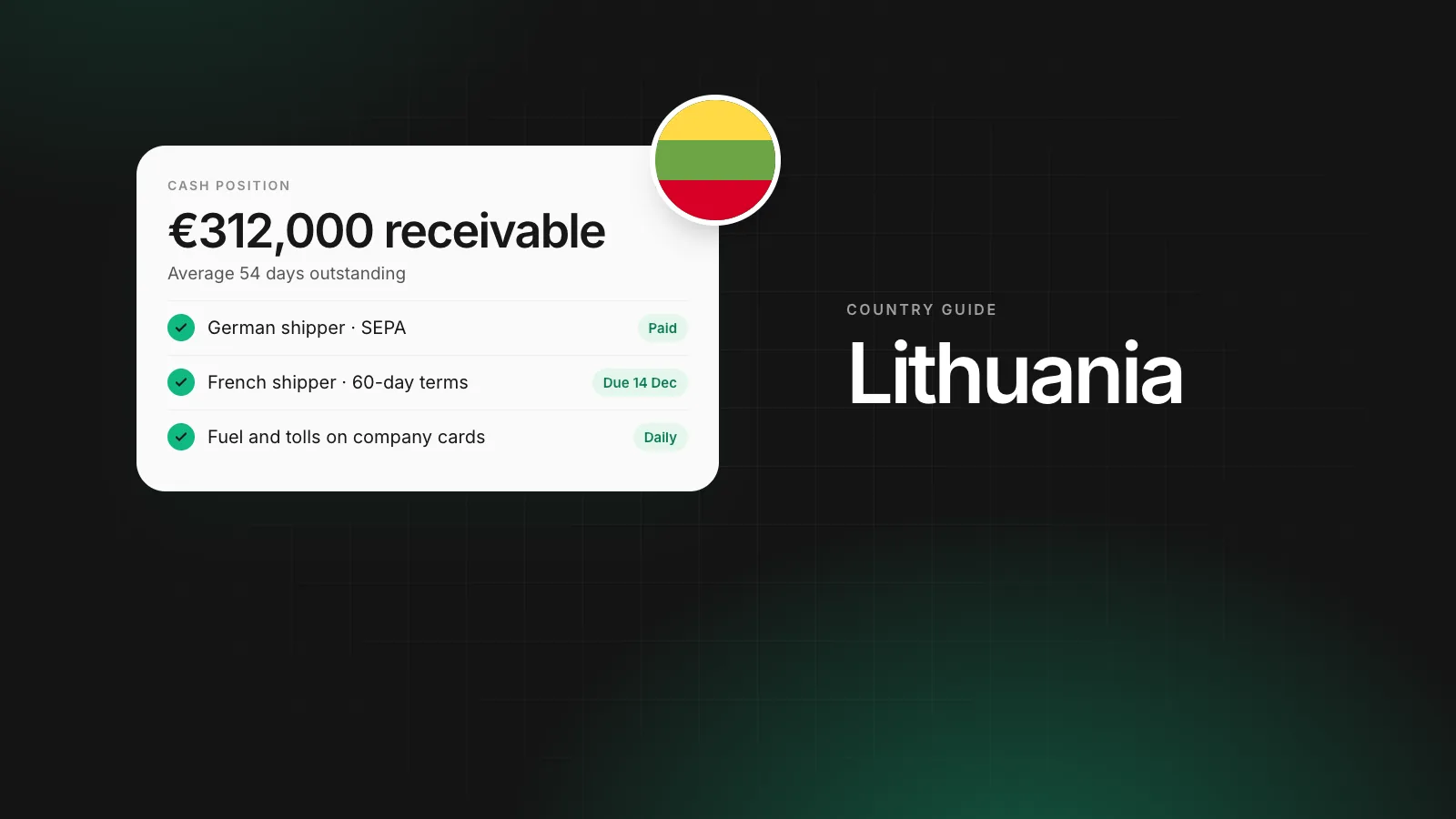
A Vilnius haulier with 40 trucks moves freight for shippers in Germany, France and the Netherlands. Its largest client pays in 60 days, another in 75. Fuel, tolls, ferry crossings and driver allowances are paid every day across five countries. The company is profitable on paper and short of cash most months.
The cash gap
Haulage has a structural mismatch. Revenue arrives on the shipper's terms; costs leave on the road's terms. For a fleet of 40 trucks, two months of receivables can easily equal several months of fuel.
What the law allows
The EU Late Payment Directive, implemented in Lithuanian law, caps business payment terms at 60 days unless the parties expressly agree otherwise and the term is not grossly unfair to the creditor. When a client pays late, you can claim statutory interest and a fixed €40 recovery cost per invoice. Few hauliers enforce it with their biggest clients, but stating it on invoices changes behaviour.
Getting paid faster
Most delays come from incomplete invoices:
- Invoice the day delivery is confirmed.
- Attach the CMR consignment note and signed proof of delivery. Use the e-CMR where the shipper accepts it.
- Quote the shipper's purchase order or transport order number exactly.
- Send to the address their accounts payable team uses, not the dispatcher's.
Some hauliers use invoice factoring for slow payers: a financier pays most of the invoice now for a fee. It helps cash flow but costs margin, so it is best kept for specific clients.
Controlling road spending
Drivers need to pay for fuel, tolls, parking and repairs abroad. Shared cards or cash advances make it hard to see who spent what. Company cards issued per driver or per truck, each with its own limit, keep spending visible and tied to trips. A card can be frozen the moment a driver leaves.
Currencies on the road
Most of the EU is in euros, but routes through Poland, Czechia, Hungary, Sweden, Norway or the UK mean costs in other currencies. Paying them from a card that draws on a euro balance at a fair rate, or from a matching currency balance, avoids high card conversion fees.
Paying into Lithuania: the local rail
| What | Detail |
|---|---|
| Local rail | SEPA Instant Credit Transfer |
| Run by | European Payments Council scheme, run by each bank |
| Settlement | Under ten seconds, 24/7 |
| Published fee | By the EU Instant Payments Regulation, no more than the bank charges for a standard SEPA transfer |
Source: European Payments Council: SEPA Instant Credit Transfer. Checked when this guide was last updated; the scheme's own page has the current figures.
Where Rivet fits
A Rivet business account gives a Lithuanian company euro details with an IBAN from the Growth plan, so shippers pay by SEPA, and Visa company cards with per-card limits for drivers, drawing on balances in several currencies. From Growth, spending and payouts can require approvals. Rivet is not a bank; regulated partner institutions hold the funds.
See also net 30 payment terms and expense management for small businesses.
Questions people ask
What payment terms do shippers usually ask for?
Thirty to 60 days is common, and some large shippers ask for longer. The EU Late Payment Directive lets businesses claim statutory interest and a fixed recovery cost when they pay late.
Can a Lithuanian haulier charge interest on late payments?
Yes. Under the Late Payment Directive as implemented in Lithuania and other EU states, statutory interest and a €40 fixed compensation can be claimed from late-paying business clients.
How do I speed up payment from shippers?
Send the invoice the day the delivery is confirmed, attach the CMR and proof of delivery, and use the shipper's purchase order or reference exactly.
How should drivers pay for fuel and tolls?
With company cards or fuel cards limited per driver and vehicle, so spending is controlled and records match each trip.
Sources
Rashidatou writes Rivet's guides to how money moves between countries: the payment rails, what each one costs, and the account details a company needs to get paid in another currency. Every figure in Rashidatou's articles is traced to the scheme rulebook, the regulator or the provider's published price list, and those sources are listed at the end.
More from Rashidatou K. →This article is general information, not legal, tax or financial advice. Rules and fees change; check the sources above and the provider’s current terms before you act on them.
- lithuania
- transport
- logistics
- payment terms
- fuel cards
- eur