Lithuania's i.SAF reporting: how invoices to foreign clients are declared
Lithuania's tax authority has received invoice-level data from VAT payers every month since 2016 through i.SAF. Sales to foreign clients and purchases from foreign suppliers are part of the register. Mismatches with the VAT return are the first thing the VMI checks.
- Published
- Reading time
- 2 min read
A Kaunas furniture manufacturer issues invoices to clients in Sweden, Germany and the US, and buys hardware from Poland and software from America. Every one of those documents goes into a monthly register uploaded to the State Tax Inspectorate through i.SAF. When the register and the VAT return disagree, the VMI notices before the company does.
What i.SAF is
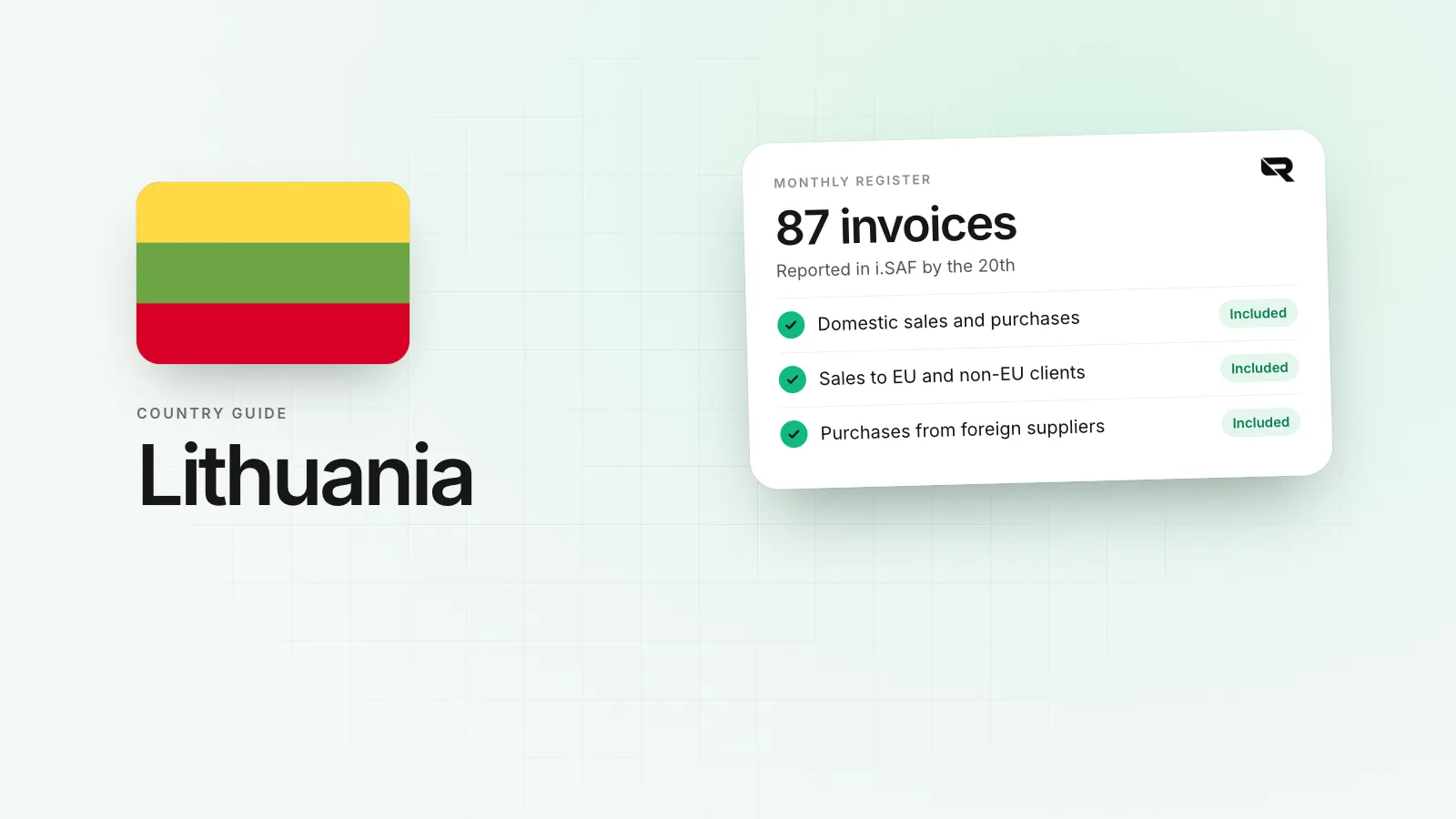
i.SAF is the VMI's invoice data subsystem, part of its electronic accounting system. Every Lithuanian VAT payer submits a register of the invoices it issued and received each month, in a standard XML format generated by accounting software or entered through the VMI portal. The deadline is the 20th of the following month.
It is a reporting obligation for data. The invoices themselves can be PDFs for private-sector clients. Public sector buyers receive e-invoices through the eSaskaita system.
Foreign transactions are in it
The register is complete, not domestic-only. It includes:
- sales to EU businesses, with their VAT numbers,
- sales to businesses outside the EU,
- purchases from EU and non-EU suppliers, including services such as software subscriptions.
For each, the counterparty's country and identifier go in. Missing foreign purchases are a common reason the VMI asks questions, because reverse-charge VAT on them should also appear in your return.
VAT on foreign sales
For most services to EU businesses, the invoice shows no Lithuanian PVM, includes both VAT numbers and refers to the reverse charge. Intra-EU sales also go in the EU sales list. For services to businesses outside the EU, the invoice states that they are not subject to Lithuanian VAT.
Getting paid
Lithuania uses the euro and is in SEPA, so EU clients pay a Lithuanian IBAN directly. American clients asked to pay a Lithuanian IBAN send an international wire, which may lose fees on the way and, into a euro account, is converted at the bank's rate. US account details in the company's own name let them pay by ACH, in full.
Paying into Lithuania: the local rail
| What | Detail |
|---|---|
| Local rail | SEPA Instant Credit Transfer |
| Run by | European Payments Council scheme, run by each bank |
| Settlement | Under ten seconds, 24/7 |
| Published fee | By the EU Instant Payments Regulation, no more than the bank charges for a standard SEPA transfer |
Source: European Payments Council: SEPA Instant Credit Transfer. Checked when this guide was last updated; the scheme's own page has the current figures.
Where Rivet fits
Rivet does not submit i.SAF registers; your accounting software does that. A Rivet business account handles foreign collections: US account details on every plan, and euro details with an IBAN plus sterling details from the Growth plan, all in the company's name. Payments are matched to invoices, and each statement line carries the rate for your bookkeeper. Rivet is not a bank; regulated partner institutions hold the funds.
Questions people ask
What is i.SAF?
The VMI's invoice data subsystem. VAT payers upload a register of issued and received invoices each month, in a standard XML format or through the VMI portal.
Are invoices to foreign clients included?
Yes. Sales to foreign businesses and purchases from foreign suppliers belong in the register, with the counterparty's country and identifier.
When is i.SAF due?
By the 20th day of the month following the reporting month.
Does i.SAF replace e-invoicing?
No. It is a reporting obligation for invoice data. Invoices to clients can be PDFs; e-invoicing through the eSaskaita system applies to public sector buyers.
Sources
William covers what happens once a company starts moving money: getting the business verified, paying contractors and suppliers abroad, and keeping card spend under control. William writes for the founder or finance lead who has to make it work this week, and links every rule cited to the text it comes from.
More from William Sunjo M. →This article is general information, not legal, tax or financial advice. Rules and fees change; check the sources above and the provider’s current terms before you act on them.
- lithuania
- i.saf
- vmi
- vat
- reverse charge
- uab