Korean SaaS companies billing overseas customers in USD
A Korean SaaS company selling to US and European customers earns in dollars and euros and pays salaries in won. The VAT, FX evidence and conversion timing decide how much of each sale it keeps.
- Published
- Reading time
- 2 min read
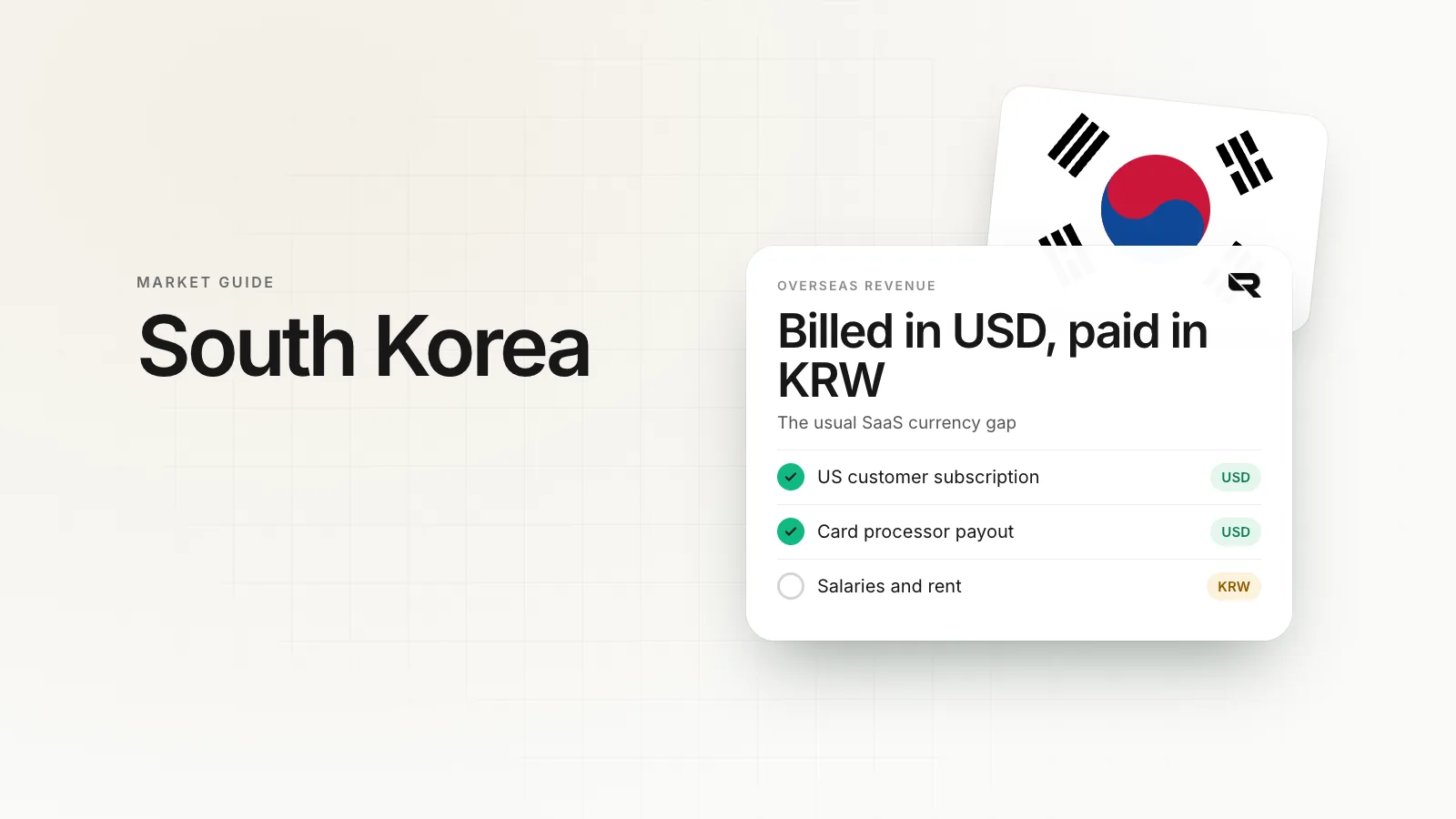
Korean software companies selling abroad have a currency mismatch built in. Revenue arrives in USD and EUR. Salaries, rent and most taxes are in won. The way money moves between those two sides decides margins more than most pricing changes.
VAT on overseas sales
Korea's VAT Act zero rates many services supplied to foreign businesses when payment comes in foreign currency through a foreign exchange bank. A US company subscribing to a Korean analytics tool and paying in dollars is usually a zero-rated sale. Keep the contract, invoice and foreign currency receipt together; that is the evidence.
Corporate tax in 2026
Korea's 2026 tax reform, enacted in December 2025, raised corporate tax by one point per bracket:
| Taxable income | 2026 rate |
|---|---|
| Up to KRW 200 million | 10% |
| KRW 200 million to 20 billion | 20% |
| KRW 20 billion to 300 billion | 22% |
| Above KRW 300 billion | 25% |
Local income tax adds 10% of the national tax. A later bill proposed cutting the first bracket again; check its status before planning.
Where FX costs hide
A company with $100,000 of monthly card revenue that converts each payout to won, then buys dollars to pay AWS and US contractors, converts twice. On a 1% margin each way, that is up to $2,000 a month.
A better flow
- Settle USD payouts into a USD balance.
- Pay USD costs from it.
- Convert the surplus to won in planned amounts.
- Keep each receipt matched to its invoice for the bank and the NTS.
Paying into South Korea: the local rail
| What | Detail |
|---|---|
| Local rail | Interbank transfers through KFTC's electronic banking network |
| Run by | Korea Financial Telecommunications and Clearings Institute |
| Settlement | Seconds, 24/7 |
Source: KFTC. Checked when this guide was last updated; the scheme's own page has the current figures.
Where Rivet fits
Rivet gives registered companies USD details on the free Starter plan and EUR and GBP on Growth, with cards for USD software spend and payouts to 120+ countries. Check our eligibility list for Korean companies. Rivet is not a bank; regulated partner institutions hold the funds. See Korea exporters and US clients.
Questions people ask
Do Korean SaaS companies charge VAT to overseas customers?
Generally not to foreign businesses paying in foreign currency, which is zero rated. Sales to foreign consumers and to Korean customers follow different rules. Check with your tax adviser.
What are Korea's corporate tax rates for 2026?
10% up to KRW 200 million, then 20%, 22% and 25% in higher brackets, for fiscal years beginning on or after 1 January 2026, plus local income tax of 10% of the national tax. A later bill proposed cutting the first bracket again; check its status.
How should we receive USD from US customers?
Card processors pay out to your account; enterprise customers often pay by bank transfer. US customers prefer paying US account details by ACH over sending an international wire.
What evidence do banks ask for?
Under the Foreign Exchange Transactions Act, banks can ask for invoices and contracts to confirm what a foreign receipt is for. Keep them linked to each payment.
Sources
Alexia compares the accounts, cards and payment tools companies weigh before they switch, and writes Rivet's market guides for founders in a specific country. Prices in Alexia's comparisons come from each provider's own pricing page on the date given in the article, rules come from the regulator or tax authority that sets them, and every source is listed at the end.
More from Alexia M. →This article is general information, not legal, tax or financial advice. Rules and fees change; check the sources above and the provider’s current terms before you act on them.
- korea saas
- korea corporate tax rate 2026
- zero rated vat
- usd revenue
- korea receive foreign payments