Korea company registration for foreigners: FDI, capital and the bank account
A foreign-owned Korean company starts with a foreign direct investment notification, then a capital remittance into a designated account, then registration. The bank is involved from the first step.
- Published
- Reading time
- 2 min read

Google's suggestions for "Korea company setup" include "company formation korea" and "how to register a company in Korea". For a foreign founder, the process runs through a bank before the company even exists.
The sequence
- File a foreign investment notification with a foreign exchange bank or KOTRA.
- Remit the investment capital from abroad into the designated account and get the remittance certificate.
- Register the company at the court registry and obtain the business registration certificate from the tax office.
- Register the foreign-invested company status.
- Open the operating corporate account and convert the capital as needed.
The KRW 100 million question
Korea treats investment of KRW 100 million or more as foreign direct investment for most purposes, and the D-8 corporate investor visa generally requires it. Founders who invest less can still own a Korean company but will not get that visa route.
After registration
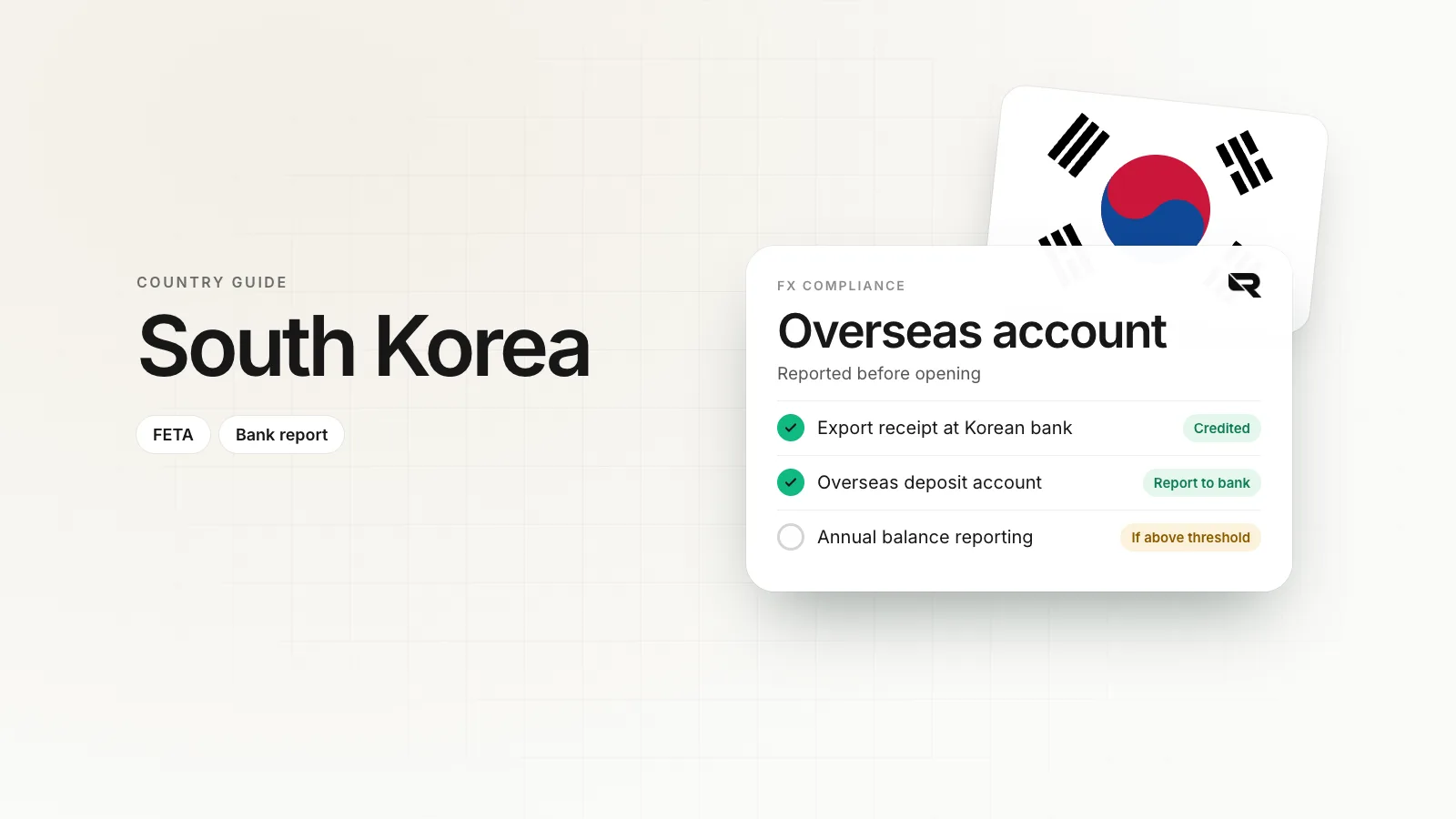
The company now needs to receive payments, pay staff and pay suppliers. Korea's Foreign Exchange Transactions Act means banks ask for evidence on many cross-border payments: invoices, contracts, and the purpose of the transfer. Organise these from the first day.
Common friction for foreign founders
- Name and address formats on the passport, the registry and the bank differ.
- Banks want the representative director present or a power of attorney with apostille.
- Overseas clients may not want to pay a new Korean company by international wire.
Paying into South Korea: the local rail
| What | Detail |
|---|---|
| Local rail | Interbank transfers through KFTC's electronic banking network |
| Run by | Korea Financial Telecommunications and Clearings Institute |
| Settlement | Seconds, 24/7 |
Source: KFTC. Checked when this guide was last updated; the scheme's own page has the current figures.
Where Rivet fits
Rivet is a multi-currency account for registered companies in supported countries. Once your Korean company is registered, check our eligibility list. Where supported, Rivet gives USD details on the free Starter plan and EUR and GBP on Growth, so clients abroad pay on their own local rails. Rivet is not a bank; regulated partner institutions hold the funds, and it does not replace the Korean account that holds the FDI capital. See KYB documents to open a business account.
Questions people ask
Can a foreigner register a company in Korea?
Yes. Foreigners can own Korean companies, usually as a jusik hoesa. Foreign investment is notified under the Foreign Investment Promotion Act, and some sectors have limits.
How much capital do I need?
There is no general minimum for a company, but a foreign-invested company generally needs KRW 100 million or more of foreign investment to qualify for foreign investment status and the D-8 visa.
Why does the bank matter so early?
The foreign exchange bank receives the FDI notification, holds the capital and issues the documents you need to register the company and its foreign investment status.
How does the company get paid by overseas customers?
Through its Korean account, or through foreign currency accounts. Keep the evidence documents banks ask for under the Foreign Exchange Transactions Act.
Sources
Alexia compares the accounts, cards and payment tools companies weigh before they switch, and writes Rivet's market guides for founders in a specific country. Prices in Alexia's comparisons come from each provider's own pricing page on the date given in the article, rules come from the regulator or tax authority that sets them, and every source is listed at the end.
More from Alexia M. →This article is general information, not legal, tax or financial advice. Rules and fees change; check the sources above and the provider’s current terms before you act on them.
- korea company registration
- company formation korea
- foreign investment
- d-8 visa
- korea bank account
- fdi