Paying freelancers abroad from a German GmbH: reverse charge, records and payment rails
Paying a developer in Kraków or a designer in Buenos Aires from a German GmbH is a reverse charge VAT entry, a status question and a payment choice. Get the first two right and the third decides how much the freelancer actually receives.
- Published
- Reading time
- 2 min read
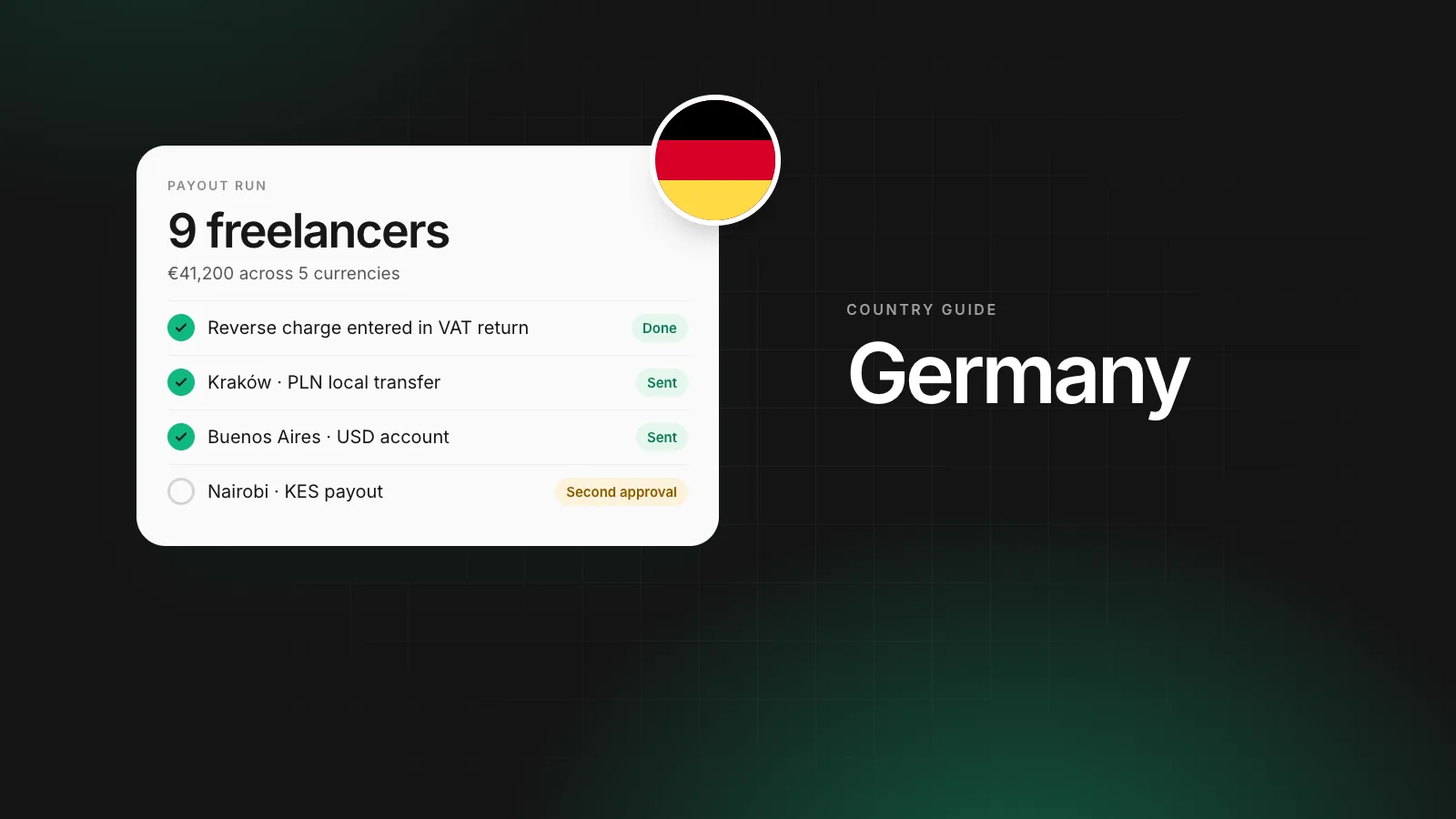
A Berlin product studio works with nine freelancers: developers in Kraków and Bucharest, a designer in Buenos Aires, a copywriter in Lisbon, a data engineer in Nairobi. Each month brings nine invoices in four currencies. Before anything is paid, two entries go into the VAT return and one question sits in the background: are these people really freelancers?
The reverse charge entry
When a GmbH buys services from a business abroad, German VAT usually shifts to the buyer under the reverse charge (§13b UStG). The freelancer's invoice should show no German VAT. For EU freelancers it should carry their VAT number and a note that the reverse charge applies.
The GmbH reports the VAT due in its return, and if it has full input tax deduction, deducts the same amount in the same return. The net cost is zero, but the entries must be there. Missing them is one of the most common findings in German tax audits of small companies.
The status question
German law watches for Scheinselbstständigkeit, bogus self-employment. A freelancer who works full time for one company, follows its schedule, uses its equipment and sits inside its team looks like an employee, whatever the contract says.
For freelancers abroad there are two systems to think about. German social security rules generally attach to work done in Germany. The freelancer's home country has its own rules, and Poland, Spain and Argentina all have them. The practical safeguards are the same everywhere:
- The contract defines deliverables, not hours.
- The freelancer can and does work for other clients.
- They use their own tools and set their own schedule.
- They invoice, rather than receiving a fixed monthly amount regardless of output.
Records
For each payment, keep the contract, the invoice with the freelancer's name, address, service, date and amount, and proof of payment. For non-euro payments, record the exchange rate used. A payment confirmation that shows the rate saves a step at month end.
Choosing the rail
In the eurozone, SEPA is cheap and often instant. Outside it, the choice matters more. A euro SWIFT transfer to Kraków arrives as zloty converted by the freelancer's bank, minus whatever it charges to receive. A local zloty transfer arrives as the invoiced amount.
In Argentina, many freelancers prefer dollars in an account they control rather than pesos. In Kenya, local shillings to a bank account or mobile wallet. Ask each freelancer which they prefer and put it in the contract.
Paying into Germany: the local rail
| What | Detail |
|---|---|
| Local rail | SEPA Instant Credit Transfer |
| Run by | European Payments Council scheme, run by each bank |
| Settlement | Under ten seconds, 24/7 |
| Published fee | By the EU Instant Payments Regulation, no more than the bank charges for a standard SEPA transfer |
Source: European Payments Council: SEPA Instant Credit Transfer. Checked when this guide was last updated; the scheme's own page has the current figures.
Where Rivet fits
A Rivet business account pays freelancers in 120+ countries, on local rails where available, from balances in euros, dollars and other currencies. Bulk payouts send the month's invoices together, and from the Growth plan a second person can be required to approve them. Each payment shows the rate before you confirm and keeps it on the statement. Rivet is not a bank; regulated partner institutions hold the funds.
See also how to pay international contractors.
Questions people ask
How does the reverse charge work for foreign freelancers?
When a GmbH buys services from a freelancer abroad, it usually owes the German VAT instead of the freelancer. It reports the VAT in its return and, if it has full input tax deduction, deducts the same amount, so the net cost is zero but both entries must appear.
Can a foreign freelancer be treated as an employee in Germany?
The risk of Scheinselbstständigkeit (bogus self-employment) depends on the facts: integration into your team, instructions on how and when to work, and working only for you. Freelancers who live abroad also fall under their own country's rules, which are often the bigger risk.
What records does the tax office expect?
A contract, an invoice in the freelancer's name with address, service, date and amount, proof of payment, and for EU freelancers their VAT number where they have one. Keep the exchange rate used for non-euro payments.
Should I pay foreign freelancers in euros?
In the eurozone, yes, by SEPA. Elsewhere, paying in the local currency usually costs the freelancer less than receiving euros and converting at their bank.
Sources
Rashidatou writes Rivet's guides to how money moves between countries: the payment rails, what each one costs, and the account details a company needs to get paid in another currency. Every figure in Rashidatou's articles is traced to the scheme rulebook, the regulator or the provider's published price list, and those sources are listed at the end.
More from Rashidatou K. →This article is general information, not legal, tax or financial advice. Rules and fees change; check the sources above and the provider’s current terms before you act on them.
- germany
- gmbh
- freelancers
- reverse charge
- 13b ustg
- payouts