What is Form M in Nigeria? The import document explained
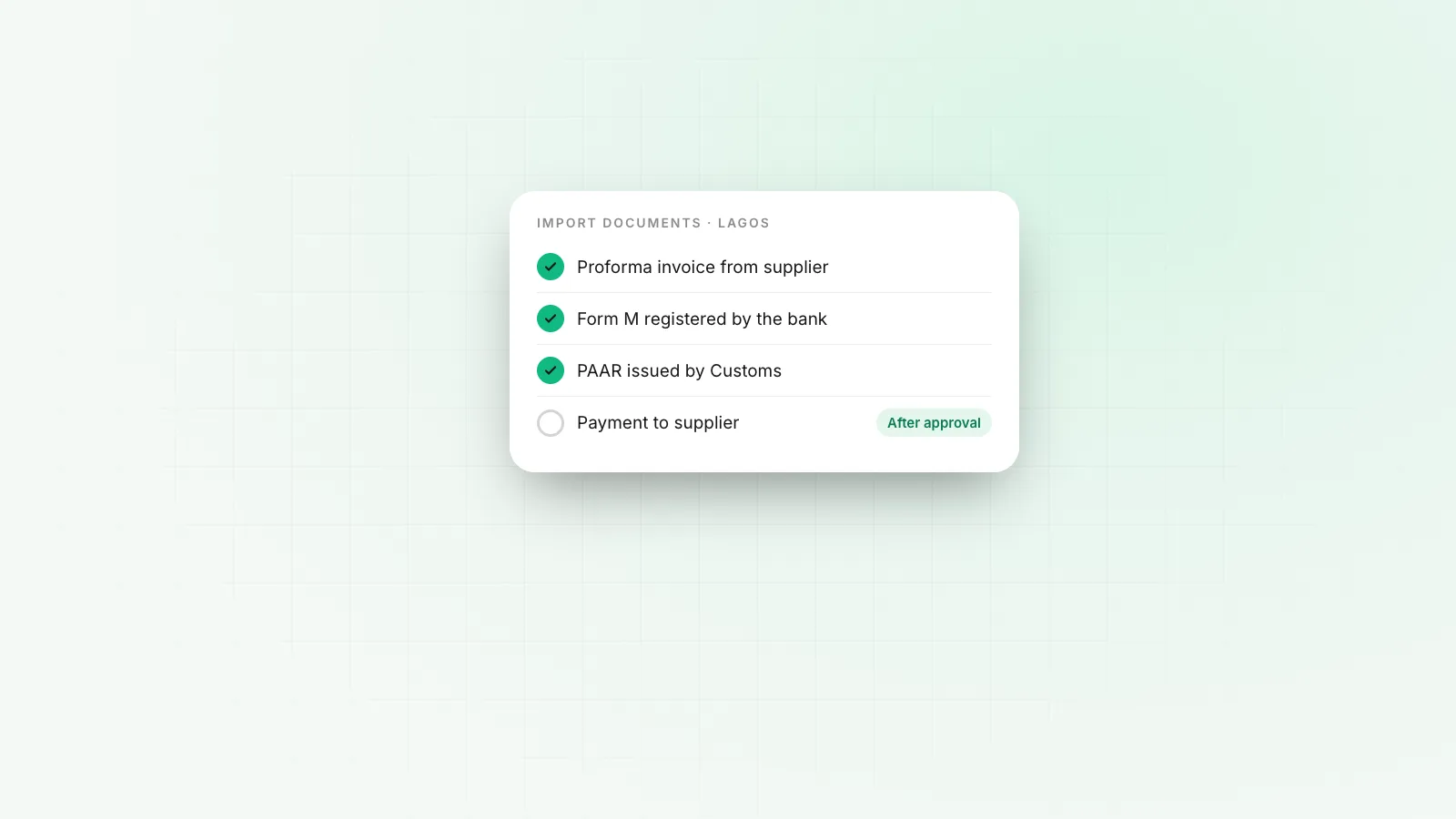
Every import into Nigeria starts with Form M, an electronic declaration filed through an authorised dealer bank on the CBN's trade monitoring system. It records what you are importing, from whom and for how much. Customs uses it to issue the PAAR, and your bank uses it to pay the supplier.
- Published
- Updated
- Reading time
- 2 min read
If you import goods into Nigeria, Form M is the first document in the chain. Without it, your bank will not pay your supplier through official channels, and Customs will not issue the assessment you need to clear the goods.
What is Form M?
Form M is a mandatory electronic declaration for imports into Nigeria. It records the importer, the supplier, the goods, their value, the currency, the port of entry and how the import will be paid for. It is filed through an authorised dealer bank on the Central Bank of Nigeria's trade monitoring system, and the bank forwards it to Customs.
It applies to all commercial imports, regardless of value. A Form M is marked either valid for foreign exchange, where the bank will process the payment, or not valid for foreign exchange, where the importer pays some other approved way.
The rules banks apply are set out in the CBN's Foreign Exchange Manual. A new, 4th edition took effect on 1 June 2026, replacing the 2018 manual, so ask your bank's trade desk which requirements changed for your goods.
What documents do you need?
| Document | Notes |
|---|---|
| Proforma invoice from the supplier | Itemised, with HS codes, quantities, prices and Incoterms |
| Importer's company registration | CAC certificate |
| Tax identification number | Required to access e-Form M |
| Product certificates for regulated goods | Such as SONCAP for standards, or NAFDAC for food and drugs |
| Insurance certificate | Marine insurance from a Nigerian insurer |
The bank may ask for more depending on the goods. Our guide to proforma vs commercial invoices explains what the supplier needs to include.
How does the process work?
- Agree terms with the supplier and get the proforma invoice.
- Submit the e-Form M through your bank with the supporting documents.
- The bank reviews and registers it on the trade monitoring system.
- Once approved, the bank can process the foreign exchange payment if the form is valid for FX.
- The supplier ships, and sends the commercial invoice, bill of lading and packing list.
- Nigeria Customs issues the PAAR (Pre-Arrival Assessment Report) from the Form M and final documents.
- You or your clearing agent pay duty and clear the goods.
How long is Form M valid?
The initial validity is 180 days, and it can be extended once. If the goods have not shipped in time, ask your bank about an extension before the form expires.
How do you pay the supplier?
Under a valid-for-FX Form M, your bank pays the supplier from your naira or domiciliary account, by letter of credit, bills for collection or direct transfer. Common terms are a deposit before production and the balance before shipment. Confirm the supplier's bank details by phone and check the account name matches the company on the proforma invoice. See how to pay Chinese suppliers from Africa and letters of credit explained.
Where Rivet fits
Form M payments for imports into Nigeria go through authorised dealer banks, so an importer's bank remains the route for paying under a Form M. Rivet is useful on the other side of trade: a registered Nigerian company selling abroad can receive USD from foreign buyers into account details in its own name in the countries we support. For exporters, see the NXP form.
Questions people ask
Is Form M required for small imports?
Form M is required for all commercial imports into Nigeria regardless of value. Some forms are marked valid for foreign exchange and some not valid, depending on how the import is being paid for.
How long does Form M approval take?
When documents are complete, banks often process Form M within a few business days. Queries on the proforma invoice, product codes or certificates add time.
What is the difference between Form M and PAAR?
Form M is the import declaration filed through your bank. The PAAR (Pre-Arrival Assessment Report) is issued by Nigeria Customs from the Form M and shipping documents, and is used to assess duty and clear the goods.
Can I pay my supplier before Form M is approved?
Banks will not process the foreign exchange payment for an import before the Form M is in place. Paying through other channels to avoid this can cause problems at clearance.
Sources
William covers what happens once a company starts moving money: getting the business verified, paying contractors and suppliers abroad, and keeping card spend under control. William writes for the founder or finance lead who has to make it work this week, and links every rule cited to the text it comes from.
More from William Sunjo M. →This article is general information, not legal, tax or financial advice. Rules and fees change; check the sources above and the provider’s current terms before you act on them.
- form m
- nigeria imports
- paar
- cbn
- importing to nigeria
- nigeria