Form 1099-K threshold for 2026: $20,000 and 200 transactions
Payment apps and online marketplaces only have to send a federal Form 1099-K when you receive more than $20,000 across more than 200 transactions in a year. The One Big Beautiful Bill Act restored that test in July 2025, ending the planned drop to $600.
- Published
- Reading time
- 2 min read
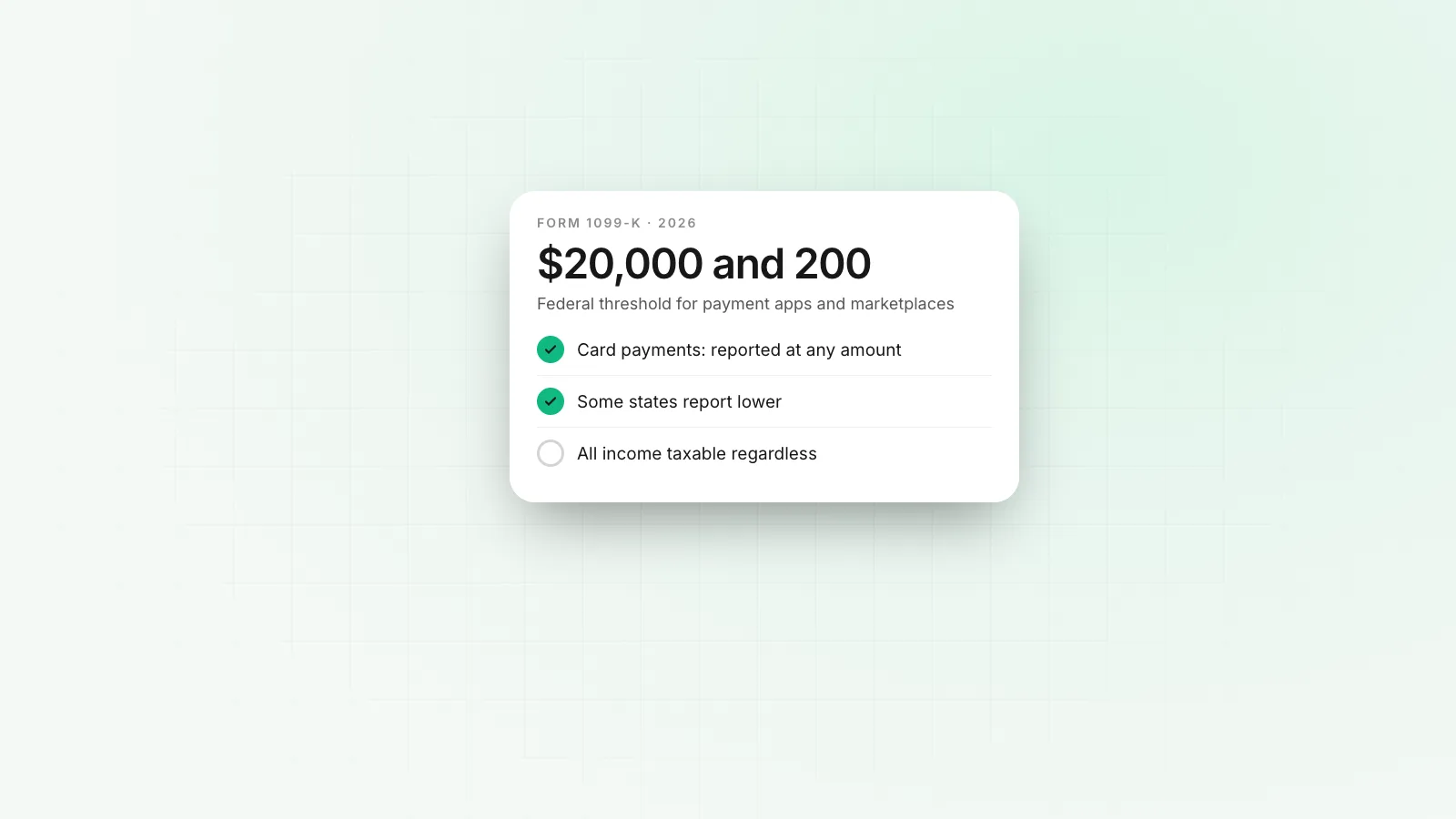
Few tax forms have changed direction as often as Form 1099-K. For 2026, the rule is simpler than it has been for years: a payment app or online marketplace sends you a federal 1099-K only if you received more than $20,000 across more than 200 transactions in the calendar year.
What is Form 1099-K?
Form 1099-K reports payments you received through payment card networks and third-party payment networks. The platform sends a copy to you and to the IRS. It shows gross amounts, before fees, refunds or shipping, so it rarely matches your profit.
There are two kinds of filer:
| Filer | Examples | Threshold |
|---|---|---|
| Payment settlement entity for card payments | Merchant acquirers processing your card sales | No minimum |
| Third-party settlement organisation (TPSO) | Payment apps, online marketplaces | More than $20,000 and more than 200 transactions |
What changed, and when?
| Tax year | Federal TPSO threshold |
|---|---|
| Up to 2021 | Over $20,000 and over 200 transactions |
| 2022 and 2023 | $600 planned, delayed by the IRS |
| 2024 | $5,000 transition threshold |
| 2025 onward | Back to over $20,000 and over 200 transactions |
The American Rescue Plan Act of 2021 lowered the threshold to $600 with no transaction count. The IRS delayed it repeatedly. The One Big Beautiful Bill Act, signed on 4 July 2025, reversed the change and restored the $20,000 and 200-transaction test, retroactively. The IRS has published updated FAQs.
Why might you still get a 1099-K below $20,000?
- Card payments. If a merchant acquirer processes your card sales, it reports them with no minimum.
- State rules. Several states require platforms to report at lower amounts, some as low as $600.
- Platform choice. A platform can send a form even when not required.
Does the threshold change what I owe?
No. The threshold decides whether a platform has to report. It does not change what is taxable. A business with $15,000 of sales through a marketplace has $15,000 of gross receipts to report, form or no form.
How should you reconcile a 1099-K?
- Compare the gross amount with your sales records for the same platform.
- Account for refunds, fees and shipping charges, which the 1099-K includes in the gross figure.
- Remove personal payments if any went through the same account, such as a friend repaying dinner. The IRS has guidance on reporting these.
- Keep the platform's reports as evidence.
Mixing business and personal payments on one app is the most common reason 1099-K figures do not reconcile. A separate business account and business profile solves most of it.
What about non-US sellers?
A seller who is not a US person and gives the platform a valid W-8 form is generally not issued a 1099-K. See W-8BEN vs W-8BEN-E. A US LLC owned by a non-resident is a US entity and can receive one. See Form 1099-NEC changes for the contractor side.
Where Rivet fits
Rivet is a business account for registered companies, not a marketplace, so it does not issue 1099-Ks. Companies use their USD account details to receive marketplace and platform payouts in the company's name, which keeps those receipts separate from anything personal.
Questions people ask
What is the 1099-K threshold for 2026?
More than $20,000 in gross payments and more than 200 transactions in the calendar year, for payments through third-party settlement organisations such as payment apps and online marketplaces.
Did the $600 1099-K rule ever take effect?
Not in full. The IRS delayed it several times and applied a $5,000 transition threshold for 2024. The One Big Beautiful Bill Act, signed on 4 July 2025, restored the $20,000 and 200-transaction test retroactively.
Do I have to report income below $20,000?
Yes. All business income is taxable and goes on your return, whether or not a platform sends you a 1099-K.
Why did I get a 1099-K for less than $20,000?
Either the payments were card transactions processed by a merchant acquirer, which have no threshold, or your state requires reporting at a lower amount, or the platform chose to send one.
Sources
William covers what happens once a company starts moving money: getting the business verified, paying contractors and suppliers abroad, and keeping card spend under control. William writes for the founder or finance lead who has to make it work this week, and links every rule cited to the text it comes from.
More from William Sunjo M. →This article is general information, not legal, tax or financial advice. Rules and fees change; check the sources above and the provider’s current terms before you act on them.
- 1099-k
- 1099-k threshold
- payment apps
- irs
- online sellers
- us tax